Lee's approval rating falls to 35.2% for second straight week; Democratic Party also plunges 7 percentage points [Realmeter]
- Input
- 2026-10-12 11:17:49
- Updated
- 2026-10-12 11:17:49
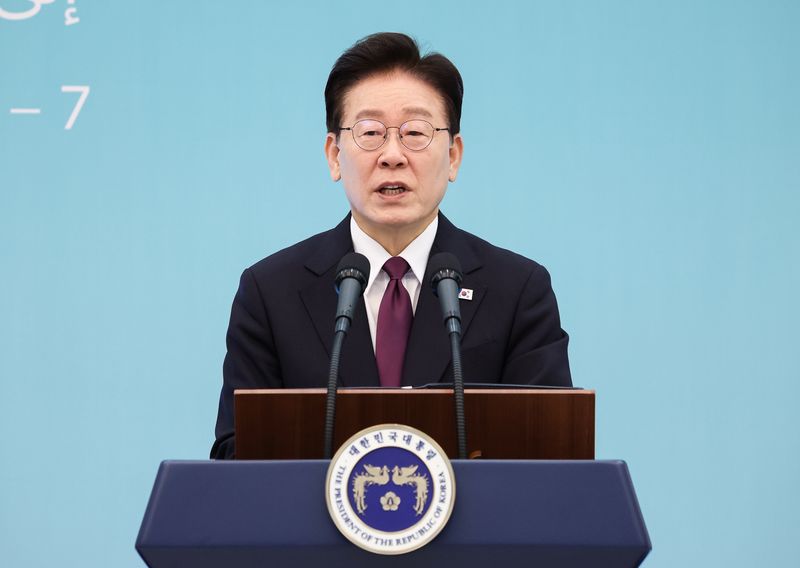
[The Financial News] A poll released on the 12th found that President Lee Jae-myung's job-performance approval rating had fallen for the second consecutive week, to 35.2%. The Democratic Party's approval rating also dropped 7.0 percentage points in a single week, with support for the president and the ruling party declining in tandem.
According to a poll released that day by Realmeter and commissioned by Asia Economy, positive ratings of President Lee's job performance fell 2.2 percentage points, from 37.4% the previous week to 35.2%. Negative ratings rose 1.6 percentage points to 61.4%, 26.2 percentage points higher than positive ratings. “Don't know” responses accounted for 3.4%.
Among centrists, the positive rating was 39.2%, down 3.5 percentage points from the previous week. Among conservatives, it was 10.2%, and among progressives, 53.0%, down 3.9 and 1.4 percentage points, respectively. The president's approval rating fell in all three groups divided by ideological orientation.
There were differences by age, however. Positive ratings among people in their 20s and 30s rose by 3.1 and 2.1 percentage points, respectively, to 27.3% and 31.3%. Ratings fell in all other age groups. The figure dropped 7.6 percentage points to 31.7% among those aged 70 and older, and 5.1 percentage points to 37.3% among those in their 40s.
Realmeter attributed the decline to the intense focus during parliamentary audits on issues including controversy over judicial independence involving Supreme Court Chief Justice Cho Hee-dae, a security dispute surrounding a landmine explosion in the DMZ, and rising jeonse and monthly rents and apartment prices in the Seoul metropolitan area.
By region, the positive rating fell most sharply in Daejeon, Sejong and Chungcheong, dropping 8.7 percentage points to 33.7%. It fell 4.7 points to 30.4% in Busan, Ulsan and South Gyeongsang, and 3.1 points to 33.0% in Incheon and Gyeonggi. By contrast, it rose 2.3 points to 59.7% in Gwangju, South Jeolla and North Jeolla.
The Democratic Party saw a larger drop in party support. Its rating fell 7.0 percentage points from 42.5% the previous week to 35.5%, while the People Power Party rose 2.9 points to 41.3%. The People Power Party overtook the Democratic Party, but the 5.8-point gap between them was within the margin of error.
The Democratic Party's support fell 17.0 percentage points among people in their 40s and 14.0 points among progressives. By region, it also fell 14.0 points in Daejeon, Sejong and Chungcheong, and 10.0 points in Incheon and Gyeonggi. The People Power Party rose by 11.8 and 5.9 points, respectively, in the same two regions.
Realmeter said the Democratic Party's rating was affected by controversy surrounding Chief Justice Cho Hee-dae's clash with the Legislation and Judiciary Committee and the push for impeachment, conflict with the Rebuilding Korea Party (RKP) over the restructuring of investigative powers, and instability in jeonse and monthly rents in the Seoul metropolitan area. It said the People Power Party strengthened its attacks on the ruling camp over security and judiciary issues early in the parliamentary audit period, benefiting from public criticism of the government and ruling party.
The other parties' support ratings were 6.3% for the Rebuilding Korea Party, 2.8% for the New Reform Party and 1.2% for the Progressive Party. Other parties accounted for 1.8%, while independents made up 11.0%.
The survey on the president's job performance was conducted from the 6th to the 8th among 1,504 people aged 18 or older nationwide. The response rate was 2.8%, and the margin of sampling error was ±2.5 percentage points at a 95% confidence level. The party support survey was conducted from the 7th to the 8th among 1,004 people aged 18 or older nationwide, with a response rate of 2.6% and a margin of sampling error of ±3.1 percentage points at a 95% confidence level. Both surveys were conducted using a 100% wireless automated response method. Further details are available on the website of the National Election Survey Deliberation Commission.
[email protected] Seong Seok-woo Reporter