600 billion won over five years for specialization at 33 private universities
- Input
- 2026-10-12 12:00:00
- Updated
- 2026-10-12 12:00:00
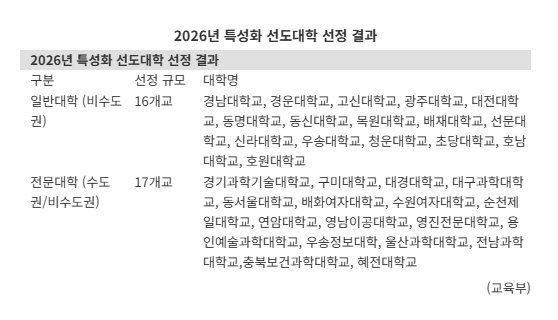
[Financial News] The government will provide about 600 billion won over five years through 2030 to support specialization at 33 private universities. In return for developing institution-specific areas of specialization ranging from advanced industries such as semiconductors and physical AI to care, culture and K-food, the selected universities must reduce their enrollment quotas by at least 3% by the 2030 academic year. On the 12th, the Ministry of Education announced the results of its 2026 Project to Foster Leading Universities for Specialization. A total of 33 institutions were selected: 16 general universities outside the capital region and 17 junior colleges in the capital and non-capital regions. The project supports universities in pursuing specializations that reflect their individual strengths and national and regional industry needs, in response to a declining school-age population and changes in the industrial structure.
The total funding for this year is 119 billion won. Of that, 85 billion won will go to 16 general universities and 34 billion won to 17 junior colleges. Average funding per institution is 5 billion won for general universities and 2 billion won for junior colleges. The project will run for five years, from 2026 to 2030.
Along with financial support, selected universities will also receive regulatory exemptions. The Ministry of Education will designate them as “Specialized Regional Universities” and support exemptions from open recruitment requirements for non-tenure-track faculty, as well as the easing of regulations on leasing campus land and facilities. Merged universities will also receive special provisions related to awarding associate degrees across general universities and junior colleges.
Universities’ areas of specialization range beyond advanced industries to include health and care, culture and content, and regional services. Among general universities, Sun Moon University will specialize in semiconductors, while Kyungwoon University and Chodang University will focus on aviation. Kosin University selected AI healthcare, and Gwangju University selected care and safety. Kyungnam University will focus on content intellectual property and wellness and integrated care, while Mokwon University chose content development and commercialization. Dongshin University will focus on energy, and Tongmyong University on smart marine industries.
Junior colleges also chose areas of specialization in line with industry and regional needs. Gyeonggi University of Science and Technology will develop manufacturing AX, while Gumi University will focus on physical AI. Suncheon Jeil College and Yeungnam University College will specialize in semiconductors and physical AI. Daegu Science University will focus on digital healthcare, Suwon Women’s University on AI-based integrated care, and Yonam College on smart agriculture. Daekyeung University and Dong Seoul University plan to develop cultural content, while Woosong College and Hyejeon College will focus on K-food.
The selected universities must reduce their enrollment quotas by at least 3% by the 2030 academic year. They are also required to reorganize departments around their areas of specialization and concentrate educational resources in those fields. The Ministry of Education has also required them to prepare measures to protect the educational rights of students in departments whose quotas are reduced or that are reorganized.
The project’s performance will be reviewed through annual assessments and a midterm evaluation. Two years after the project begins, the Ministry of Education will conduct a midterm evaluation to decide whether it should continue, and plans to allocate funding at different levels based on the results. For up to five years after the project ends, it will also check implementation annually.
Vice Minister of Education Choi Eun-ok said, “This project will give universities an opportunity to focus their capabilities on specialized fields through autonomous structural reform and provide students with a high-quality education.” She added, “We will support private universities through financial assistance and regulatory easing so they can pursue specialization and strengthen their competitiveness.”
[email protected] Kim Man-gi Reporter