Why Do Cancer Cells Spread to Other Organs? The Secret Hidden in ‘Pressure’ [Health LAB]
- Input
- 2026-10-13 05:00:00
- Updated
- 2026-10-13 05:00:00
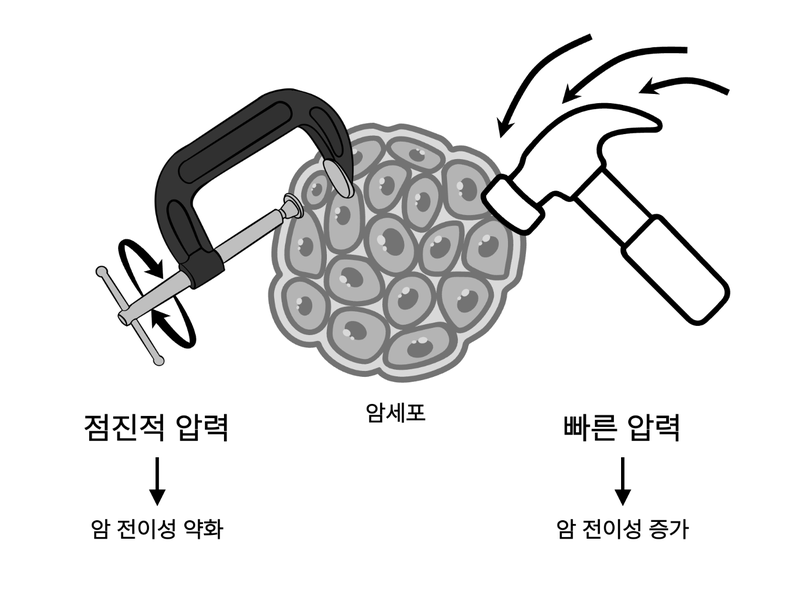
[Financial News] It has been found that the faster pressure on cancer cells increases, the more likely they are to acquire the ability to spread to other tissues. Korean researchers developed a technology to directly measure pressure inside living tumors using magnetic resonance imaging (MRI), and identified how changes in pressure affect cancer metastasis.
According to the Institute for Basic Science (IBS) on the 13th, a research team led by Jinwoo Cheon, head of IBS’s Center for Nanomedicine and an Underwood Professor at Yonsei University, and Professor Young-Wook Jun of UCSF developed the world’s first “M3 (mechanoMR microparticle) sensor,” which uses MRI to measure pressure inside tumors and identify in advance, at submillimeter resolution, the locations of cells with metastatic potential. The team used the M3 sensor to determine how the rate at which pressure is applied to cancer cells affects their metastatic potential.
The M3 sensor developed by the team consists of tiny magnetic nanoparticles embedded in an alginate hydrogel that is safe for use in the body. When the hydrogel contracts under external pressure, the water-molecule environment around the magnetic nanoparticles changes, causing the MRI signal to change. Using this principle, the team precisely measured pressure stress accumulated inside tumors across a pressure range of biological importance for cancer (1–15 kPa).
The team tracked cancer cells’ responses to pressure changes in tumor organoids, three-dimensional cell cultures that mimic the characteristics of tumors, and in animal models. The results showed that the rate of change in stress accumulated in cancer can affect changes in cancer cells’ metastatic potential.
When pressure on cancer cells increased slowly, no noticeable changes occurred in the cells. However, cells exposed to a rapid increase in pressure stress developed high levels of oxidative stress, a state of physiological imbalance, and increased expression of the YAP/TAZ genes, which respond to physical stimuli. The EMT process was also promoted, loosening connections between cells and increasing their motility and invasiveness. The team showed that when pressure builds up rapidly inside a tumor, cancer cells may acquire traits that favor metastasis, and proposed a new mechanism for cancer metastasis.
Team leader Jinwoo Cheon said, “This study tracked the ‘invisible forces’ in living tumors using MRI and found that changes in the pressure stress acting on cancer cells are closely linked to their propensity to metastasize.” He added, “We expect the M3 sensor to be useful in the future for clarifying the role of physical forces in a range of biological phenomena, including not only cancer metastasis but also tissue regeneration, inflammation and fibrosis.”
The findings were published on September 28 in the international journal Nature Nanotechnology.
[email protected] Ji-an Yeon Reporter