Jeju plans 40-MW AI data center, gauges demand from around 20 public institutions
- Input
- 2026-10-12 10:07:41
- Updated
- 2026-10-12 10:07:41
【Financial News, Jeju = Jeong Yong-bok】 Jeju Province is moving to link its plan to build a 40-MW-class artificial intelligence (AI) data center with actual demand from public institutions. To flesh out its plan to run AI computing facilities on renewable electricity, the province intends to assess each institution’s demand for computing resources, data-use plans and on-site pilot projects, and design a system for shared use.
According to Jeju Special Self-Governing Province on the 12th, the province will hold a briefing on the ‘Jeju Region AX Transformation Project for Public Institutions’ at 2 p.m. on the 16th in a meeting room at Jeju Technopark for around 20 organizations, including local public corporations, invested and funded institutions, and educational institutions.
The briefing is intended to share the direction of the Jeju Region AX Transformation Project and public institutions’ demand for AI, and to flesh out each institution’s role and potential collaborative projects. AX (AI Transformation) means the transformation to artificial intelligence. It refers to changing an organization’s operations to center on AI—including data analysis, decision-making and service delivery—rather than merely using AI programs for existing tasks.
The core of Jeju Province’s AX Transformation Project is to connect a renewable-energy-powered AI data center with the transformation of local industries and public services through AI in a single system.
The largest piece of infrastructure envisioned is an eco-friendly AI data center rated at 40 MW based on its power intake. The 40-MW figure indicates the amount of electricity supplied to the data center. The plan calls for a large-scale power base capable of running servers and graphics processing units (GPUs) needed for AI training and inference. The facility’s size, computing equipment configuration and actual power supply arrangements will need to be fleshed out in a future project plan.
The characteristics of Jeju’s local electricity industry are behind the province’s efforts to combine renewable energy with an AI data center. In Jeju, output from some power generation facilities is curtailed when solar and wind generation exceeds electricity demand or constraints arise in operating the power grid.
Jeju Province is considering an ‘integrated power and computing operations model’ that concentrates AI computing demand during periods of high renewable energy generation. The strategy is to increase the use of renewable energy by forecasting generation and electricity demand and adjusting the volume of AI computing.
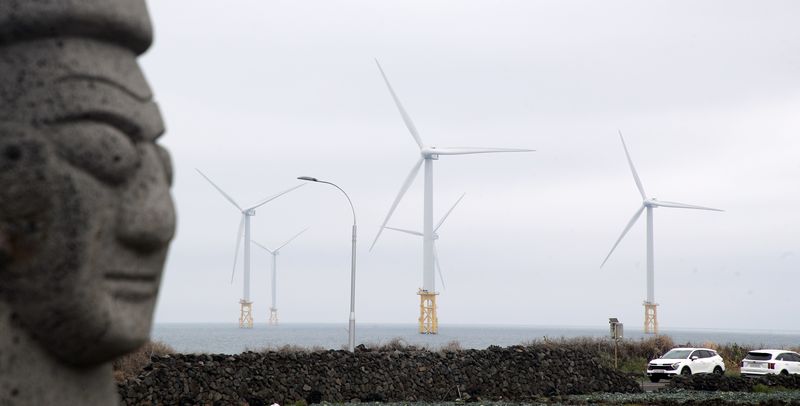
However, large-scale data centers require a stable power supply. Separate technical and economic assessments are needed to determine how much renewable energy that cannot be used because of output curtailment can actually be converted into computing demand, and how to ensure stable power supplies and manage operating costs.
A key topic at the briefing will be the actual potential for using these computing resources. Jeju Province is conducting an initial demand survey of public institutions and research and industry organizations in the province. The survey covers each institution’s current use of AI; demand for shared computing infrastructure, including GPUs; AI model development and data links; and areas in which they would like to participate in on-site pilot projects.
A GPU is a computing device that processes large amounts of data simultaneously and is essential for training and running generative AI and industrial AI models. Establishing infrastructure that institutions can use jointly, rather than having each public institution acquire expensive computing equipment on its own, can improve the efficiency of equipment operations and resource allocation.
At the briefing, Jeju Province plans to share its project proposal and analysis of the initial demand survey, and discuss how each institution could participate and collaborate.
Potential AI applications have been broadly identified, from regional strategic industries such as energy, space and biotechnology to areas specific to Jeju, including climate, tourism, safety and primary industries. In energy, options under consideration include forecasting renewable energy production and consumption and managing the power grid; in space, analyzing satellite data; and in biotechnology, applying AI to research and development.
The province also plans to identify pilot projects for AI services in areas such as tourism demand analysis, climate and disaster response, and production management in agriculture, fisheries and livestock. Jeju’s proposed AX project is expected to take shape by selecting projects with strong potential for real-world application based on each institution’s needs, and then verifying their results.
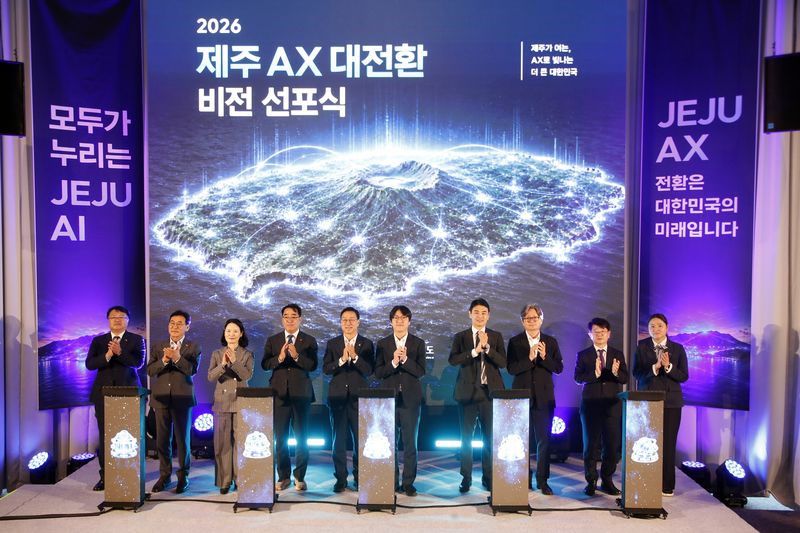
This project is a follow-up planning effort to the ‘Jeju AX Transformation Vision’ announced by Jeju Province on September 11. At the time, the province outlined five strategies: AI infrastructure, AX for residents, administrative AX, industrial AX and global AX. On the 16th of the same month, it held a project planning service kickoff report meeting at Jeju Technopark and began drawing up detailed plans.
The plan is to pursue this as a large-scale national project from 2028 to 2032, based on project planning funded with 500 million won from the Ministry of Science and ICT. Jeju Province is pursuing a renewable-energy integration pilot using a small-scale AI data center, while also asking the government to allocate national GPU resources and provide institutional support for building large-scale infrastructure.
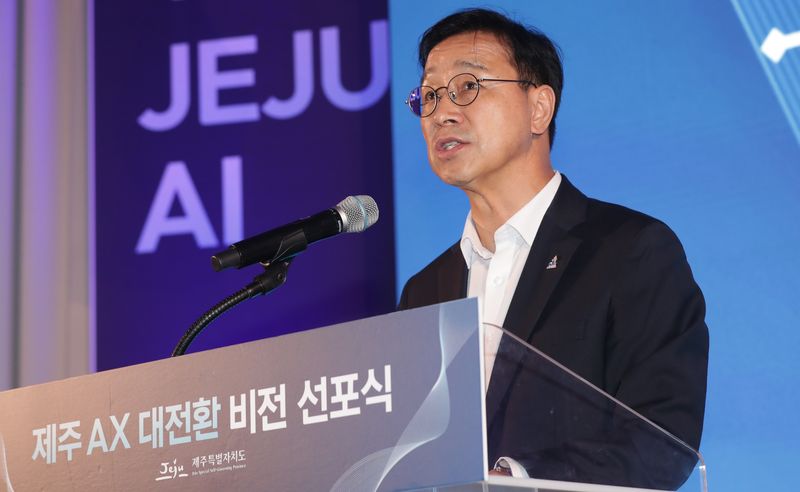
Last month, Jeju Governor Wi Seong-gon asked the National AI Strategy Committee, among other things, to give Jeju priority in the allocation of national GPU infrastructure and exempt the Jeju Region AX Transformation Project from a preliminary feasibility study.
This is also why the public institutions’ demand survey matters. Even if a large-scale AI data center is built, operating costs could become a burden if there are not enough actual users and computing demand. Conversely, securing projects that public institutions, local businesses and research organizations can use jointly could help make the case for national investment and private-sector participation.
In particular, the data held by administrative and public institutions may be subject to different management systems and security standards. Expanding shared use will also require consideration of data standardization, access permissions and personal information protection.
Jeju Province plans to use feedback gathered at the briefing in developing locally tailored AI infrastructure, designing a system for shared use and identifying pilot projects across public-sector fields.
‘This briefing will provide an opportunity for public institutions in the province to discuss building an AI foundation and ways to collaborate,’ said Jang Cheol-won, head of Jeju Province’s Future Industries Bureau. ‘We will incorporate on-the-ground demand from the planning stage and pursue an AI transformation linked to a national project of the Ministry of Science and ICT.’
The Jeju Region AX Transformation Project is at a stage where it must demonstrate both the need to build a large-scale AI data center and demand for its use from local industries. Whether the projects identified at this public institutions briefing can be developed into concrete computing demand and project plans is expected to be a key consideration in securing national funding and moving the project forward.
[email protected] Jeong Yong-bok Reporter