"Samsung at 250,000 won, Hynix at 1.62 million won" KOSPI falls below 6,600 early in session ... What could spark a rebound?
- Input
- 2026-10-12 09:47:38
- Updated
- 2026-10-12 09:47:38
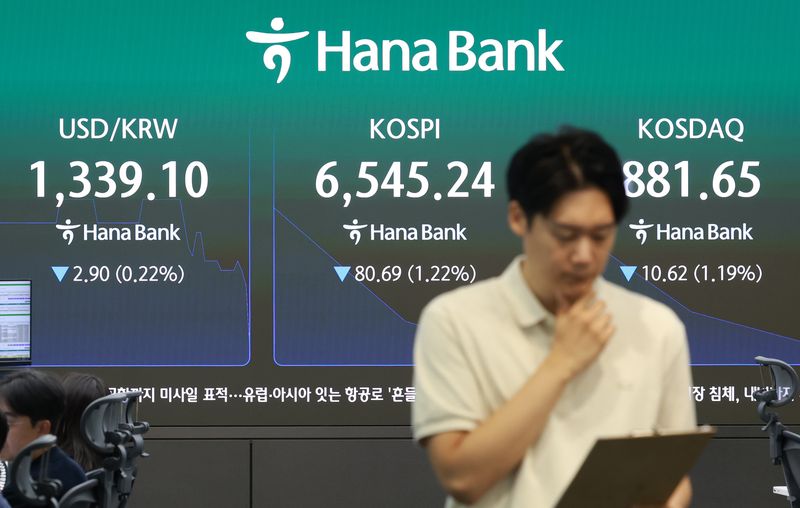
[Financial News] The KOSPI fell early on the 12th and was trading below 6,600. After the 7,000 level gave way last week, heavyweight semiconductor stocks including Samsung Electronics and SK hynix also weakened, extending the decline in South Korean stocks.
According to the Korea Exchange, the KOSPI stood at 6,569.99 at around 9:30 a.m. on the 12th, down 55.94 points (0.84%) from the previous trading day. The index opened at 6,578.17, down 47.76 points from the previous session, before extending its losses.
Samsung Electronics and SK hynix, two of the largest companies by market capitalization, also fell early in the session. Samsung Electronics traded at around 259,000 won, down about 1% from the previous trading day, while SK hynix was down about 3.5%, trading in the low 1.62 million won range.
Last week, the KOSPI plunged more than 5%, falling below 7,000. It closed at 6,625.93 on the 8th, down 377.81 points (5.39%) from 7,003.74 the previous week. During that period, foreign investors and institutions were net sellers of around 6.3 trillion won and 2.3 trillion won, respectively, while individual investors were net buyers of around 6.2 trillion won.
Samsung Electronics posted operating profit of 107.4 trillion won in the third quarter, but that failed to prevent investor sentiment from weakening amid rising global oil prices and government bond yields. Despite improved earnings at semiconductor companies, continued foreign selling led the KOSPI to post a steep decline.
The release of the U.S. Consumer Price Index (CPI) and Producer Price Index (PPI) for September is seen as a key factor for the stock market this week. Analysts say that if inflation moderates, government bond yields could stabilize and investor appetite for risk assets could recover.
Hwang San-hae, a researcher at LS Securities, forecast a KOSPI range of 6,600–7,100 for this week. “Until now, high earnings expectations have supported the floor of the domestic stock market, but the possibility that those expectations themselves could become a burden is coming into focus,” Hwang said, warning of the burden on exporters from exchange rates, global oil prices and high interest rates.
However, increased AI investment by global Big Tech companies could help the stock market rebound. Investors are watching to see whether improved earnings at semiconductor companies spread to firms involved in data centers and capital investment.
Lee Kyung-min, a researcher at Daishin Securities, said the KOSPI’s 12-month forward price-to-earnings (P/E) ratio had fallen to 5.26 times, a historically undervalued level. “Even applying a forward P/E of just 6 times would make it possible for the KOSPI to reclaim the 7,700 level,” he said, predicting greater upside potential if inflation and interest rates stabilize.
Meanwhile, brokerages are naming shipbuilding, insurance, automobiles, retail and software, alongside semiconductor and AI-related stocks, as sectors of investment interest. Ahead of the U.S. midterm elections, investors are also watching the potential for energy storage systems (ESS) and eco-friendly industries to benefit from government policy.
[email protected] Han Seung-gon Reporter