LH rental housing stock surpasses 1.5 million units, saving each household 3.92 million won a year in housing costs
- Input
- 2026-10-12 09:41:46
- Updated
- 2026-10-12 09:41:46
According to LH on the 12th, its rental housing stock grew by 555,000 units over the past 10 years, surpassing 1.5 million as of August. That represents 77% of the 1.95 million units of long-term public rental housing in South Korea with a term of at least 10 years.
About 2.66 million people live in LH rental housing, more than the approximately 2.35 million residents of Daegu Metropolitan City. They account for 5.1% of South Korea's total population of about 51.61 million.
Rental terms are about 45% of prevailing jeonse market rates. Applying the jeonse-to-monthly-rent conversion rate to the gap between nearby jeonse market prices and LH rental terms over the past five years, the average housing-cost savings for resident households nationwide came to 330,000 won a month, or about 3.92 million won a year. That is about 20% of the average monthly living expenses of 1.69 million won for a one-person household in 2024.
In the capital region, where housing costs are relatively burdensome, the savings were estimated at 410,000 won per household per month, or about 4.86 million won a year. The annual savings of 5.1 trillion won for all resident households amount to about 12% of the Ministry of Land, Infrastructure and Transport's 2026 budget of 41.7 trillion won for housing, urban development and welfare.
The average stay for residents of rental housing was 7.3 years, more than twice the 3.6-year average for ordinary renter households nationwide. LH says the homes serve as a housing safety net, allowing residents to live there stably over the long term.
Female-headed households accounted for the largest share of residents, at 49.4%. They were followed by one-person households at 42.8%, benefit-recipient households at 38.5%, and elderly households at 34.0%. Those in income brackets 1–4 of the 10 deciles made up about 70% of all residents.
Efforts are also underway to improve living quality. The average residential floor area of LH rental housing is 44 square meters, more than 20% larger than the 36-square-meter minimum set by the Ministry of Land, Infrastructure and Transport for a three-person household.
Each year, LH carries out remodeling of about 9,000 units and facility improvement projects at around 160 complexes, targeting permanent and national rental housing and other homes completed at least 15 years ago. In a satisfaction survey of residents whose homes had undergone repairs, a score of 98 out of 100 was recorded in 2025.
This year's target for rental housing supply is 75,000 units in total: 11,669 construction-based rental units, 26,000 purchased rental units and 38,000 jeonse rental units.
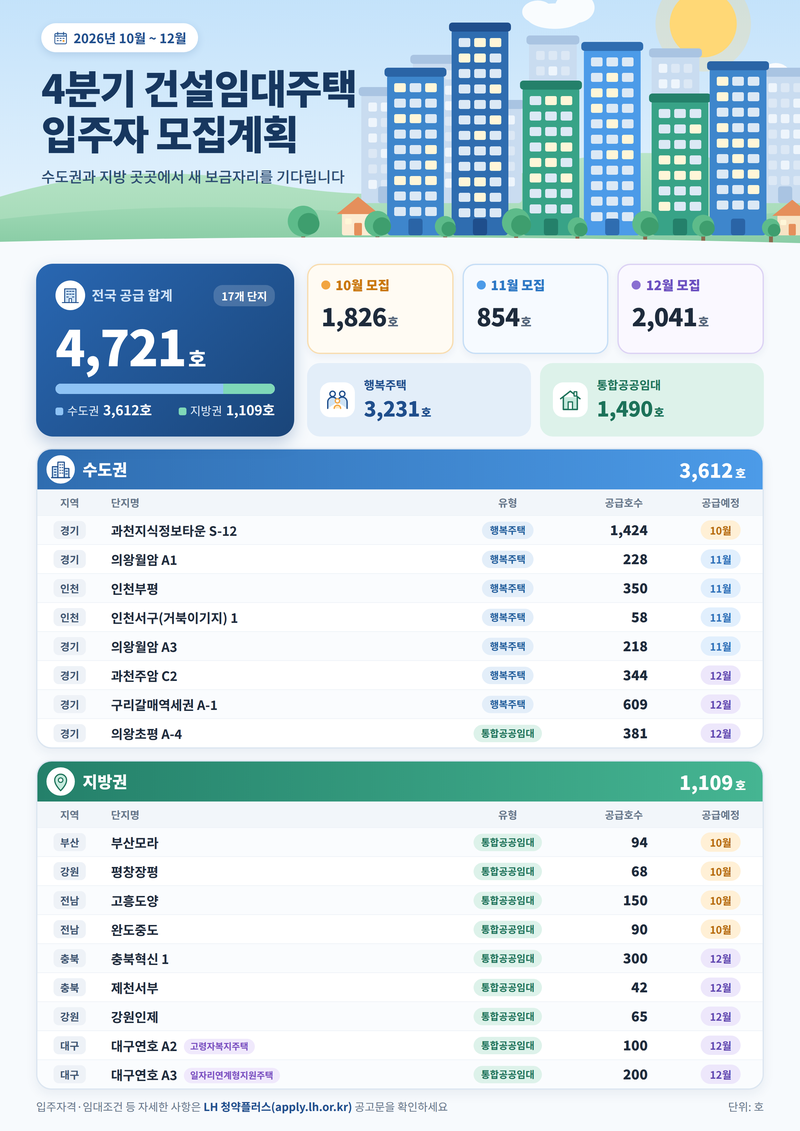
In the fourth quarter, LH will recruit tenants for 4,721 construction-based rental units nationwide, including 3,612 in the capital region. These include 1,424 units in Block S-12 of Gwacheon Knowledge Information Town and 609 in Block A-1 of Guri Galmae Station Area. To speed up supply, regular recruitment for purchased rental housing has been replaced with rolling, region-by-region recruitment, while applications for jeonse rental housing are accepted year-round.
In line with the government's housing supply measures, LH plans to provide at least 140,000 units of construction-based, purchased and jeonse rental housing in the capital region each year from 2027 through 2030.
LH President Lee Seong-hun said, “Building on our 1.5 million rental homes, we will continue to provide a housing safety net at affordable cost for women, young people and others,” adding, “In line with the government's housing stability plan, we will make active efforts to expand supply, including introducing universal rental housing in well-located areas such as the Third New Towns.”
[email protected] Choi Ga-young Reporter