Evaluation committee members involved in misconduct to be removed immediately... PPS strengthens its ‘three-tier verification system’
- Input
- 2026-10-12 10:12:28
- Updated
- 2026-10-12 10:12:28
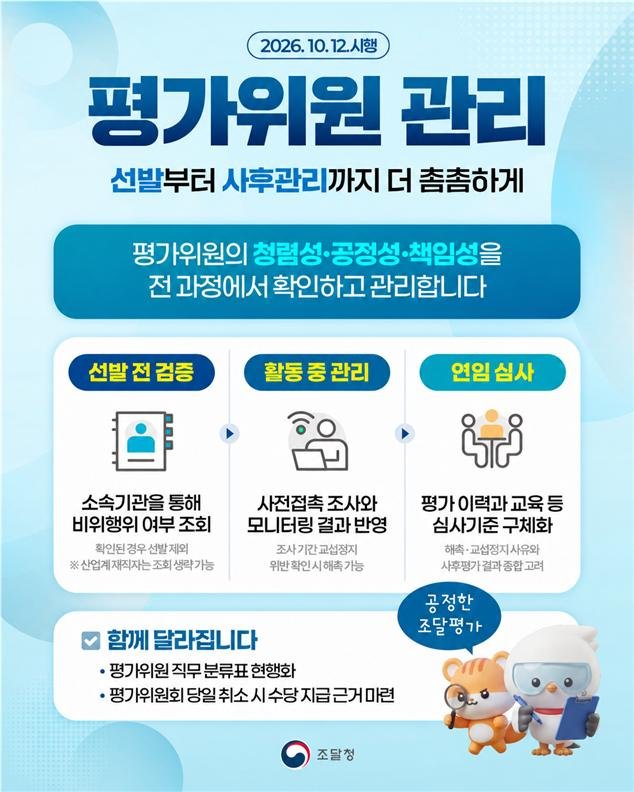
The Public Procurement Service announced on the 12th that it would fully implement its revised Regulations on the Integrated Management of Evaluation Committee Members to strengthen the fairness of evaluations and the integrity and accountability of committee members.
The Public Procurement Service has monitored more than 10,000 evaluators through its so-called ‘three-tier management system’: a pre-evaluation prior-contact reporting center, an evaluation-period monitoring group for committee members, and a post-evaluation system for managing evaluation histories. This revision focuses on linking the monitoring results closely to every stage, from evaluator selection and reappointment to post-appointment management, to increase the practical impact of enforcement and sanctions.
Under the revised rules, evaluators will not be approached for assignments while allegations of prior contact are being investigated. Strict legal grounds have been established for their immediate removal if an investigation or probe confirms that prior contact actually took place.
The criteria for sanctions based on monitoring during evaluations have also been made more specific. A committee member who receives an unsatisfactory rating on at least two fairness criteria, or on at least three of the eight criteria overall covering fairness and conscientiousness, will be barred from being approached for assignments for six months. Anyone subject to this suspension twice or more will be stripped of their evaluator credentials and removed.
Misconduct screening at the evaluator-selection stage will also be expanded to all fields. Previously, disciplinary records at an evaluator’s affiliated institution were checked in advance only in construction-related fields. Going forward, checks for misconduct will be conducted before selection in every evaluation field, including information technology (IT), services and goods, and anyone found to have grounds for disqualification will immediately be excluded from consideration.
Reappointment criteria will also be tightened. The agency will discourage automatic reappointment simply because a term has expired, and will decide whether to reappoint an evaluator by comprehensively weighing their records of removal or suspension of assignment-related contact, post-evaluation results, findings from investigations into prior contact, monitoring records, and completion of mandatory online training.
In addition, a new provision allows a minimum attendance allowance to be paid to committee members who arrive at the venue when a meeting is canceled that day because of sudden circumstances at the requesting institution, making the system more practical to operate. The revision responds directly to criticism from inside and outside the agency that after-the-fact sanctions and management have been lax relative to the authority held by evaluators. It also aligns with the Public Procurement Service’s ongoing policy to expand its ‘Evaluation Committee Member Selection Service’ across public institutions. The agency expects that encouraging requesting institutions to use its rigorously vetted evaluator pool and system even for contracts they procure independently through negotiations will help block favor-based appointments and local collusion in evaluations conducted by local governments and public institutions themselves.
Kim Ji-wook, director-general of the Public Procurement Service’s Digital Fair Procurement Bureau, said, “We expect this revision to significantly improve the fairness and accountability of evaluations by further strengthening the management of evaluation committee members. We will continue to improve the system to create a fair procurement evaluation environment that the public can trust.”
[email protected] Kim Won-jun Reporter