AhnLab, Inc. to build security framework for AI use for National Research Foundation of Korea’s internal network
- Input
- 2026-10-12 09:46:29
- Updated
- 2026-10-12 09:46:29
[Financial News] AhnLab, Inc. is building a National Network Security Framework (N2SF) to enable the safe use of generative artificial intelligence (AI) and the internet on the National Research Foundation of Korea’s internal network. The project’s key aim is to reduce the inconvenience of having to use a separate internet-connected PC in the existing network-separation environment while applying security controls based on information classification.
AhnLab, Inc. announced on the 12th that it would support the National Research Foundation of Korea’s N2SF deployment through the Korea Internet & Security Agency (KISA)’s “2026 National Network Security Framework Adoption Support Project.”
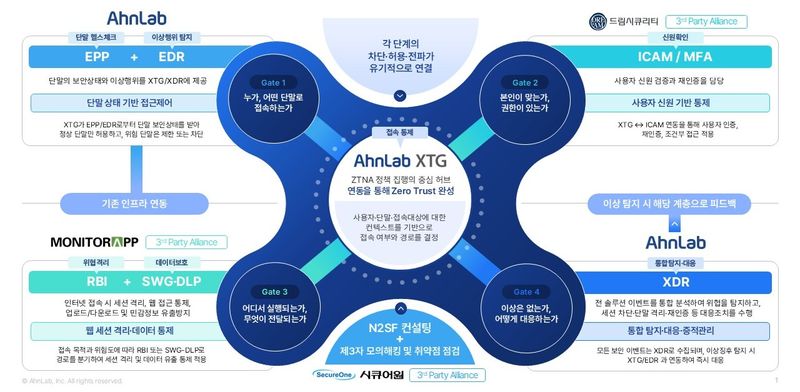
As the lead company in the consortium for the project, AhnLab, Inc. has been working with Monitorapp, Dream Security and SecureOne on the security framework since June. The security solutions have now been configured and integrated, and all 97 security control requirements for the deployment model have been implemented. The deployment scope is set to expand from the end of this month, with completion expected by the end of November.
The project is notable for applying both “Information Service Model 2,” which uses generative AI on the internal network, and “Model 4,” which enables internet access from work devices. It supplements the National Research Foundation of Korea’s existing security infrastructure with the necessary functions, allowing users to access approved external services without switching to a separate internet-connected PC.
To this end, user authentication, device validation, web isolation and data protection functions have been integrated between work devices and external services. Users’ identities and access permissions, as well as the security status of their devices, are checked to ensure that they can access only approved services. External web content is run in an isolated environment to minimize exposure to security threats.
N2SF’s principle of applying differentiated controls by classification is used for information transfers. Information is classified as confidential (C), sensitive (S) or public (O), and whether it can be transferred is determined by the destination and the file’s classification. Only O-class files can be sent to approved O-class generative AI services and internet sites. Transfers of S- and O-class files to S-class business information systems are permitted according to policy, while C-class files are blocked.
The consortium members are supporting the deployment by integrating their respective security technologies. AhnLab, Inc. is responsible for endpoint security and network access control, while Monitorapp handles web isolation and data protection. Dream Security provides user authentication, and SecureOne conducts N2SF consulting, vulnerability assessments and penetration testing.
“We will support efforts to ensure that the experience gained through this project leads to the adoption and expansion of N2SF at a range of organizations,” said Baek Min-kyung, team leader at AhnLab, Inc.’s Solution Consulting Division.
[email protected] Choi Hye-rim Reporter