“The starting point for Arctic shipping is ‘eco-friendliness, safety and international cooperation’”
- Input
- 2026-10-12 09:38:57
- Updated
- 2026-10-12 09:38:57
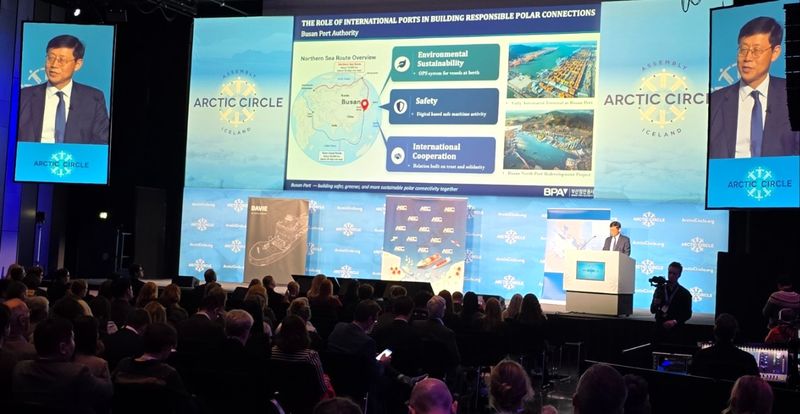
[Financial News] “The success of the Arctic shipping route depends not on how much it is used, but on how responsibly it is used.”
Busan Port Authority President Song Sang-geun made the remarks and presented principles for responsible use of the Arctic at the 2026 Arctic Circle Assembly, held in Reykjavík, Iceland, from the 8th to the 10th (local time).
According to the authority on the 12th, the Arctic Circle Assembly, held every October in Reykjavík since 2013, is the world’s largest international conference on the Arctic, drawing about 2,000 attendees from around 70 countries, including government officials, representatives of international organizations, academics, industry members and Indigenous representatives.
President Song was invited to speak at a session organized by the Arctic Economic Council (AEC) during the assembly, where he presented on “The Role of International Ports in Responsible Polar Connectivity.”
In his presentation, President Song stressed that if consideration of the Arctic shipping route becomes unavoidable amid supply chain crises, it should be guided by three principles: environmental responsibility, safety, and international cooperation based on trust and solidarity.
He explained that these were lessons he had learned while working on Arctic policy during his time at the Ministry of Oceans and Fisheries, as well as his own view of the role of international ports.
In particular, he outlined ports’ roles in decarbonization, including building infrastructure for bunkering environmentally friendly fuels and onshore power supply (OPS) facilities; serving as hubs to collect, verify and share data on sea ice, weather and the marine environment; and linking ports across national borders.
He also proposed a “Green Arctic Shipping Route” as a framework for putting these principles into practice. It would be a platform for multilateral cooperation in which Arctic countries and non-Arctic countries such as South Korea participate together on the basis of trust, share environmentally friendly fuels and standards, ensure safety based on scientific data, and respect Indigenous communities.
During the assembly, President Song met with former Icelandic President Ólafur Ragnar Grímsson, founder and chair of Arctic Circle. They agreed on the urgency of responding to the Arctic climate and environmental crisis and on continuing international cooperation based on trust.
He also met with Gunnar Tryggvason, CEO of Iceland’s Faxaflói Port Authority, to discuss the operating status of both ports and ways to cooperate. The authority oversees four ports, including Reykjavík Harbour, and has an organizational structure similar to that of Busan Port Authority.
President Song said, “The Arctic is on the front line of climate change and a shared natural heritage of humanity,” adding, “Even if the use of the Arctic becomes unavoidable, we need to work with the international community in line with global principles such as environmental sustainability and safety.”
[email protected] Kwon Byeong-seok Reporter