Hyundai Engineering Co., Ltd. Earns Technical Certification for H-Beam Modular Connection Technology
- Input
- 2026-10-12 08:47:57
- Updated
- 2026-10-12 08:47:57
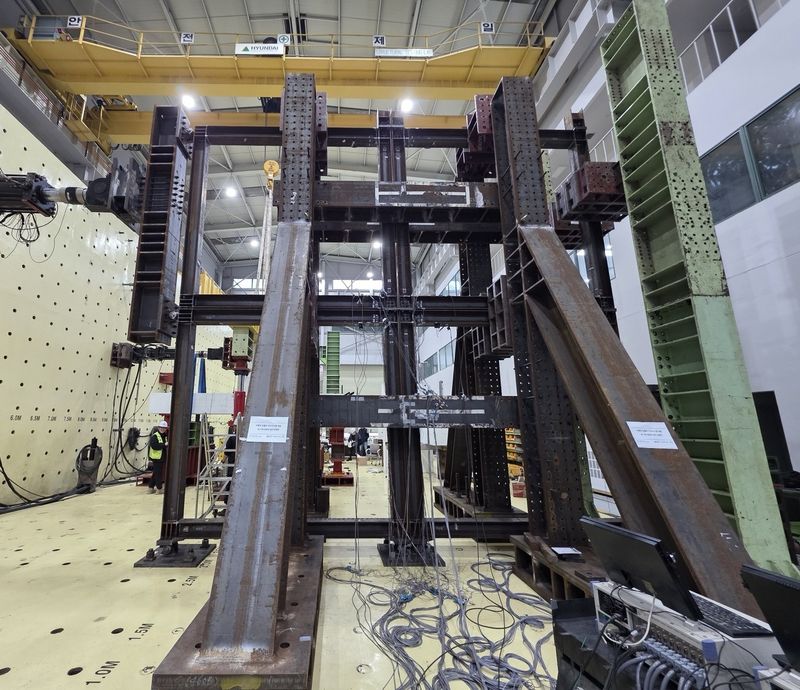
[Financial News] Steel modular connection technology that can withstand shaking reaching twice the legally mandated seismic standard has crossed the threshold to commercialization.
According to Hyundai Engineering Co., Ltd. on the 12th, the H-beam-based connection system it developed with Hyundai Steel Company has received technical certification from the Korean Society of Steel Construction. The system uses standardized steel sections and changes the direction in which bolts are fastened, improving on-site assembly efficiency.
The certification covers the connection technology used to join factory-made, box-shaped modular units as they are stacked on site. Following the revision of the seismic design standards for steel structures in May 2024, newly developed steel-structure connection technologies must be verified by the Korean Society of Steel Construction, an institution designated by the Ministry of Land, Infrastructure and Transport, before they can be used at construction sites.
Seismic performance was confirmed through a full-scale, two-story frame test conducted with researchers from the society. The test repeatedly recreated situations in which a building shakes severely during an earthquake or strong winds. The structure showed no damage or loss of strength even when deformed to around 4%, far exceeding the maximum interstory drift of 2% set by the current building structural standard (KDS). Interstory drift refers to the degree to which upper and lower floors shift sideways relative to each other as a building shakes. The structure was kept simple so that loads would be transferred directly to the columns, reducing both the concentration of force in one area and the tendency of the building to tilt.
Full-scale stacking tests have also been completed. The companies applied the technology at H-Modular Lab, a full-scale modular testing facility they opened in November 2024, and verified the process of stacking the modules. The facility was built inside Hyundai Steel Company’s research institute in Dangjin, South Chungcheong Province. It has two above-ground floors and eight rooms. It is used to verify the entire modular construction process at full scale, from design through fabrication, transportation and installation.
The research organization is also focusing on OSC (Off-Site Construction). HMG Construction Technology Research Institute, the integrated R&D organization of Hyundai Engineering Co., Ltd. and Hyundai Engineering and Construction, is concentrating its research capabilities on four pillars: energy, future housing, smart construction and infrastructure. The institute is developing OSC, including modular construction, as a future growth engine. It is also developing fire-resistance, seismic, acoustic and connection technologies needed for high-rise modular buildings. Hyundai Engineering Co., Ltd. plans to use this certification as a springboard to expand the application of OSC technologies to data centers and industrial buildings.
A Hyundai Engineering Co., Ltd. official said, “The competitiveness of modular construction depends not only on the precision of factory production but also on how quickly and safely the units can be assembled on site.” The official added, “This H-beam steel modular connection system is a technology that accommodates construction tolerances while ensuring worker safety and structural seismic performance. We expect it to set a new standard for the high-rise modular construction market in the future.”
[email protected] Jeong Gyeong-su Reporter