'Assassin(s)' Group Screenings Completed at 8 Schools, Plans Canceled at 6; Controversy Also Reaches Education Sector
- Input
- 2026-10-12 08:55:08
- Updated
- 2026-10-12 08:55:08
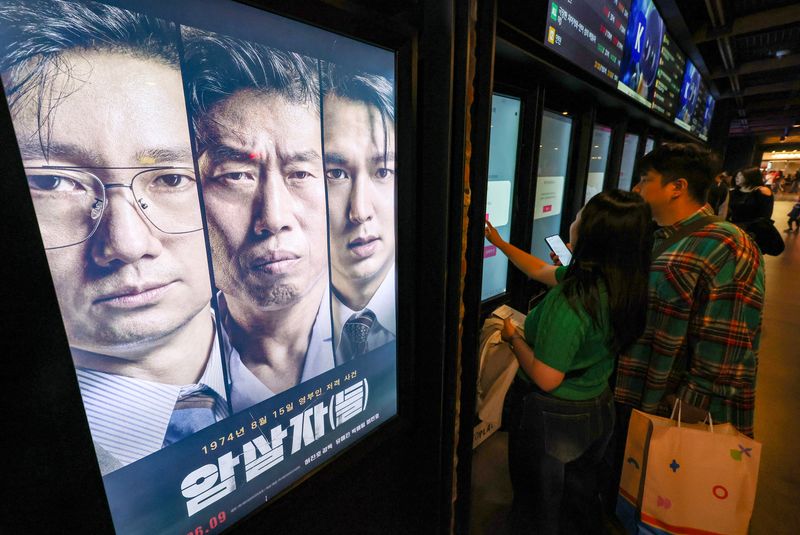
[Financial News] Seventeen elementary, middle and high schools nationwide have been identified as having held or planned group screenings of the film 'Assassin(s).' Amid continued controversy over historical distortion, eight schools have completed screenings, six have canceled their plans, and the remaining three are planning to hold screenings.
According to information compiled on the 10th by Rep. Lee In-seon of the People Power Party, a member of the National Assembly's Education Committee representing Suseong B in Daegu, 17 elementary, middle and high schools nationwide had held or planned group screenings of 'Assassin(s).' Eight schools have completed screenings, and three are still planning to hold them. The remaining six canceled their planned screenings.
Two schools each in Gyeonggi, Gangwon and South Chungcheong, and one each in North Gyeongsang and Gwangju, have completed screenings. The schools still planning to see the film are one in Seoul and two in South Jeolla.
The schools that canceled group screenings were three in South Jeolla and one each in Seoul, North Gyeongsang and Ulsan. No cases of group screenings being held or planned were identified in Daegu.
By the political leaning of the superintendent of education in each school's region, 15 of the 17 schools were located in regions with progressive-leaning superintendents. The other two were in North Gyeongsang. An investigation found that most schools that disclosed screening costs paid them from their school budgets.
Rep. Lee opposed group screenings of the film at schools. He stressed, "It is educationally inappropriate for schools to hold group screenings of a film embroiled in controversy over historical distortion," adding, "There should be no group screenings that carry a high risk of instilling a distorted view of history in students."
The controversial film 'Assassin(s)' is based on the shooting of the late Yuk Young-soo during a Liberation Day commemoration on August 15, 1974. The film's depiction of the Presidential Security Service and the Korean Central Intelligence Agency as being involved in the incident, and its suggestion that former President Park Chung-hee may have been behind it, led to controversy over historical distortion.
One cinema has also stopped screening the film. On the 6th, a cinema in Gumi, North Gyeongsang—the hometown of former President Park—halted screenings of the work. However, it has not been confirmed whether the decision was prompted by opposition from political circles or local groups.
Opinions are also divided within the education sector over group screenings of the film. In a statement released on the 6th, the Korean Federation of Teachers' Associations expressed concern, saying, "By dealing with actual historical events and real people while blurring the boundaries between confirmed facts, unverified suspicions and cinematic imagination, the film could instill a distorted view of history in young people."
Education Minister Choi Kyo-jin, by contrast, said there were limits to the Education Ministry's ability to intervene in schools' decisions to screen the film. At a parliamentary audit on the 7th, he said, "I think there may be limits to the Education Ministry interfering in every single case." He also stressed the need to teach students to distinguish historical facts from fiction in films.
The filmmakers rejected claims that the film distorts history. In an official statement on the 28th of last month, they said, "This is not a film made to establish a particular historical conclusion anew or to deny or distort existing facts."
Meanwhile, protests targeting actor Yoo Hae-jin, who appeared in the film, have continued. Recently, a rally calling for screenings to be halted and an apology to be made was held outside a house said to be Yoo's residence. His agency said it would take legal action over the spread of false information, malicious personal attacks and invasions of privacy, among other things.
After Yoo Hae-jin's side requested protection for his personal safety, police began taking protective measures on the 6th. Yoo did not attend the 2026 Buil Film Awards, held on the 7th, and events related to 'Assassin(s)' that had been planned for the Busan International Film Festival were also canceled.
Despite the controversy, the film's audience numbers continue to rise steadily. According to the Korean Box Office Information System (KOBIS), as of 7 a.m. on the 11th, 'Assassin(s)' had cumulative admissions of 2,884,498. It had the highest advance-booking rate among Korean films for 27 consecutive days, while the CGV Golden Egg Index and NAVER's actual audience rating both rose after the controversy.
[email protected] Han Seung-gon Reporter