“I Spent More Than a Day Preparing, but the Lecture Fee Was 300,000 Won” ... Yonsei Professor Says He “Felt Insulted”
- Input
- 2026-10-12 07:28:47
- Updated
- 2026-10-12 07:28:47
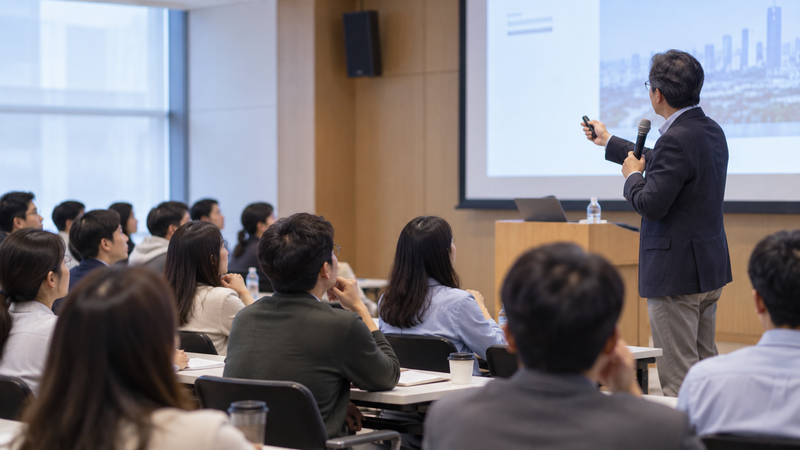
[Financial News] A university professor who prepared a lecture at the request of a government agency said he felt insulted after being told the fee would be 300,000 won. He said the time and effort he had invested in building expertise and preparing the lecture were not being properly valued.
Professor Kim Hyun-cheol of Yonsei University College of Medicine shared his experience on social media (SNS) on the 10th, in a post titled “What Is Fair Compensation for Knowledge Workers?”
He said a government agency recently asked him to give a lecture on the topic at a debate forum being held for the public nationwide.
The lecture was intended to explain the basic framework so participants could discuss the topic. Professor Kim said he accepted because he thought he could draw on his existing research, adding, “It was a lecture that laid out the broad framework so participants could start their discussion.” He continued, “I had been researching this field, writing about it and organizing my thoughts, so I thought I could prepare well with a little more refinement and agreed to do it.”
He said the actual preparation took a considerable amount of time. Professor Kim said, “I reviewed all the materials I had accumulated, spent a day organizing the content and making slides. If I had started from scratch, it would have taken at least a month. I had also been thinking about the direction of the lecture whenever I had a chance during the week before.”
Professor Kim said he had to spend the entire day at the venue on the day of the event, meaning that preparation and attendance alone took at least two days. Including the time invested in the underlying research, he said, “The lecture took at least two days in actual time, and at least a month if you count the work that laid the groundwork.”
He said he learned the lecture fee while preparing to report the outside lecture. Under the so-called Kim Young-ran Act, Professor Kim had to report the lecture content in advance, so he asked the agency to confirm the amount he would be paid. He said, “Even the official in charge didn’t know the lecture fee. The amount they found out at my request was 300,000 won.”
Professor Kim believes the payment was far too low compared with the time he put into the lecture. He said, “Honestly, I felt insulted. A general worker’s daily wage is around 300,000 won just for spending the whole day at the venue. Then there’s the time spent preparing.”
After some deliberation, Professor Kim told the agency that he would give the lecture but would not accept payment. He said, “After thinking about it briefly, I told them I would give the lecture for free,” adding, “That was how I could protect my self-respect.”
He said he raised the issue partly out of consideration for how other lecturers might be treated in the future. Professor Kim said, “I didn’t turn down the lecture,” but added, “I deliberately made a little noise, thinking of the lecturers this agency would invite in the future.” He said the agency subsequently began a process to adjust lecture fees, adding, “Perhaps the agency was surprised too; afterward, a process to adjust the lecture fee got underway.”
To explain appropriate compensation for expertise, he cited the consultation fees charged by psychiatrist Dr. Oh Eun-young.
Professor Kim argued that people with top-level expertise in a particular field can command high compensation. He said, “There has been a lot of debate over Dr. Oh Eun-young’s consultation fees. She is the best-known figure in infant and adolescent mental health, and people said a session could cost up to several million won an hour.” He added, “I didn’t think that price was necessarily expensive for an hour with the top expert in a field. That seems even more true when you compare it with the appearance fees earned by top singers and the highest-paid professionals in other fields.”
He also said that consultation fees at a privately run clinic are a matter of choice for healthcare consumers. Professor Kim said, “Dr. Oh Eun-young is also self-employed and runs her own clinic. In a capitalist society, she is free to set whatever price she wants. If consumers think it’s expensive, they don’t have to go.”
By contrast, he said, university professors are subject to legal caps on fees for outside lectures. Professor Kim said, “For professors at private universities, the maximum fee for an outside lecture is 1 million won for one hour and 2 million won for two hours.”
He went on to argue that the actual amount of work cannot be judged by the length of the lecture alone. He said, “But a one-hour lecture isn’t one hour of work. Preparation can take anywhere from a few hours to one or two weeks.”
Professor Kim again emphasized the issue of compensation for expertise, saying, “There are people at the highest level in both knowledge work and physical labor.” He concluded his post by asking, “How should our society treat people at the top of their respective fields?”
After the post was made public, other professors and researchers also shared their experiences, saying they had faced similar situations when giving lectures for public institutions.
Associate Professor Lee Dong-won of the Hong Kong University of Science and Technology (HKUST) said a public institution had once offered him 250,000 won for a 15-minute keynote speech. He said he opted to give the lecture for free at the time: “A public institution offered me 250,000 won for a 15-minute keynote, so I once said I would do it for free for the same reason.” He added, “When I found out that the YouTubers and MCs who attended with me that day were paid much more per hour than professors’ lecture fees, I began to have doubts.”
Some also pointed to the difference in lecture fees between the United States and South Korea. Director Kim Yong-jeong, a former professor at Columbia University College of Medicine, said, “There, I was paid $500 to $1,000 an hour after adding together the time spent preparing for the lecture, flying and lecturing. But in Seoul, I get just 300,000 won, or 260,000 won after tax. I feel a sense of self-loathing after the lecture.”
Medical journalist Hong Hye-geol also agreed that the relevant system should be improved. He said, “I agree,” adding, “I hope these issues will be addressed through amendments to the law.”
Others argued that the budgets and purpose of public institutions should be taken into account. One online user said, “Government and public institutions and libraries have little budget to invite distinguished people, and their work is largely about sharing knowledge with marginalized people.” The user added, “It is best to distinguish businesses from the state and public institutions.”
[email protected] Han Seung-gon Reporter