Hangul Day Marks 100 Years Since Its Establishment: Exploring the Future of Korean in the Hallyu and AI Era
- Input
- 2026-10-12 08:00:00
- Updated
- 2026-10-12 08:00:00
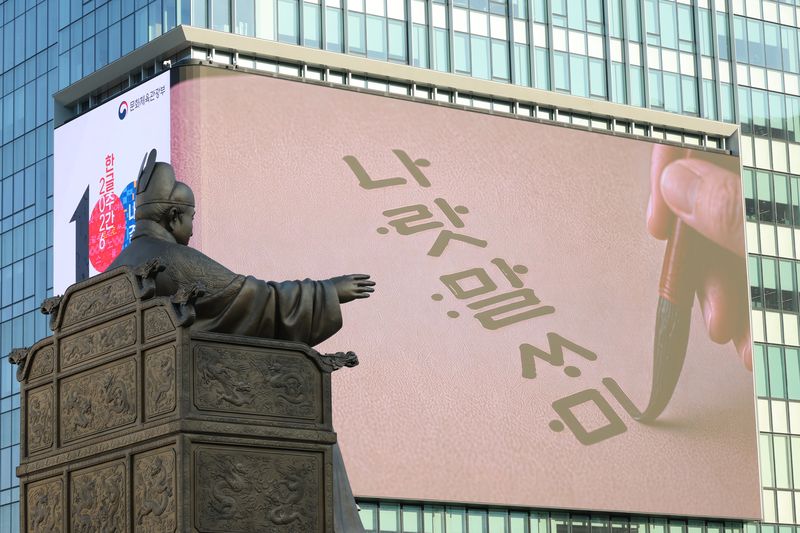
According to the Ministry of Culture, Sports and Tourism, it will hold a symposium with the National Association of Korean Language Culture Centers that day at the small auditorium of the National Museum of Korea, under the theme “Milestones in 100 Years of Hangul Day: Hangul Beyond Borders, Opening the Future of the Korean Language.”
Hangul Day began in 1926 as “Kagyanal,” established by Joseoneo Yeonguhoe and Sinminsa to mark the 480th anniversary of the promulgation of Hunminjeongeum. The commemorative day was launched to raise interest in the Korean language and writing system, and has been known as “Hangul Day” since 1928.
In his keynote address, Kim Juwon, president of the Korean Language Society, will examine the value of Hangul’s contribution to South Korea’s economic development. Park Jinho, a professor in Seoul National University’s Department of Korean Language and Literature, will then moderate and lead the presentations and panel discussion.
In the globalization session, Jo Jieun, a professor in Oxford University’s Faculty of Oriental Studies, will discuss the formation of “Global Korean”—including Korean words in the Oxford English Dictionary—and strategies for its development from the perspective of cultural diversity. Ahn Soong-beom, a professor in Kyung Hee University’s Department of Korean Language and Literature, will analyze how the global consumption and spread of Korean culture affect the globalization of Hangul.
In the AI session, Kim Han-saem, a professor at Yonsei University’s Institute of Language and Information Studies, will introduce the development of Korean-language corpora and changes in Hangul-processing technology. Jin-sik Lee, a leader at LG AI Research, will present the technical challenges and prospects for Korean large language models (LLMs), focusing on “Sovereign AI”—self-reliant artificial intelligence—and linguistic sovereignty.
The performance of AI models is affected by the quality of their training data. That is why securing Korean-language data is a challenge tied not only to the spread of the language but also to competitiveness in AI technology.
The panel discussion will include Im Jun-ho, a principal researcher at the Electronics and Telecommunications Research Institute; Sun Hyun-woo, CEO of Talk To Me In Korean; Park Jong-ung, a research fellow at the Korea Culture and Tourism Institute; Kang Mi-young, director of the Language Research Division at the National Institute of Korean Language; and Kim Eun-hee, director of the Korean Language Policy Division at the Ministry of Culture, Sports and Tourism. They will discuss future directions for Korean language policy based on the presentations.
First Vice Minister of Culture, Sports and Tourism Kim Young-soo said, “I hope this symposium will be a meaningful opportunity to explore how Hangul and the Korean language can grow into a writing system and a language that communicate with the world in the era of globalization and artificial intelligence.”
[email protected] Jang In-seo Reporter