Renewable Energy Is the Most Common New Business Purpose Among the Top 1,000 Listed Companies
- Input
- 2026-10-12 06:00:00
- Updated
- 2026-10-12 06:00:00
[Financial News] The new business purposes added by the top 1,000 listed companies are concentrated in renewable energy and robotics, a finding attributed to rising corporate demand for renewable energy procurement as the national greenhouse gas reduction target for 2035 is set to be finalized.
The Federation of Korean Industries (FKI) announced on the 11th the results of an analysis of newly added business purposes in the articles of incorporation of the top 1,000 listed companies by assets. Among the nine new-industry fields, the companies showed a concentration in the top three: energy (31.1%), manufacturing and mobility (19.8%), and artificial intelligence (AI), information and communications technology (ICT), and digital (12.3%).
These were followed by convergent knowledge services (7.5%), materials and components (6.6%), semiconductors and displays (3.8%), biohealth (3.8%), and the environment and smart agriculture, livestock and fisheries (2.8%).
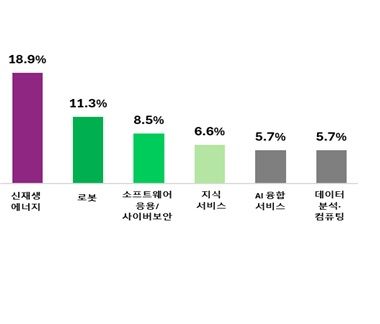
Among the detailed fields within new industries, renewable energy (18.9%) and robotics (11.3%) had the largest shares. They were followed by software applications and cybersecurity (8.5%), knowledge services (6.6%), AI convergence services (5.7%), and data analytics and computing (5.7%).
There were also clear differences in the distribution of industries for new business purposes between the top and bottom 500 companies.
The top-ranked companies were relatively evenly distributed across fields such as energy (28.4%), ICT and digital (17.9%), manufacturing and mobility (16.4%), AI (16.4%), and convergent knowledge services (10.4%). The bottom-ranked companies, however, tended to be concentrated in energy (35.9%) and manufacturing and mobility (25.6%).
The detailed fields showed a similar pattern: among the top 500 companies, software- and service-based fields accounted for more than 30%, including renewable energy (16.4%), software applications and cybersecurity (13.4%), knowledge services (10.4%), robotics (9.0%), and data analytics and computing (9.0%).
By contrast, among the bottom 500 companies, the leading fields included renewable energy, robotics (15.4%), precision medicine (7.7%), semiconductors (7.7%), and aerospace, space and defense (7.7%); hardware-based businesses accounted for nearly half.
The top 500 companies averaged 2.1 new-industry business purposes per company, about 1.6 times the 1.3 average for the bottom 500.
Lee Sang-ho, head of FKI’s Economic Affairs Division, said, “Our companies’ entry into and expansion in new industries are concentrated in a few fields, such as renewable energy and robotics, and the scope and patterns of their entry into new industries differ by company size.” He stressed that “institutional support should be strengthened, including by expanding tax support for research and development (R&D) and improving the effectiveness of regulatory sandboxes for new industries, so that companies can venture into a variety of new-industry fields and secure future competitiveness.”
[email protected] So-hyun Park Reporter