[Exclusive] “You know this is illegal, right?” As things quiet down in Cambodia, arrests of scam suspects in Vietnam triple
- Input
- 2026-10-13 06:00:00
- Updated
- 2026-10-13 06:00:00

Scam crime groups in Southeast Asia, which sparked public outrage last year, have yet to be eradicated despite crackdowns and are expanding into neighboring countries. Although the government has bolstered police staffing at overseas missions and expanded cooperation with local investigators, producing visible arrest results, a so-called “balloon effect” is becoming more pronounced: groups are evading crackdowns targeting specific countries by shifting their bases to neighboring countries such as Vietnam. The groups are also evolving into covert, loosely connected cells and skillfully evading investigations, prompting calls for urgent, multifaceted, long-term international cooperation that goes beyond localized crackdowns.
A year after the Cambodia crisis... Arrests of scam suspects in Vietnam surge threefold
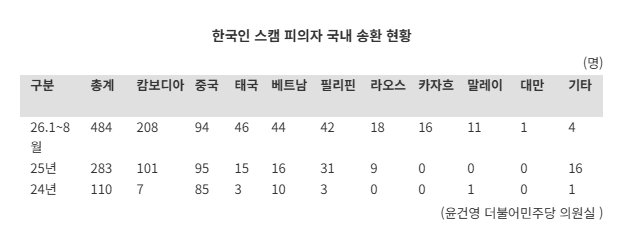
These figures show that bolstering police staffing at overseas missions and strengthening cooperation systems have had some effect. In fact, 484 suspects in scam crimes based overseas were repatriated to South Korea between January and August this year, already far exceeding the 283 repatriated over the whole of last year.
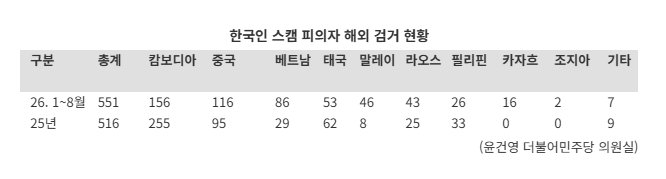
However, arrest trends by country point to a balloon effect. Cambodia still had the highest number of arrests between January and August this year, at 156, but that was a sharp decline from the 255 arrested over the whole of last year. By contrast, arrests in neighboring Vietnam surged from 29 last year to 86 between January and August this year, about three times last year’s total. Arrests in other neighboring countries, including China (116), Thailand (53), Malaysia (46) and Laos (43), also rose across the board or remained high.
The government currently has a total of 100 personnel deployed to overseas missions and other locations, including 78 police attachés and 22 police liaison officers. Of these, 37 are assigned to nine Southeast Asian countries to coordinate investigations. In Cambodia, 13 personnel are assigned: six at the embassy and seven to the Korea-dedicated team at the local police agency. In Vietnam, seven personnel have been dispatched: three to the Korean Embassy in Vietnam, three to the Korean Consulate General in Ho Chi Minh City and one to the Korean Consulate General in Da Nang.
Police are tracking and arresting suspects who have fled overseas, and pursuing their repatriation to South Korea, through INTERPOL Red Notices and cooperation with local law enforcement agencies. International cooperation to recover criminal proceeds is also underway. The authorities are taking steps such as using INTERPOL’s Rapid Intervention Mechanism for the Movement of Criminal Funds (I-GRIP) to request temporary measures, including account freezes, and using “Silver Notices” to track assets hidden overseas.
“The fact that crackdowns on Cambodia have intensified does not mean transnational scam crimes have disappeared altogether,” lawmaker Yoon Geon-young said. “Because it is difficult to root out criminal organizations based overseas through one-off crackdowns alone, international cooperation with local investigative agencies must be strengthened on an ongoing basis,” he said.

Hidden in small, loosely connected cells... Criminal groups evade investigations
As government crackdowns and repatriations increase, scam crime groups are evading the law by breaking themselves up into small, loosely connected cells. As the groups spread from Cambodia to neighboring countries such as Vietnam, anxiety is mounting among Korean communities in Southeast Asia.
A Korean resident of Hanoi, identified as A, told this newspaper, “There are rumors that Korean scam criminals are being caught one after another during recent crackdowns on illegal Airbnb rentals and investigations into immigration law violations.” A added, “I get the sense that there have been noticeably more men in their 20s and 30s lately.”
Among the cases uncovered by local authorities and made public so far this year, Hanoi police raided a villa in an upscale residential area in January and caught a group that included Korean nationals. Members of voice-phishing groups who moved their bases to Bac Ninh Province and elsewhere to evade crackdowns in Cambodia were subsequently caught by the Ministry of Public Security. In Ho Chi Minh City, too, members who were wanted under INTERPOL Red Notices were forcibly repatriated following a request for cooperation from South Korean police. Groups that left Cambodia are repeatedly being detected by local investigators as they expand their hideouts across Vietnam.
Even in Cambodia, where the number of suspects has fallen considerably over the past year, there are concerns that “the scam groups will come back someday.”
A Korean resident of Cambodia, identified as B, told this newspaper by phone, “Recent crackdowns and other efforts have achieved a lot, but many Koreans are still involved in online scam crimes in Cambodia, including voice phishing.” B added, “They split into small groups, stay shut up in their lodgings, operate mostly at night and take extreme care to avoid being seen.”
A Korean resident of an unnamed Southeast Asian country, identified as C, said, “Since the Cambodia crisis, criminal groups have shifted to small-scale, guerrilla-style operations.” C added, “Every few months, they move around Southeast Asian countries, including Cambodia, Laos, Thailand and the Philippines, evading the law and making them even harder to catch.” Previously, each operation involved close to 20 people at a minimum, including approach, withdrawal and money-laundering teams, as well as people impersonating prosecutors, police and the Financial Supervisory Service. Now, with help from artificial intelligence (AI) and other tools, a small crew of around a single-digit number of people can run an entire operation. As a result, C explained, crackdowns in one country will inevitably trigger a recurring balloon effect, with the groups disappearing into another country right away.

“Crackdowns have yielded results, but long-term multinational cooperation is essential”
Jeon Hyeong-hwan, a former police officer and head attorney at Mega X Law Office, said, “It is true that increasing the number of police attachés has had a considerable effect on local crackdowns and arrests.” However, he noted, “A balloon effect is emerging, with groups driven out of Cambodia moving through Vietnam and Thailand, and some relocating to other regions.”
“The current lull may be a temporary phenomenon, with the groups lying low for a while to avoid crackdowns,” he said. “Southeast Asia remains an ideal place for them, with the nightlife infrastructure scam groups prefer and relatively less severe penalties.” Jeon added, “The surest way to prevent transnational crime is to maintain a close system of cooperation with investigative agencies in neighboring countries at all times, rather than stopping at one-off arrests.”
There were also calls for a comprehensive response, given the nature of transnational organized crime.
Lee Geon-su, a professor in the Department of Police Science at Baekseok University, said, “Investigations must be broadened to arrest not only domestic recruiters but also the financial operatives and overseas ringleaders, so that the entire organization can be dismantled.” He added, “There is a need to quickly trace criminal proceeds and disrupt money-laundering networks to prevent the groups from moving their bases or rebuilding.”
[email protected] Kim Jun-seok and Park Seong-hyeon Reporter