[Editorial] Choi Tae-won’s push to fast-track Gwangju fabs; infrastructure must keep pace
- Input
- 2026-10-11 19:12:47
- Updated
- 2026-10-11 19:12:47
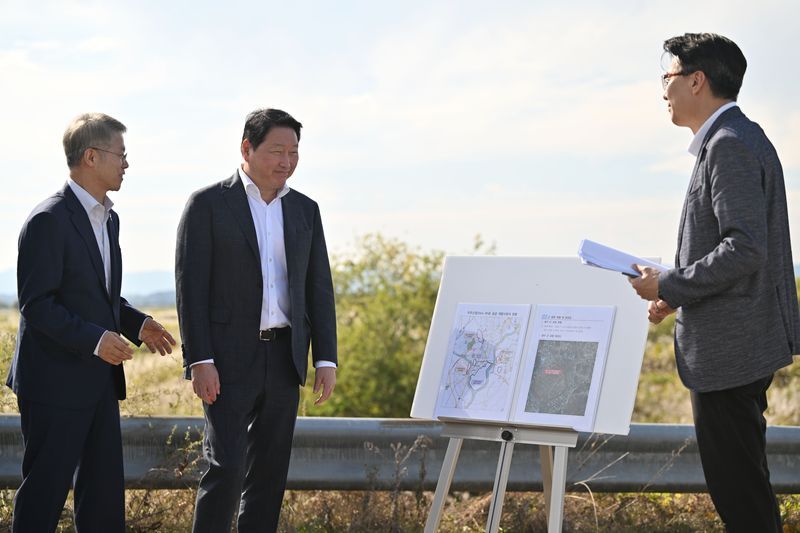
The remarks should dispel some people’s doubts that the company might be shouldered with the Gwangju semiconductor investment under government pressure. Skepticism was considerable after the government announced the Gwangju cluster project in June. At recent parliamentary audits, questions about the project’s feasibility also poured in, particularly from the opposition. Voices of concern were heard in Gwangju as well, fearing the project might fizzle out. Against this backdrop, the head of the company’s direct visit to the site and his bold remarks can be seen as an effort to ease those concerns and accelerate the project.
It is worth considering what lies behind Choi’s remarks about moving quickly and investing more. On the ground, supply cannot keep up with the soaring demand for advanced memory. Samsung Electronics’ third- and fourth-quarter operating profit topping 100 trillion won also illustrates this unprecedented boom. For SK hynix, the dominant player in the high-bandwidth memory (HBM) market, future profits and market leadership depend on how quickly it can expand production capacity. Even with orders piling up, the company will inevitably miss opportunities if it has no factories capable of handling them. Building a semiconductor factory takes years, from site preparation through facility construction to actual operations. By the time construction begins after demand has exploded, it is already too late. The decision to hurry a new factory in Gwangju despite bringing forward the construction schedule in Yongin by as much as 12 years shows just how fierce the competition to gain an early market lead is.
The key is for national infrastructure to keep pace with companies’ drive to move quickly. The four fabs in the Honam Semiconductor Cluster will require 6.3 GW of power and 650,000 tons of water a day. Gwangju City plans to supply an initial 3.1 GW of power and 150,000 tons of water by the end of 2028, with the aim of beginning initial mass production in June 2030. The question is when the remaining amounts will be delivered. No specific schedule has been presented for supplies after the initial allotment. If power and water are not supplied on time, factories could be built but left unable to operate. Relocating Gwangju Military Airport and preparing the site are also challenges that must be addressed.
It is also concerning that the government’s energy policy is failing to respond to the urgency on the industrial front. The government postponed until the end of the year its draft of the 12th Basic Plan for Electricity Supply and Demand, which it had initially said it would prepare by October, citing the need for public discussion on the role of nuclear power. Despite surging electricity demand from the artificial intelligence (AI) and semiconductor industries and a succession of large-scale investment plans, drawing up a long-term blueprint for electricity supply is taking an inordinate amount of time. Thorough discussion of nuclear power’s safety and economic viability is necessary. But public debate must not become a reason to delay policy decisions indefinitely.
Building the transmission grid is another pressing task. Even if there is enough generation capacity, it is useless without a power grid capable of delivering the electricity to industrial sites. The government maintains that schedules will not be disrupted when the actual construction period for each project is taken into account, but there is no room for complacency given residents’ opposition and complicated permitting procedures. The central government and local governments must review their power and water supply plans and mount an all-out, whole-of-government response. Businesses are trying to bring the future forward; national infrastructure must not remain stuck in the past.