U.S. Nuclear Projects, Like MASGA, to Build Up Local Workforce
- Input
- 2026-10-11 18:30:59
- Updated
- 2026-10-11 18:30:59
The nuclear investment project in the United States under discussion by Korea and the U.S. targets the construction of eight large-scale nuclear power plants, including two Korean-designed APR1400 units. However, investment decisions on individual projects and specific implementation schedules have not yet been finalized.
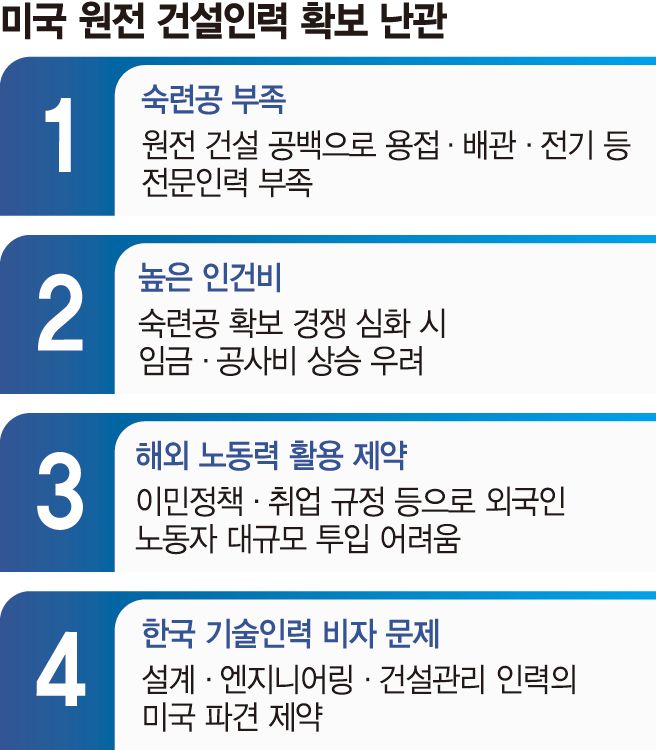
The key issue is the U.S. capacity to build nuclear power plants. The United States has foundational nuclear technology and a licensing framework, but its skilled workforce and equipment supply chains have weakened after a long lull in new large-scale nuclear plant construction. Nuclear plant construction requires specialized workers for each phase, including welding, piping and electrical systems, making it virtually impossible to deploy general construction workers immediately. This has prompted calls to use Korea’s technology and experience to expand the local construction base in the United States.
A Ministry of Trade, Industry and Energy official said, “MASGA also faces significant disruptions in U.S. supply chains, and nuclear power has similar aspects. If we build nuclear power plants in the United States, we should build something like workforce training centers together.” The government will need to consider ways to secure and train local workers as well. However, no specific plans to establish training facilities have been drawn up, nor are discussions with the U.S. side underway.
Sending specialized Korean technical workers to U.S. construction sites is also a challenge. Highly skilled personnel responsible for nuclear plant design, engineering and construction management could be deployed from Korea, but visa and immigration-status issues must first be resolved for them to work in the United States.
By contrast, skilled tradespeople responsible for construction need to be recruited and trained locally. In effect, the two challenges—sending Korean technical workers and training skilled workers in the United States—must be addressed at the same time.
The entry of on-site skilled workers into the United States, in addition to Korean technical personnel, could also be discussed in the future. During construction of the Barakah nuclear power plant in the United Arab Emirates (UAE), skilled workers from third countries, including those in Southeast Asia, were employed. But applying the same approach in the United States may prove difficult because of visa and employment restrictions. If the United States moves quickly to expand nuclear plant construction, the extent to which it will allow foreign workers to enter the country is expected to be a key issue.
The Korean Nuclear Society (KNS) also stressed in a recent position statement on the Korea-U.S. nuclear framework agreement that “the expansion of domestic companies’ production facilities and the training of specialized workers must proceed in parallel, and immigration and residency systems must provide support so that our technical workers can be deployed smoothly at U.S. sites.”
[email protected] Park Ji-young Reporter