Seoul’s small and midsize apartments enter the ‘1.6 billion won era’ ... demand, seeking to avoid regulations, flocks to ‘smaller homes’
- Input
- 2026-10-11 18:30:50
- Updated
- 2026-10-11 18:30:50
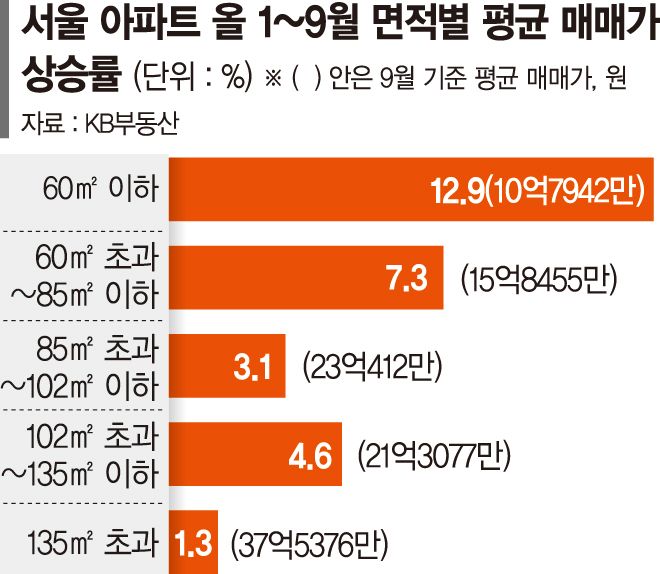
On the 11th, Financial News analyzed KB Real Estate data on average sale prices by apartment size in Seoul and found that the gap between price increases by floor area has widened considerably since the start of the year. In general, home prices have risen more sharply for smaller units.
Looking at average sale price increases by floor area from January to September this year, small apartments with an exclusive floor area of 60 m2 or less rose 12.9%, the largest increase. They were followed by small-and-midsize apartments with an exclusive floor area over 60 m2 and up to 85 m2, which rose 7.3%. By contrast, midsize apartments (over 85 m2 and up to 102 m2) rose 3.1%, medium-to-large apartments (over 102 m2 and up to 135 m2) 4.6%, and large apartments (over 135 m2) 1.3%. In the nine months so far this year, small apartments rose 12%, while large apartments posted gains in the 1% range.
With prices rising more sharply for smaller units, average sale prices for small and small-and-midsize apartments are now far higher than during the 2021–2022 housing price boom.
According to KB Real Estate, as of September, the average sale price of small-and-midsize apartments in Seoul was 1,584,550,000 won, approaching 1.6 billion won. That was up by about 100 million won from January (1,476,500,000 won). At the height of the housing price boom, the peak average sale price was in the 1.23-billion-won range.
The average sale price of small apartments also rose from 956,130,000 won in January to 1,079,420,000 won in September, an increase of at least 120 million won, bringing it close to 1.1 billion won. At the time, in 2021–2022, the peak average sale price was in the 860-million-won range. Kim Deok-rye, a director at the Housing Industry Research Institute, said, “The sharp rise in small-and-midsize apartment prices is the result of a series of government real estate regulatory policies, including measures on lending and taxation.” She added, “In particular, instability in the rental market is driving up prices for smaller, cheaper apartments.”
[email protected] Lee Jong-bae, Jeong Gyeong-su Reporter