Labor Emerges as a Key Variable in U.S. Investment Projects... Alaska LNG Project Alone Needs 6,000 Workers
- Input
- 2026-10-11 18:24:56
- Updated
- 2026-10-11 18:24:56
■ 9,000 Workers to Build Two U.S. Nuclear Reactors
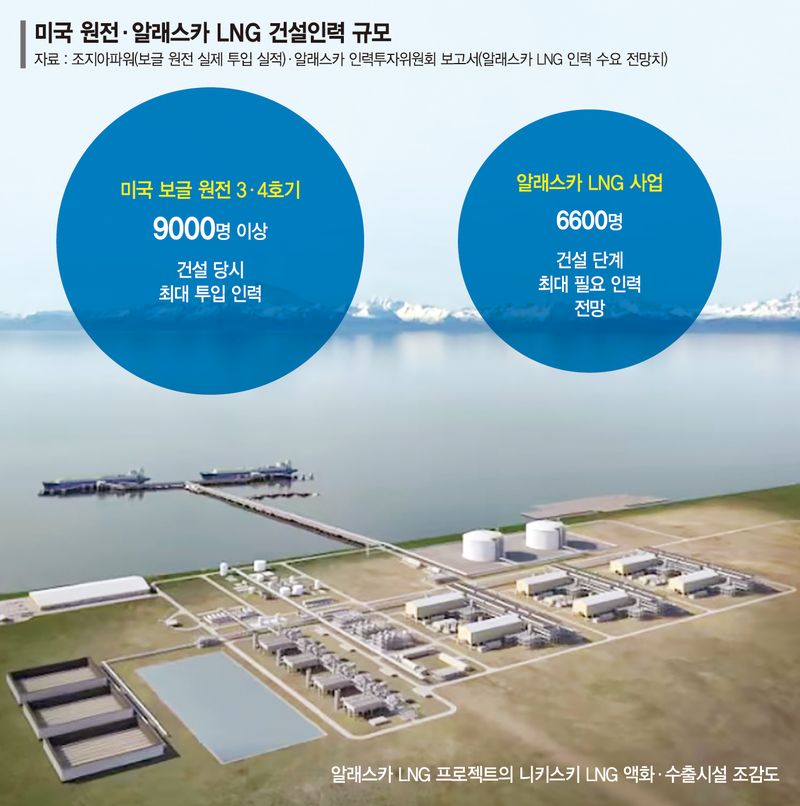
According to information on the construction of Vogtle nuclear power plant Units 3 and 4, posted on the website of U.S. utility Georgia Power on the 11th, at least 9,000 workers were deployed at the construction site during the peak of construction.
Vogtle is a leading example of new nuclear plant construction in the United States, using Westinghouse Electric Company's AP1000 reactor design. The nuclear investment project in the United States under discussion between South Korea and the U.S. involves plans to build eight large reactors, including two Korean APR1400 units, and is expected to require a substantial workforce if it moves forward in earnest.
The problem is that the U.S. nuclear construction industry has been weakened by a prolonged gap in new construction. Nuclear power plants require a high level of expertise in key areas such as welding, piping and electrical systems, making it difficult to train workers in a short time. If several nuclear construction projects proceed simultaneously, competition for skilled workers could push up wages, while failure to secure the workers needed in time could also lead to additional costs from construction delays.
Daniel Poneman, a former U.S. deputy secretary of energy, also said in an interview with The National Interest (TNI), a U.S. publication specializing in foreign policy and security, “The constraint in the United States is not on the demand side. The question is whether we can scale up [the capabilities of the nuclear industry] that quickly.” He stressed the need to expand construction capacity, saying, “The United States has built only three nuclear reactors over the past 30 years.”
■ Alaska LNG Project to Need Up to 6,600 Workers
Securing workers is also a key issue for the Alaska LNG Project. According to the report “2026 Alaska LNG Workforce Trends and Opportunities,” released in August this year by the Alaska Department of Labor and Workforce Development, up to approximately 6,600 workers will be needed when construction of the gas pipeline and LNG liquefaction facilities overlaps. The report concluded that it would be difficult to meet demand because the local construction workforce is aging and the working-age population is shrinking.
Earlier, Minister of Trade, Industry and Energy Kim Jung-kwan also cited workforce supply as a major obstacle to the Alaska LNG Project during a briefing on investment in the United States. “Recruiting workers is the most difficult part, due to issues such as the weather,” Kim said, explaining that this could lead to cost overruns and other problems. He added that the project's viability could improve if changes to the project structure proposed by the U.S. side improved permitting and workforce availability.
Difficulty securing workers is directly linked to investment returns, not just a construction issue. In addition to higher wages to secure skilled workers and the costs of transporting and housing workers from elsewhere, delays in construction also increase financing costs. For projects such as nuclear power plants and LNG facilities, which require enormous upfront investment and long construction periods, delays in the start of commercial operations can postpone revenue generation, lengthen the time needed to recoup the investment and lower expected returns.
High labor costs in the United States and labor regulations that vary from state to state also make project costs difficult to estimate. Even if skilled workers needed for nuclear construction can be secured, workforce management may be constrained by the need to account for local wage levels, working conditions and labor regulations.
This is why the government is reviewing not only workforce availability for U.S. nuclear construction projects but also local labor markets and the institutional environment. “The U.S. has, in any case, high labor costs, and labor regulations differ from state to state. Some places have strict regulations,” an official from the Ministry of Trade, Industry and Energy said. “We first need to prepare for and respond to those issues.”
[email protected] Park Ji-young Reporter