Farmland Bank budget at 2 trillion won ... another 1 trillion needed to meet demand for farmland purchases and pensions
- Input
- 2026-10-11 18:20:56
- Updated
- 2026-10-11 18:20:56
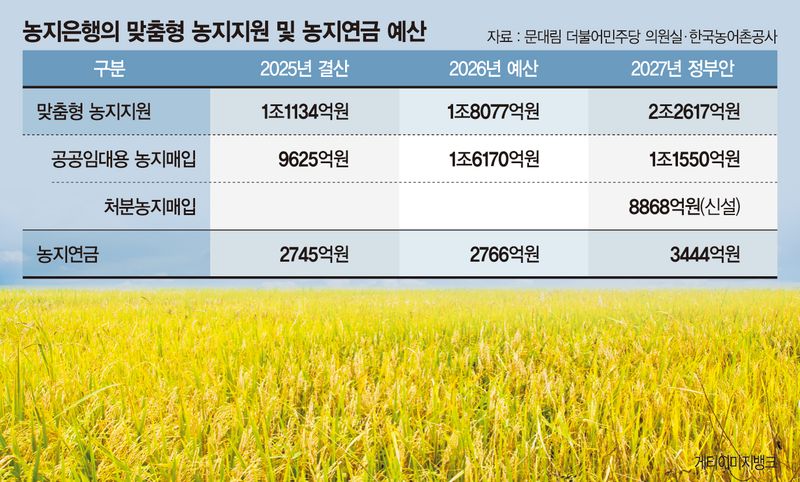
The Farmland Bank, run by the Korea Rural Community Corporation, operates seven programs tailored to the life cycle of farm households. Its main programs include Tailored Farmland Support, which encompasses Public-Lease Farmland Purchase, under which the Corporation buys farmland and leases it long-term to young farmers; Farmland Pension, which provides farmers with monthly living expenses using their farmland as collateral; and Management Rehabilitation Support Farmland Purchase, under which the Corporation buys farmland from farms facing temporary business difficulties and uses the proceeds to repay their debts.
According to data submitted by the Korea Rural Community Corporation to the office of Rep. Moon Dae-rim of the Democratic Party on the 11th, as of August this year, the backlog for Public-Lease Farmland Purchase was estimated at about 3,220 hectares. That is 11 times the area of Yeouido, or the equivalent of 4,510 soccer fields. It is the amount of farmland that farmers have applied to sell but the Corporation has been unable to purchase. The budgeted purchase price for Public-Lease Farmland Purchase is 385 million won per hectare, so buying 3,220 hectares would require about 1.2397 trillion won.
As of August this year, 3,688 applications to enroll in the Farmland Bank were on the waiting list. The required funding is about 40.3 billion won. Combined, the two would require an additional 1.28 trillion won in budget allocations.
Both farmland purchases and Farmland Pension applications have backlogs because budgets are fixed even as demand grows. Requests to sell farmland have increased every year as older farmers retire and inheritances become more common. The slowdown in farmland price growth and decline in transactions are also cited as reasons. The budgeted unit price for farmland purchases is another problem: it is in the 300-million-won range per hectare, while actual purchase costs in Gyeonggi Province are in the 400-million-won range. Even when the Korea Rural Community Corporation tries to buy farmland in Gyeonggi, where demand for farmland leases is highest, the budget burden is substantial, and regional caps apply to purchase prices per unit. Moreover, the Farmland Bank does not automatically purchase all farmland. It applies various criteria, including ownership, area and rights relationships.
Next year’s government budget proposal for Tailored Farmland Support is 2.2617 trillion won. This is a record high, at least 450 billion won above this year’s 1.8077 trillion won. Compared with 2022, when it was 782.1 billion won, the budget has roughly tripled in five years. The proposal also includes 886.8 billion won in new funding for “Purchase of Farmland for Disposal,” taking into account the comprehensive farmland survey. Farmland Pension funding will also rise to 344.4 billion won next year, up 67.8 billion won from this year’s 276.6 billion won.
Next year’s government proposal for Tailored Farmland Support and Farmland Pension represents a net increase of 521.8 billion won from the previous year. But because budget allocations do not reflect the “backlog demand,” an increase of at least 1 trillion won is still needed—an amount equivalent to half of the government proposal.
The Ministry of Agriculture, Food and Rural Affairs is calling for a budget increase and plans to ease the purchase criteria as well. Minister Song Mi-ryeong said on the 8th, “We will expand the volume of farmland purchases and the scope of consignment handled by the Farmland Bank.” She added, “Some people say the Farmland Bank cannot buy their farmland right away because of the budget or the purchase criteria. I will consult with the National Assembly on ways to increase next year’s budget so we can reduce the backlog of purchase requests.” She continued, “We will make the Farmland Bank an option for people who want to find a tenant because they can no longer farm, those who want a long-term lease, and those who want to sell their farmland.”
The Ministry of Planning and Budget is taking a cautious stance on a 1 trillion won increase, since the increase in the government’s Farmland Bank budget proposal is already substantial. There is also a possibility that funds budgeted for “Purchase of Farmland for Disposal” could be redirected to purchases for public leasing and other purposes. The government has set a standard of not disposing of farmland except in three types of speculative cases, based on the results of its comprehensive farmland survey. If less farmland is disposed of than expected, the remaining funds can be used for farmland purchases.
An official at the Ministry of Planning and Budget said, “Starting next year, the Farmland Bank budget will be funded by the Agricultural Development Fund, which combines three funds, including the Farmland Management Fund. Funding can be drawn from one program and used for another within the farmland-related budget programs.” The official added, “For example, if funds remain in the budget for Purchase of Farmland for Disposal, the fund management plan can be changed following a request from the Ministry of Agriculture, Food and Rural Affairs and consultation with the Ministry of Planning and Budget. The remaining budget can then be used for Public-Lease Farmland Purchase.”
[email protected] Choi Yong-jun, agriculture specialist Reporter