Yongsan Electronics Market breaks ground as development of an AI- and ICT-based industry hub gets underway
- Input
- 2026-10-11 16:04:00
- Updated
- 2026-10-11 16:04:00
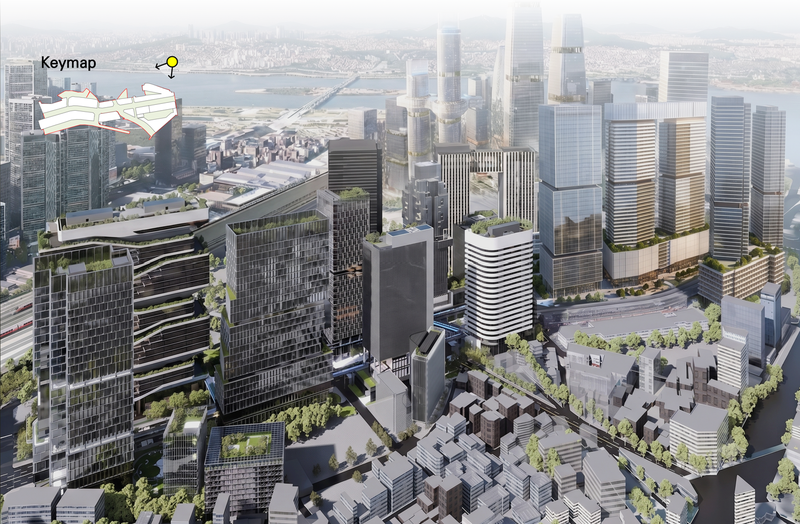
According to Seoul Metropolitan Government on the 11th, Special Planning Zone 5, which includes Buildings 12 and 13 of Najin Mall, will break ground this month. Development projects are currently underway in 8 of the 11 zones, and 4 of them have received building permits.
Yongsan Electronics Market grew into the country's largest hub for electronics distribution as personal computers (PCs) became more widely available in the 1990s. But the district's commercial fortunes declined after the 2000s as online shopping spread, the industrial structure changed and facilities aged. At one point, the average vacancy rate topped 60%, prompting continued calls to restructure the industry, which had centered on electronics distribution.
Seoul Mayor Oh Se-hoon presented a vision in 2021 to develop Yongsan into an “Asian Silicon Valley.” Seoul Metropolitan Government fleshed out the plan and, in June 2023, announced the “Linkage Strategy for the Yongsan International Business District and Yongsan Electronics Market Area.” It has since pursued a project to transform Yongsan Electronics Market into a hub for new industries based on AI and ICT.
Seoul Metropolitan Government is developing the electronics market area in stages, dividing it into 11 special planning zones. It eased regulations on existing distribution and business facilities, allowing mixed-use developments that combine office, commercial and residential functions. It also encouraged private-sector development by easing public contribution requirements for projects that devote at least 30% of their total gross floor area to new industries such as AI and ICT.
Building permits have been issued for Special Planning Zones 4, 5, 7 and 10. Zone 8 has advanced to architectural review, while Zone 6 has reached the stage of a public notice announcing the decision on its detailed development plan. Zones 1 and 2 have also completed public notices for residents to review their detailed development plans.
The 8 zones where development is underway have a combined gross floor area of about 800,000 sq. m. Each zone will feature advanced office facilities based on AI and ICT, alongside retail, cultural, assembly and sports facilities. The plan is to create a mixed-use urban space combining work, industry and everyday life.
The development focuses on replacing aging commercial buildings while expanding Yongsan Electronics Market's electronics and ICT industrial base into new industries of the future. The vision is to link its industrial and business functions with those of the adjacent Yongsan International Business District (YIBD) and develop the area into a new growth hub for Seoul.
To that end, the project will bring in facilities for AI- and ICT-based software and digital content, research and development, and startups. It will also build an industrial ecosystem where business activities, technology exchanges and startup ventures take place in one space.
The pedestrian environment around the electronics market will also be completely revamped. Spaces now cut off by individual shopping complexes and roads will be connected by pedestrian passageways and green areas, creating an open space where people can move around freely and stay.
An elevated public pedestrian passage about 570 meters long will be built east to west, along with 11 connecting bridges between the zones. The plan is to link each zone's publicly accessible open spaces and open green areas, connecting Yongsan Station, the electronics market and nearby development sites along a single pedestrian route.
On September 18, project operators for each zone signed the “Business Agreement Among Project Operators for the Creation of a Three-Dimensional Pedestrian Network.” They will draw up shared design guidelines and build the pedestrian passageways in stages in line with the completion schedules of individual projects.
Public facilities for local residents and the wider public will also be expanded. A startup support center and an operations center for the AI and ICT Content Industry Special Development Promotion District will support businesses and startup activities. Daily-life amenities, including a single-person household support center and public parking, will also be provided.
The project will provide about 9,668 sq. m. of public support facilities, 9,214 sq. m. of public rental office facilities—including Seoul Metropolitan Government's veterans hall—and a 5,130-sq.-m. park atop a retention basin. A public parking facility with a gross floor area of 20,848 sq. m. and about 400 parking spaces is also planned.
The development will also secure about ₩247 billion in cash public contributions. Seoul Metropolitan Government plans to use the funds to promote balanced development across the city, returning benefits generated by private development to the local area and the city as a whole.
Seoul Metropolitan Government plans to step up administrative support so that other projects can also gain momentum, starting with groundbreaking in Special Planning Zone 5. It will monitor progress in each zone through a public-private consultative body and build connecting facilities, including pedestrian passageways and green areas, in line with the schedules of individual developments.
[email protected] Choi Ga-young Reporter