[Exclusive] Public restrooms are no longer the “hidden-camera danger zone”—the surprising place where cases are six times more common
- Input
- 2026-10-12 06:00:00
- Updated
- 2026-10-12 06:00:00
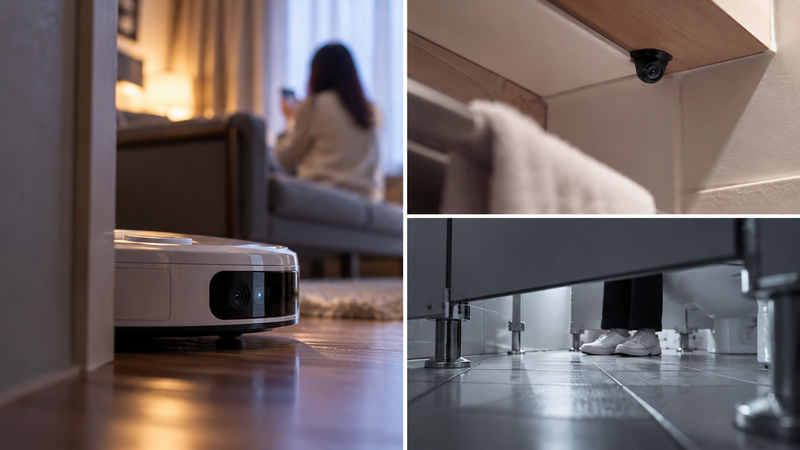
[Financial News] Illegal-filming crimes uncovered in Seoul have occurred at least six times as often in residences and homes as in public restrooms so far this year. While offenses in public restrooms are declining, the share occurring in residences has risen for three consecutive years, prompting calls to supplement prevention measures that have traditionally focused on public places.
One in four illegal-filming cases takes place at home
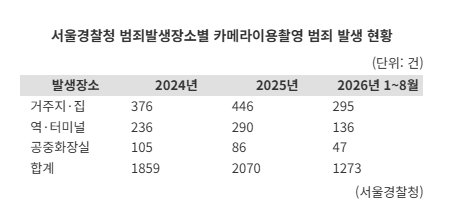
According to the Seoul Metropolitan Police Agency on the 12th, of the 1,273 crimes involving the use of cameras to film recorded in Seoul from January through August this year, 295 took place in residences or homes. That accounts for 23.2% of the total, close to one in four cases.There were 47 crimes uncovered in public restrooms during the same period. The number of offenses committed in residences or homes was about 6.3 times that in public restrooms.
The gap between the two locations has continued to widen over the past three years. In 2024, 376 crimes occurred in residences or homes, 3.6 times the 105 recorded in public restrooms. Last year, cases in residences or homes rose 18.6% from the previous year to 446, while those in public restrooms fell 18.1% to 86, widening the gap to 5.2 times. So far this year, the figure has exceeded six times.
The share of all illegal-filming cases occurring in residences or homes has also risen each year: 20.2% in 2024, 21.5% in 2025, and 23.2% from January through August this year.
Camera-based filming crimes across Seoul are also on the rise. According to figures on offenses recorded and cases in which suspects were apprehended by police stations under the Seoul Metropolitan Police Agency, 1,859 cases occurred in 2024 and arrests were made in 1,533 cases. Last year, 2,070 cases occurred and arrests were made in 1,706 cases, up 11.4% and 11.3%, respectively, from the previous year. Through August this year, 1,273 cases had occurred and arrests had been made in 1,108 cases.
Strengthen personal security and AI-based prevention measures
Experts say covert filming is more feasible in private spaces such as homes than in public places, potentially causing greater harm to victims.Lee Yoon-ho, a professor in the Department of Police Administration at Dongguk University, explained, “In public places, there are limits on what areas or people can be filmed, but at home, filming can be much more covert and can extend to sexual body parts.” He added, “Methods are also becoming more varied, including not only filming from a distance but also hacking wall pads.”
The private nature of these spaces also limits the police’s ability to act preemptively. At facilities used by many people, such as public restrooms, preventive measures like checking for illegal recording devices are possible, but in practice it is difficult for police to intervene directly in private homes.
Professor Lee said, “There is little the police can do in advance in a person’s private space,” adding, “Alongside individual preventive steps, such as managing passwords and getting professional security inspections, preventive measures through management offices are also needed in multi-unit housing.”
Lee Keon-su, a professor of police administration at Baekseok University, stressed that attention should also be paid to crimes committed in areas close to victims’ everyday lives, such as those involving acquaintances or neighbors. He said, “There are cases of filming not only people the perpetrator knows, but also women living alone in residential neighborhoods,” adding, “These crimes are a serious problem because they can go beyond violating privacy and lead to other sex crimes.”
Experts also advised using technology to address gaps in existing prevention systems. Professor Lee explained, “It is worth considering a system that uses artificial intelligence (AI) closed-circuit television (CCTV) and other tools to detect behavior suspected of involving illegal filming and issue alerts when risky behavior occurs.” He added, “After a crime has taken place, punishment, education and oversight should be strengthened to prevent illegally filmed material from being distributed.”
[email protected] Lee Dong-hyuk Reporter