Will a string of diplomatic and security setbacks derail Lee’s push to unite the nation?
- Input
- 2026-10-11 15:47:16
- Updated
- 2026-10-11 15:47:16
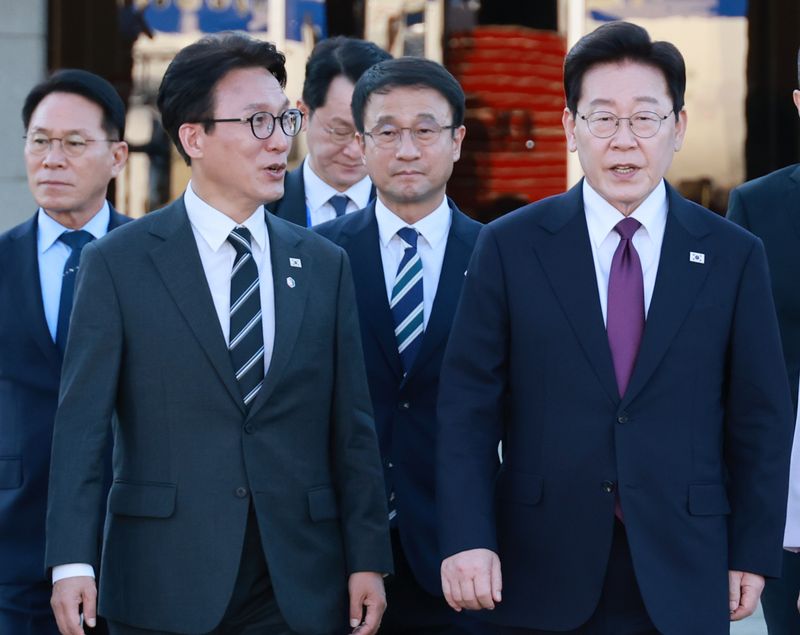
Political sources said on the 11th that Kim Min-seok, leader of the Democratic Party of Korea, is stepping up efforts to build “pan-progressive unity” to win the next general election and continue his camp’s rule.
This move aligns with President Lee’s plan to broaden support for his administration to include centrist and conservative voters. Lee has maintained that the U.S.-South Korea alliance and stronger self-reliant defense capabilities are mutually necessary and sufficient in the fields of foreign affairs and security.
Recent controversy over signs of trouble in U.S.-South Korea relations has added pressure to this plan. After delays in issuing a U.S. visa to former Democratic Party leader Jeong Cheong-rae, who was involved in the occupation of the U.S. ambassador’s residence, it later emerged that the National Intelligence Service had been excluded over U.S. objections from a trilateral meeting among South Korea, the United States and Japan to address North Korean cyber threats.
Responses to North Korea and tensions with Ukraine are also new variables. In connection with the DMZ landmine explosion, the government has demanded an apology and the removal of landmines from North Korea and launched a joint investigation with the United Nations Command. It must ease security concerns while keeping the door open to dialogue with North Korea. Tensions with Ukraine have also arisen over controversy surrounding a secret agreement on the repatriation of North Korean prisoners of war. The ambassador to Ukraine returned on the 10th following a decision to recall him.
The People Power Party’s criticism of the government’s diplomacy toward the United States and its North Korea policy is growing more intense. In a Facebook post that day, party leader Jang Dong-hyuk said, “The U.S.-South Korea alliance is moving beyond misunderstanding and toward a breakdown,” and called for the immediate dismissal of Unification Minister Chung Dong-young and National Intelligence Service Director Lee Jong-seok.
People Power Party floor leader Chung Jeom-sik also said at a National Assembly press conference that day, “The Lee Jae-myung administration is provoking a crisis in the U.S.-South Korea alliance in the fields of foreign affairs, security and the economy, while picking and choosing things that North Korea and Russia would like.” People Power Party lawmaker Ahn Cheol-soo wrote on Facebook the previous day, “An anti-personnel mine believed to have drifted from North Korea was found near Daebinchang Beach on Jumun Island, Ganghwa County, Incheon,” adding, “North Korea is turning even South Korean waters into a minefield. How long will President Lee remain silent?”
President Lee’s pragmatic diplomacy, centered on self-reliant national defense and the U.S.-South Korea alliance, is expected to come under scrutiny during the National Assembly’s audit of the Embassy of the Republic of Korea in the USA, scheduled for the 12th (local time) in Washington, D.C.
[email protected] Song Ji-won Reporter