“In the dark for over a month”... Consolidation of facilities management firms at financial public institutions hits a snag
- Input
- 2026-10-11 16:35:32
- Updated
- 2026-10-11 16:35:32
[Financial News] The government’s plan to consolidate 109 public institutions includes a proposal to merge the facilities management (FMC) subsidiaries of five financial public institutions, but unions are mounting strong opposition. The Financial Services Commission (FSC) plans to establish a Policy Finance FMC in line with the government’s push for greater efficiency, but differences in pay systems and the distances between workplaces have emerged as major obstacles.
According to the financial industry on the 11th, the FSC convened representatives from the Korea Asset Management Corporation (KAMCO), the Korea Deposit Insurance Corporation, the Korea Development Bank, the Export-Import Bank of Korea and the Korea Credit Guarantee Fund last month to discuss plans to establish a Policy Finance FMC. The government had earlier announced on the 3rd of last month that it would consolidate the FMC subsidiaries of five public institutions into a newly established Policy Finance FMC. It also plans to consolidate a total of 109 public institutions to reform their functions and maximize the efficiency of government operations. The plan is to merge 186 public institutions into 77 and relocate some institutions to regional areas. Public-sector labor groups affiliated with the two major labor federations have strongly opposed the plans and launched joint action through large-scale rallies.
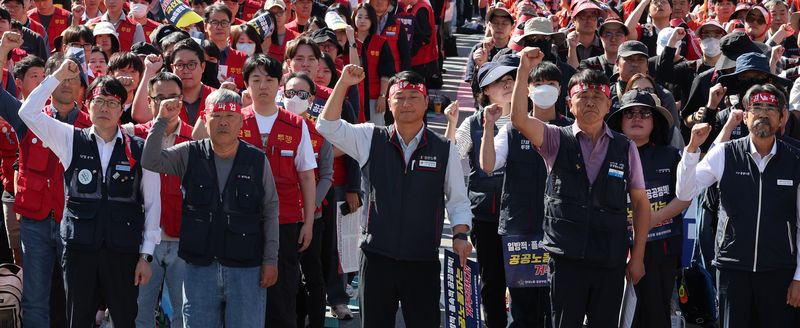
The Joint Action Committee of Public-Sector Unions of the Two Major Labor Federations held a rally pledging an all-out struggle on the 9th. Employees of the FMC subsidiaries at the five financial institutions are also protesting. KAMCO FMC, the largest of the subsidiaries, held an open press conference and made clear its opposition to integration talks conducted through “backroom administration.” KAMCO FMC had 1,037 employees as of the end of last year, accounting for 48% of the 2,166 employees across all five subsidiaries.
The Public Solidarity Workers’ Union of the Democratic General Workers’ Federation, affiliated with the Korean Confederation of Trade Unions, held a press conference on September 30 in front of KAMCO Capital Tower in Seo-gu, Daejeon, and called on the government to withdraw its plan to integrate the subsidiaries, calling it “a violent attempt to make subsidiary workers scapegoats for public institution reform.” The union argued that the government’s proposed approach to integrating KAMCO’s subsidiaries is opaque and could serve to disperse employers’ responsibilities rather than improve workers’ treatment.
The union argued that even if the consolidation goes ahead, it will yield little in cost savings from the government’s stated goal of “efficiency,” since the companies already have a low proportion of management staff. The union said, “It has been eight years since KAMCO FMC was established, yet it still has not even equalized pay and working conditions for employees in the same job categories,” adding, “They have failed to balance working conditions even within a single subsidiary. Merging other subsidiaries as well would lead to a leveling down of working conditions and confusion at worksites.”
The union urged the FSC to agree to a meeting and KAMCO to disclose its views on the integration that it submitted at an FSC meeting. It also demanded that KAMCO convey the subsidiary workers’ opposition to the relevant ministry and agree to a meeting with its president.
A financial industry official said, “The FMCs established after discussions on converting public-sector non-regular workers to regular status often have complex labor-management relations, including annual wage negotiations, and their pay systems all differ.” The official added, “There haven’t even been plans to relocate to regional areas before merging the FMCs, and actual workplaces in Yeouido and Euljiro in Seoul and Munhyeon in Busan are all different. If the integration is pushed through regardless, opposition will grow even stronger.”
[email protected] Park Mun-su Reporter