LH plans to provide 20,528 purchase-rental homes in Seoul over three years
- Input
- 2026-10-11 13:56:57
- Updated
- 2026-10-11 13:56:57
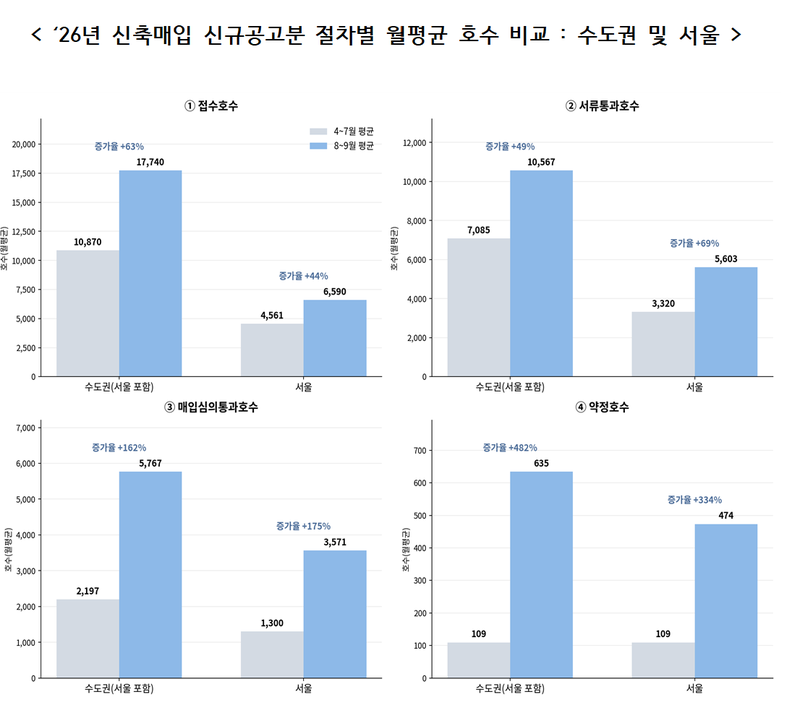
According to LH on the 11th, average monthly applications in the capital region have increased by 63% since the new-build purchase agreement system was improved last July. LH plans to speed up the supply of purchase-rental homes in urban areas of the capital region by improving project procedures and expanding dedicated staffing.
Purchase-rental housing is public housing that LH provides to young adults, newlyweds and others at rents below market rates. LH either buys newly built homes from private developers after they are completed under purchase agreements, or purchases existing homes. It takes about one to two years from the start of construction to move-in, allowing homes to be supplied relatively quickly in urban areas.
LH currently manages 207,000 purchase-rental homes nationwide: 113,000 in the capital region and 34,000 in Seoul. Last year, it recorded purchase agreements for 44,000 newly built homes in the capital region and 11,000 in Seoul.
This year, in line with the housing supply measures announced by the government last May 22, LH is working to secure 62,000 newly built purchase-rental homes in the capital region for 2026–2027.
Policy improvements that expand support for private developers’ initial project costs and pay construction costs according to progress have also been in effect since last July. The number of staff handling purchase-rental projects in the capital region rose by 83, from 199 at the start of the year to 282.
To reduce work gaps throughout the year, LH will also prioritize hiring 62 non-regular employees by November and assign them to field sites. It plans to hire additional staff based on future workloads.
The volume processed at each project stage has also increased since the policy improvements. Since last August, average monthly applications in the capital region have risen 63% compared with April to July, before the changes, while the number passing document screening has increased 49%. The numbers passing review and signing purchase agreements have grown by 162% and 482%, respectively. The volume of agreements signed in Seoul has also risen 334%.
Demand for these homes is also growing, supported by rents that are low compared with those in central locations near transit stations. In Seoul, the competition ratio for purchase-rental homes for newlyweds and households with newborns rose more than sevenfold, from 0.9:1 in 2020 to 6.7:1 last year.
Last June, 128 people applied for two purchase-rental homes for newlyweds and households with newborns in Yeoksam-dong, Gangnam District, Seoul. The homes have two to three rooms and are a 10-minute walk from Yeoksam Station; elementary, middle and high schools are also within walking distance.
Depending on tenants’ income and assets, purchase-rental homes for newlyweds and households with newborns are divided into Type I, with rents at 30–40% of market rates, and Type II, at 70–80%. Tenants can stay for up to 20 years. LH will recruit tenants for 5,171 homes this year, about 58% of them in the capital region.
The competition ratio for youth purchase-rental homes in Seoul rose from 44:1 in 2020 to about 130:1 last year. Factors cited for the increased demand include rents at 40–50% of market rates, deposits in the 1 million to 2 million won range, and built-in furnishings.
Youth purchase-rental homes in Yeonji-dong, Jongno District, Seoul, saw move-ins begin last October. In the recruitment held in June of the same year, they drew 40 applicants per unit. The homes are a seven-minute walk from Jongno 5-ga Station, with deposits of 1 million to 2 million won and monthly rents of 400,000 to 600,000 won.
These amounts are below the average Seoul officetel market rates cited by LH: a 10 million won deposit and monthly rent of 800,000 to 1 million won. This year, 5,522 youth purchase-rental homes are available nationwide, about 68% of them allocated to the capital region.
Of the 20,528 homes to be supplied in Seoul over the next three years, 14,558 are for young adults, accounting for 70.9% of the total. Homes for newlyweds number 3,398, or 16.6%, while 2,572 are in other categories, or 12.5%.
By district, Dongdaemun District has the most, with 1,920 homes, followed by Guro District with 1,900, Gangdong District with 1,861, and Gangseo District with 1,638. The average annual supply is about 7,000 units.
LH President Lee Seong-hun said, “In line with the government’s Housing Stability Plan, we will concentrate the supply of purchase-rental homes through 2030 in the capital region and Seoul, so that young people, newlyweds and others with genuine housing needs can feel the impact.” He added, “We are putting all our capabilities into this, so please look forward to it.”
[email protected] Choi Ga-young Reporter