Could the Leadership Vacuum End? Kim Ji-yong to Face Hearing on the 14th as Nominee to Head the Serious Crime Investigation Agency... A Test of Organizational Normalization [Seocho Intersection]
- Input
- 2026-10-11 15:13:50
- Updated
- 2026-10-11 15:13:50
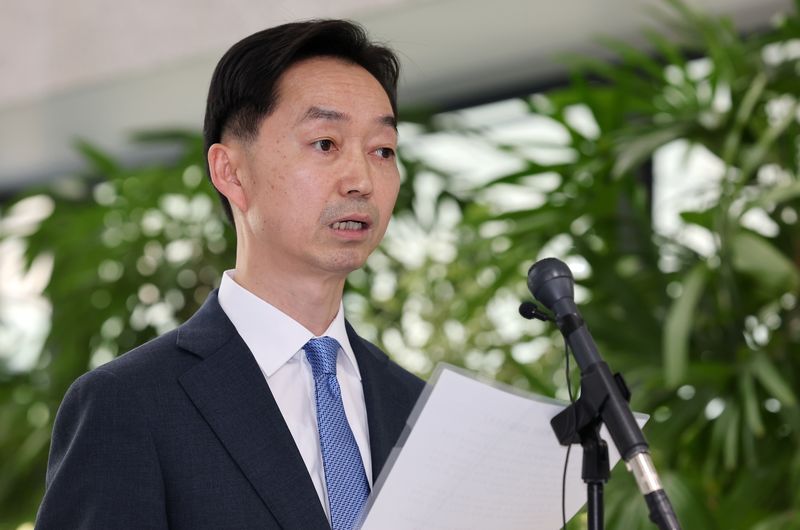
[Financial News] As the Serious Crime Investigation Agency nears its tenth day since launch, the process of selecting its inaugural chief is gathering pace. The National Assembly will hold a confirmation hearing for Kim Ji-yong, the nominee to head the agency, on the 14th. Attention is focused on whether the agency, which began operating without a chief under acting deputy head Jeon Jong-min, can end the leadership vacuum and move quickly to normalize its operations.
According to legal circles and other sources on the 11th, the National Assembly will hold a confirmation hearing for Kim on the 14th. The Serious Crime Investigation Agency, which launched on the 2nd, has so far been operating under acting deputy head Jeon.
At the hearing, Kim’s record during his time in the prosecution service and his views on the new criminal justice system are expected to come under close scrutiny. Kim previously emphasized the need for supplementary investigations by prosecutors during the legislative process for the so-called “complete deprivation of prosecutors’ investigative powers.” In 2020, he also signed a statement by senior prosecutors opposing the removal from duty of then-Prosecutor General Yoon Suk Yeol.
Key issues are expected to include how fully to implement the separation of investigations and prosecutions and how to ensure political neutrality. During recent preparations for the hearing, Kim stressed “ending the politicization of investigations,” political neutrality and investigative independence, and said he would not repeat the prosecution’s targeted investigations or fishing-expedition-style investigations.
After the hearing, the task will be to quickly stabilize the agency’s organization in its early days. The Serious Crime Investigation Agency opened with around 1,900 staff, in the 60-percent range of its authorized 2,874 positions. Regional offices have begun reviewing cases by assigning complaints and accusations to investigative departments, but staffing, office conditions and the division of duties have yet to be fully established. Kim also said on the 8th that, upon taking office, he would immediately form a “dedicated team” to assess the agency’s initial setup and accelerate the recruitment of “non-prosecution” talent, including police officers and lawyers.
The Korea Information System of Criminal Justice Services (KICS), a key piece of investigative infrastructure, is also operating with only some functions available, such as case intake and assignment. Each investigative department will need to handle actual cases while developing its working procedures. The agency must also determine the criteria for selecting and investigating cases transferred from the prosecution and newly filed complaints and accusations, and establish its role alongside other investigative bodies, including the police.
Legal circles say that in circumstances like these, the agency should establish investigative principles and an internal chain of command first, rather than rushing to produce visible results such as its “first investigation.”
A lawyer who previously worked in the prosecution service said, “As long as there are people on staff, there is no reason the agency cannot begin investigating even a single case. But being able to operate at 100% capacity and being able to conduct investigations befitting an investigative agency are two different things,” adding, “It may take considerable time for the Serious Crime Investigation Agency to conduct proper investigations.”
The lawyer went on to stress, “Rather than focusing on when the first case or a compulsory investigation will begin, it is important to establish working procedures for identifying the right cases and to have a leader with authority take the reins and set investigative principles and a chain of command.” This underscores how significant the inaugural chief’s role is for the newly established agency.
Meanwhile, Minister of the Interior and Safety Yoon Ho-joong ordered an inspection of Im Eun-jeong, chief of the Gwangju Regional Serious Crime Investigation Agency, who has publicly criticized Kim. In a post on X that day, Yoon said of Im, “It seems the agency is being mistaken for an organization engaged in politics,” and added, “Many people are concerned to see her preoccupied with criticizing the nominee to head the agency.” Yoon, who ordered the inspection under his supervisory authority pursuant to the Serious Crime Investigation Agency Act, drew a clear line, saying, “The nominee’s vetting will be conducted in accordance with the Constitution and the law by the President, who has the power to appoint, and the National Assembly, which is responsible for the confirmation hearing.”
[email protected] Choi Eun-sol Reporter