“Turns Out It Makes Money” ... Franchise Chains Vie Fiercely for Multi-Unit Owners
- Input
- 2026-10-15 14:22:29
- Updated
- 2026-10-15 14:22:29
[Financial News] Franchise chains are moving to increase the number of franchisees who operate two or more stores. With an amendment to the Franchise Business Act set to take effect this December, franchisors can steadily expand their store networks by drawing on existing franchisees’ operational know-how without increasing the number of franchisees.
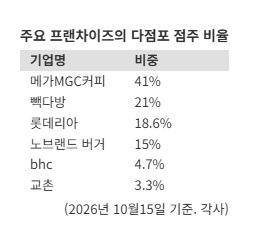
According to the franchise industry on the 15th, the share of multi-unit franchisees at major franchisors is rising. Of Lotteria’s roughly 1,300 stores nationwide, 242 are operated by multi-unit franchisees. That represents 18.6% of all stores, and some franchisees operate as many as seven Lotteria locations. As of July, 15% of No Brand Burger stores, operated by Shinsegae Food, were run by multi-unit franchisees, up 6 percentage points from 9% in the same period a year earlier.
The share of multi-unit franchisees at Paik’s Coffee, a coffee chain operated by The Born Korea, also rose from 16.8% to 21.0% over the same period, an increase of 4.2 percentage points. The company says the actual number of multi-unit franchisees is even higher, as many franchisees operate multiple locations of the same brand as well as different company brands, such as Paik’s Coffee and Hong Kong Banjeom.
The share of multi-unit franchisees has also risen at mid- to low-priced coffee chains. The proportion of Mega MGC Coffee stores run by multi-unit franchisees climbed sharply from 30.4% to 41.0%, while major chicken chains have maintained their share of multi-unit franchisees steadily in the 4%–5% range.
The amendment to the Franchise Business Act, scheduled to take effect this December, is one reason the number of multi-unit franchisees is growing. Under the amendment, if at least 10% of all franchisees come together, they will have the right to collective bargaining with the franchisor. Since eligibility for collective bargaining is based on the number of franchisees, not the number of stores, a multi-unit strategy is advantageous for franchisors: they can expand their total store count without aggressively increasing the number of franchisees.
A franchise industry source said, “With several issues overlapping, including the amendment to the Franchise Business Act and differential franchise fees, franchisors have recently tended to avoid aggressively opening new locations. As consumer demand for experience-driven consumption grows, they are increasing company-owned stores while pursuing a stable strategy of expanding their store networks through proven franchisees.”
Entry barriers to multi-unit operations have fallen significantly for franchisees, too, as more store models, such as takeout outlets and compact stores, can be launched with relatively little capital. No Brand Burger operates compact stores that can be opened with an investment of around 90 million won in a space of about 50 square meters (15 pyeong). Thanks to this advantage, the number of No Brand Burger stores operated by multi-unit franchisees has increased by 46% year over year since the launch of the compact stores.
Low-cost coffee chains also focus on takeout, so their stores are small and the initial startup costs are relatively low. Moreover, franchisees who have already run a store are familiar with the menu and have experience managing an outlet, making it much easier to operate an additional location of the same brand.
Lee Eun-hee, a professor in the Department of Consumer Studies at Inha University, said, “With high prices and an economic slowdown increasing the burden of startup costs, more existing franchisees are opening additional locations based on the operational experience and know-how they gained from their first store. Franchisors also benefit from greater efficiency because they have fewer franchisees to manage.”
[email protected] Park Kyung-ho Reporter