Jeju Flounder Grand Festival runs through the 11th... Boosting consumption with ‘10,000-won flounder sashimi’
- Input
- 2026-10-11 12:12:14
- Updated
- 2026-10-11 12:12:14
【Financial News, Jeju = Jeong Yong-bok】 A seafood festival is underway in Jeju, a major producer of farmed flounder in South Korea, to boost flounder consumption and expand market access for fish farmers.
According to Jeju Special Self-Governing Province on the 11th, the 9th Jeju Flounder Grand Festival, hosted and organized by the Jeju Fish Farming Cooperative, opened on the 9th and is being held through today around the cooperative’s headquarters on Yeonsam-ro in Jeju City. Sponsored by Jeju Province and the National Federation of Fisheries Cooperatives, the event aims to broaden the consumer base for Jeju flounder through discounted flounder dishes and family activities.
Now in its ninth edition, the Jeju Flounder Grand Festival is an event where a producers’ organization directly promotes a signature local seafood product and meets consumers. Around 30,000 people, including local residents and tourists, visited last year.
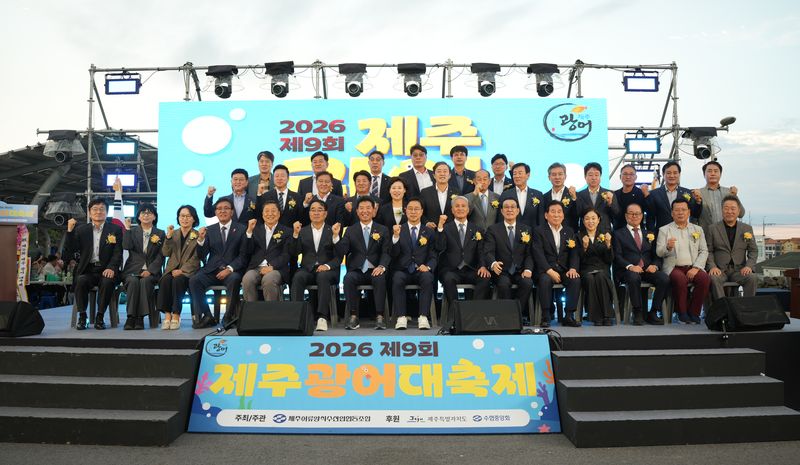
Around 500 people, including local residents and tourists, attended the opening ceremony on the 9th. They included Jeju Governor Wi Seong-gon, Jeju Provincial Council Speaker Song Young-houn, National Assembly members Moon Dae-rim and Kim Seong-beom, National Federation of Fisheries Cooperatives Chairman Noh Dong-jin, and Jeju Fish Farming Cooperative Chairman Han Yong-seon.
The opening ceremony began with a street-opening performance by the Oradong samulnori troupe and a pre-ceremony performance by the Navy Band’s combo band, followed by the official proceedings, congratulatory performances and audience-participation events.
Food made with Jeju flounder is at the heart of the festival. At the venue, 250 g of flounder sashimi, eight pieces of flounder sushi and 250 g of sliced sole sashimi are each on sale for 10,000 won. Five flounder fish-cake skewers, flounder fish-cake tteokbokki and a flounder and seafood pancake are each available for 5,000 won.
Flounder is served not only as sashimi but also in a range of dishes, including sushi, fish cakes and pancakes, to help consumers become familiar with Jeju farmed seafood.
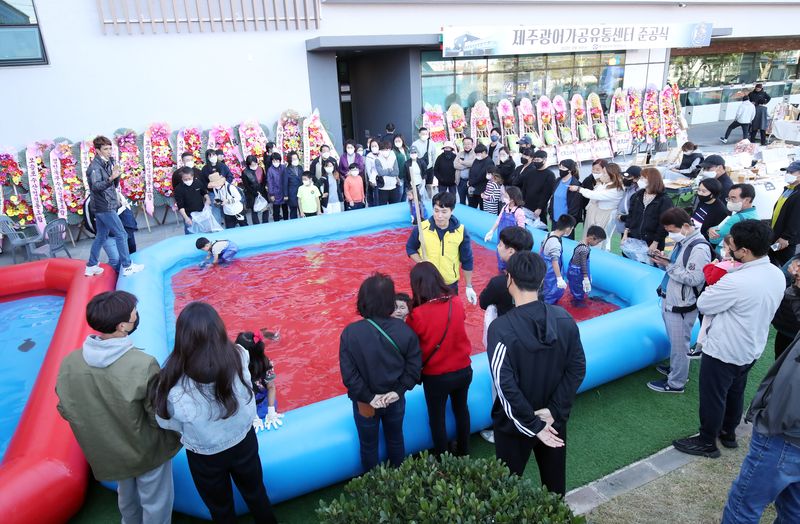
Activities for families are also on offer. A women’s arm-wrestling contest, a weight-guessing contest and the Jeju Flounder Song Festival were held on the 10th. On the final day, the 11th, a youth dance festival, the Jeju Flounder Golden Bell quiz and a treasure hunt are scheduled. Other activities include bare-handed fishing for flounder and sole, a children’s art contest, insect experiences, inflatable play equipment and face painting.
The festival is drawing attention against the backdrop of the large share of Jeju’s aquaculture industry in national production and recently worsening business conditions.
According to the results of the 2025 Fish Farming Trends Survey, released by the National Data Agency last March, fish-farming production in Jeju reached 27,200 tonnes last year, up 8.9% from the previous year.
Production value rose 18.3% from the previous year to 472 billion won, surpassing 400 billion won for the first time. Flatfish production was worth 378.9 billion won, accounting for about 80% of the province’s total fish-farming production value.
Nupchi is the standard Korean name for flounder. Jeju flounder is a key product in the province’s aquaculture industry and a major source of fish for South Korea’s sashimi market.
At the opening ceremony, Governor Wi Seong-gon also emphasized that “Jeju accounts for at least half of South Korea’s farmed flounder production,” and praised the efforts of fishers who have worked to advance aquaculture technology and maintain quality.
However, growth in production volume and value does not guarantee improved profitability for individual fish farms. This summer, prolonged high water temperatures in Jeju caused farmed flounder deaths. As of August 20, 298,000 flounder deaths had been reported at 39 farms in the province, with losses at the time estimated at about 1 billion won.

When high water temperatures persist, farms have to run more equipment to manage water temperature and supply oxygen, increasing operating costs such as electricity bills.
In August, the Jeju Fish Farming Cooperative estimated the production cost of flounder at 17,462 won per kilogram, factoring in feed and electricity costs, among others. Farm-gate prices at the time remained in the 17,000-won range, with rising production costs and losses from fish deaths cited as factors squeezing fish farms’ profitability.
This is why technological innovation to reduce production costs needs to go hand in hand with improvements to the distribution system that can secure stable sale prices.
Before the opening ceremony, Governor Wi toured the food stalls and activity areas and encouraged cooperative officials and fish farmers. In his remarks, he said, “The more Jeju flounder sells and gets a fair price, the more fishers’ incomes rise and the stronger the local economy becomes. But high water temperatures caused by climate change and rising production costs are making things increasingly difficult at fish farms.”
Governor Wi stressed, “We will provide solid support at every stage, from production through distribution and sales, so that cost savings achieved through technological innovation and improved quality lead to stable market access and higher incomes for fishers.”
He also voiced his determination to develop Jeju flounder into a seafood product that can compete in global markets. Governor Wi said, “I will work alongside fishers to make Jeju flounder a premium seafood product recognized around the world, not just in South Korea.”
[email protected] Jeong Yong-bok Reporter