From No. 5 to No. 3 globally, revenue tops 300 trillion won... Chung Eui-sun’s six years, and his next big bet: “Physical AI”
- Input
- 2026-10-11 11:49:25
- Updated
- 2026-10-11 11:49:25
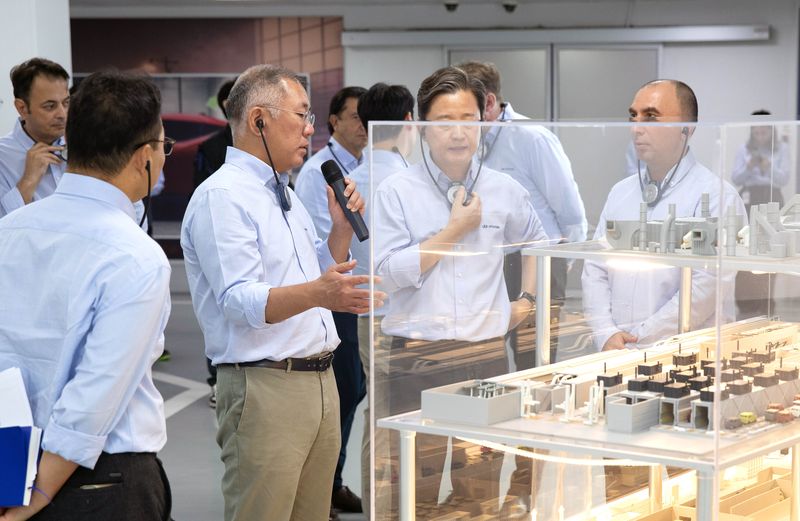
[Financial News] Hyundai Motor Group Chairman Chung Eui-sun will mark the sixth anniversary of his appointment on the 14th. He has lifted the group, which had long remained among the world’s top five, to become the third-largest automaker group globally and ushered in an era of combined revenue of 300 trillion won for Hyundai Motor and Kia Corporation. After reshaping its profit structure through electrification and higher-value vehicle models, the group is now accelerating its transition into a “physical AI solutions company” spanning robotics, autonomous driving and hydrogen.
■Among the global top three for four straight years... the 300-trillion-won revenue era
According to the auto industry on the 11th, Hyundai Motor Group rose to third place in global sales in 2022, behind Toyota and Volkswagen, two years after Chairman Chung took office. It held that position for four straight years through last year. Hyundai Motor and Kia Corporation sold about 7.27 million vehicles worldwide last year, and their combined revenue exceeded 300 trillion won for the first time. Their annual operating profit also reached about 20.5 trillion won, surpassing Volkswagen Group.The improvement in performance has been driven by an electrification strategy and the move upmarket in the vehicle lineup. Alongside introducing its dedicated EV platform, Hyundai Electric Global Modular Platform (E-GMP), the group increased hybrid supply in response to changing market demand and expanded the share of Genesis and sport utility vehicles (SUVs). The group sold about 1.76 million eco-friendly vehicles last year.
In the first half of this year, global hybrid sales rose from a year earlier by 18% at Hyundai Motor, to 363,000 vehicles, and by 47% at Kia Corporation, to 316,000. Genesis, which Chairman Chung has supported since the brand’s launch, also surpassed 1.5 million cumulative global sales in January this year. The strategy of defending profitability with hybrids and premium cars even as EV growth moderates is seen as having paid off.
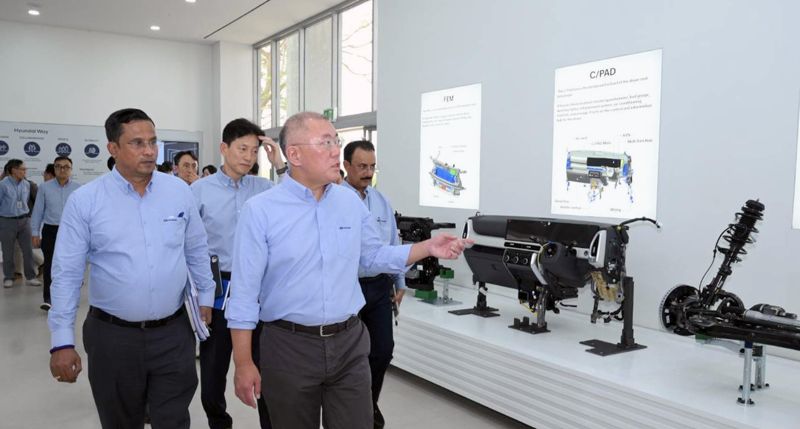
Chairman Chung is now seeking to change the business structure itself, moving beyond increasing sales of finished vehicles. At the AI Summit in San Francisco, United States, last July, he said, “Hyundai Motor Group is expanding beyond the boundaries of traditional auto manufacturing into areas including autonomous driving, robotics and AI factories, and is pursuing a transition into a physical AI solutions company.”
■Expanding into robotics and hydrogen... commercialization and stable labor relations remain challenges
Investment in future businesses is already gathering pace. Hyundai Motor Group plans to invest 125.2 trillion won in South Korea over five years starting this year, and to put 9 trillion won into Saemangeum by 2029 to build a hub combining AI, robotics and hydrogen energy. It is also pursuing strategic investments totaling $26 billion in the United States. The group broke ground last month on an electric arc furnace steel plant in Louisiana, and is demonstrating manufacturing technologies combining AI and robotics at Hyundai Motor Group Metaplant America in Georgia.The group is also accelerating efforts to secure technology. Following the establishment of autonomous-driving joint venture Motional and the acquisition of Boston Dynamics, it is developing software-defined vehicle (SDV) technology with 42dot at its center. It is also expanding cooperation with global technology companies such as NVIDIA Corporation and Waymo LLC.
Hydrogen is another pillar that Chairman Chung has pursued since 2018. Hyundai Motor sold 20 of its all-new NEXO hydrogen fuel-cell vehicles in Japan from April through August this year, securing a 10.9% share of the country’s passenger hydrogen fuel-cell vehicle market. On the 7th, Hyundai Rotem signed a memorandum of understanding with Egypt’s National Authority for Tunnels on cooperation in hydrogen fuel-cell tram projects. Hyundai Motor Group is broadening its business from hydrogen fuel-cell commercial vehicles to railways and hydrogen production and refueling infrastructure.
The overseas footprint of the hydrogen fuel-cell vehicle business is also growing. As of August this year, Hyundai Motor Group had deployed about 4,000 hydrogen fuel-cell trucks and buses across 16 markets worldwide, while its passenger hydrogen fuel-cell vehicles had sold more than 49,000 units cumulatively in 25 or more countries.
The challenge is turning the scale of investment into actual returns. For hydrogen, production costs and the expansion of refueling infrastructure remain hurdles, while robotics and physical AI must demonstrate commercial results beyond technical trials. Labor relations also remain a source of uncertainty, with Hyundai Motor’s union launching its first all-out strike in 10 years this year. Building a stable foundation for labor-management cooperation has become important as the group pursues AI transformation at production sites and expands overseas hubs.
“In the physical AI era, not only rapid technological innovation but also stable labor-management cooperation and organizational execution capabilities will be important factors shaping future competitiveness,” an industry source said, adding, “Bringing to fruition a new industrial paradigm that leads the physical AI era will be an important task going forward.”
[email protected] Kim Dong-ho Reporter