“Should I Pay Off My Loan or Not?” With Mortgage Rates Nearing 7%, Bank Private Bankers Offer Advice
- Input
- 2026-10-11 17:32:31
- Updated
- 2026-10-11 17:32:31
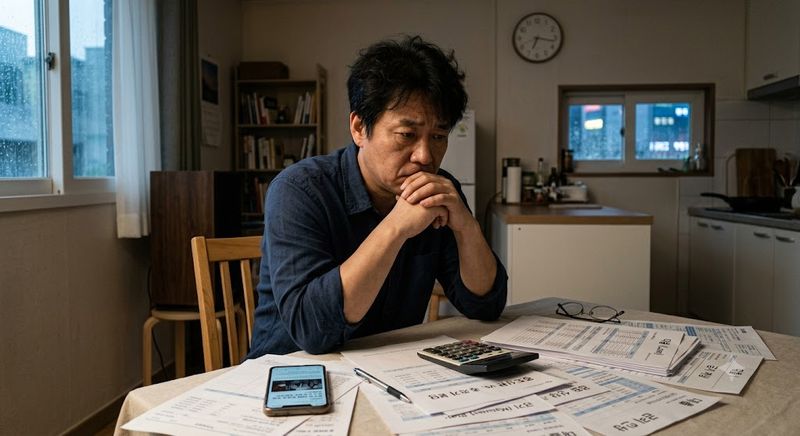
Wealth management (WM) experts at four major commercial banks advised borrowers to compare loan rates with after-tax investment returns while also considering future rate trends and funding needs. For investments, they recommended securing high rates over the long term while keeping liquid funds available to respond to market changes.
Take care when switching to a fixed-rate mortgage
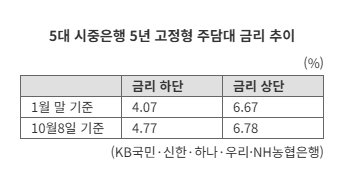
According to financial industry sources on the 11th, five major commercial banks—KB Kookmin, Shinhan, Hana, Woori and NH Nonghyup Bank—offered five-year fixed-rate mortgages at annual rates of 4.77% to 6.78% as of the 8th. Compared with 4.07% to 6.67% at the end of January, the lower end of the range rose by 0.70 percentage points. At four of the five banks, the lower end of mortgage rates had climbed into the 5% range. As the upper end neared 7% a year, borrowers were considering using spare cash to repay principal or switching to fixed rates to reduce interest costs.Kim Do-a, a PB branch manager at Woori Bank’s TCE Signature Center, recommended using spare cash to pay off high-interest loans first. “You should compare the interest you would save by repaying a loan with the after-tax returns you could earn from investing,” Kim said. “Even if an investment earns an annual return in the 8% range, similar to mortgage rates, taxes can leave you worse off than if you had paid down the loan. You should consider whether there is a product that can comfortably earn more than your loan rate.” She explained that when interest and dividend income is taxed at 15.4%, a pretax return of about 9.5% is needed to offset an annual loan interest rate of 8%.
Kim Su-kyung, a PB team leader at Shinhan Bank’s PWM Apgujeong Center, stressed that borrowers should “compare loan rates, expected returns on investment assets, taxes, early repayment fees and future cash flows as a whole” and that “it is important to keep enough liquid funds to deal with unexpected situations even after repaying a loan.”
Some also said borrowers should consider whether they would be able to borrow the money they might need later before making a repayment. Jung Sung-jin, deputy head of KB Kookmin Bank’s Gangnam Star PB Center, pointed out, “If you repay a loan to reduce interest costs, you may not be able to borrow as much as you want when you need funds later. It is important to set aside money you may need in the future before repaying the loan.”
They advised taking a cautious approach to switching from a variable rate to a fixed rate. Kim said, “Considering that rate hikes may wrap up around the first half of next year, I think it is already late to switch to a fixed rate now.” Yoon Ji-young, a VIP PB manager at Hana Bank’s Seogyo-dong Branch, also said, “Switching to a fixed rate can be advantageous during a rate-hiking cycle, but it is impossible to know how long high rates will last. The possibility of rates falling over the long term should also be taken into account.”
The team leader recommended considering the costs of switching loans. He said, “You should calculate the actual break-even point after factoring in both early repayment fees and all costs incurred during refinancing.”
“Secure high-yield products, but keep cash on hand”
At investment consultations, interest has grown in products that can lock in today’s high rates over the long term. With the exchange rate down from its recent peak and U.S. bond yields rising, more customers are looking for products that let them buy and invest in dollars.Yoon, the PB manager, said, “As the exchange rate has fallen and yields on U.S. Treasuries and corporate bonds have risen, we have received more inquiries about dollar-based products.”
However, some cautioned against buying dollars solely because the exchange rate has fallen from its peak. Jung, the deputy center head, explained, “Even though the exchange rate has fallen below the 1,500-won range, 1,340 won is not necessarily cheap. Unless a customer already holds dollars, I would not recommend exchanging won for dollars just to invest in U.S. Treasuries.”
Demand has also risen among those seeking to lock in today’s high rates for the long term. Jung, the deputy center head, recommended long-term fixed-rate insurance products with terms of three, five or 10 years for funds that are not expected to be needed for a long time. He said, “Since high rates will not last forever, many people want to lock them in for the long term while rates are high. Insurance products can be held for longer periods than deposits.”
Kim, the PB team leader, named U.S. Treasuries, dollar-denominated repurchase agreements (RPs) and dollar-denominated insurance products among the options drawing the most interest. “You should not invest simply because ‘dollar interest rates are high,’” he said. “It is important to determine the appropriate share of dollar assets by considering the customer’s allocation between won- and dollar-denominated assets, investment horizon and tolerance for exchange-rate fluctuations.” He added, “The more volatile interest rates are, the more important it is to diversify appropriately among stable assets such as deposits and bonds, restrained assets and liquid assets, rather than concentrating in a particular product.”
In particular, he recommended staggering maturities according to when the funds will be needed. Short-term spare funds intended for use in about three to six months can be kept liquid in money market deposit accounts (MMDAs) or money market funds (MMFs), while some funds not expected to be used for at least a year can be placed in time deposits or high-grade bonds to lock in current rates.
Some also said there is no need to cut all stock investments solely because interest rates are rising. Kim, the branch manager, said that unlike during the 2022 rate-hiking cycle, profits at U.S. AI and semiconductor companies are now supporting share prices. “We advise clients to hold some assets related to U.S. AI and semiconductors while keeping cash available to respond to market volatility,” he said.
[email protected] Lee Hyun-jung Reporter