National Assembly audits enter second week; BOK rates, CIO and Seoul real estate under scrutiny
- Input
- 2026-10-11 11:53:35
- Updated
- 2026-10-11 11:53:35
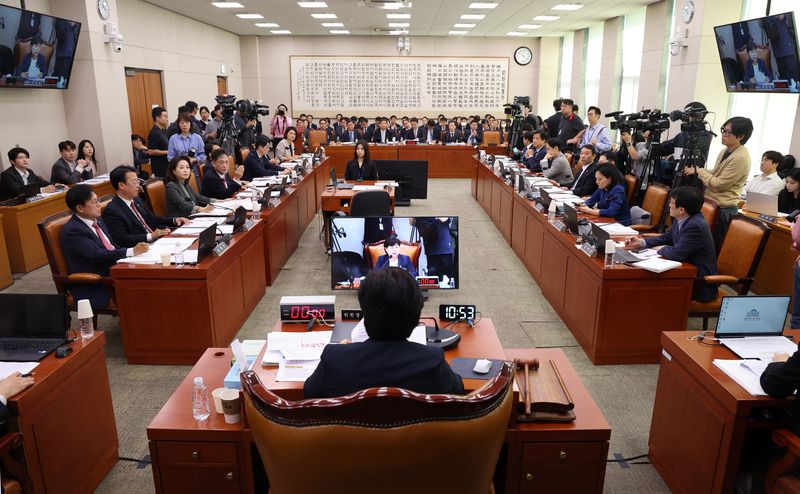
[Financial News] The first National Assembly audit since the Lee Jae-myung administration took office enters its second week on the 12th. This week, economic and political issues will come under National Assembly scrutiny, ranging from the Bank of Korea’s monetary policy and controversy over investigations by the Corruption Investigation Office for High-ranking Officials (CIO) to Seoul Metropolitan Government’s real estate policies. As audits that focused on government ministries in the first week expand to major public institutions and judicial and investigative agencies, clashes between the ruling and opposition parties are expected to intensify further.
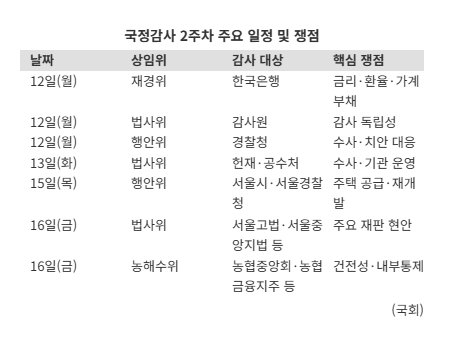
According to the National Assembly on the 11th, the Finance, Economy and Planning Committee will audit the Bank of Korea on the 12th. The management of the benchmark interest rate, exchange-rate fluctuations and household debt are cited as key issues. In particular, lawmakers from both the ruling and opposition parties are expected to focus their questions on the impact of interest-rate policy on the real estate market and household lending. That same day, an audit of the Board of Audit and Inspection by the Legislation and Judiciary Committee is expected to put the independence and political neutrality of audits under scrutiny.
The Legislation and Judiciary Committee’s audit of the CIO on the 13th is drawing attention. Clashes between the ruling and opposition parties are expected over the progress of investigations into major cases, the division of authority among investigative agencies and the appropriateness of the CIO’s operations. Concerns about gaps in investigations resulting from the restructuring of the criminal justice system could also become an issue, ahead of the abolition of the Supreme Prosecutors’ Office and the launch of the Serious Crime Investigation Agency and the Public Prosecution Office.
The Security and Public Administration Committee’s audit of Seoul Metropolitan Government on the 15th is attracting attention. As debate over the government’s real estate policies continues, Seoul’s plans to expand housing supply, regulations on reconstruction and redevelopment, and transportation infrastructure policies are expected to come under scrutiny. That same day, the Strategy and Finance Committee of the National Assembly is expected to address major issues, including customs clearance management and customs administration, in its audit of the Korea Customs Service.
Partisan tensions are also expected during the Legislation and Judiciary Committee’s audit of courts in the Seoul metropolitan area on the 16th, including the Seoul High Court and Seoul Central District Court. Questions may continue on the progress of trials in major political cases and the independence of the judiciary. At the Agriculture, Food, Rural Affairs, Oceans and Fisheries Committee’s audits of the National Agricultural Cooperative Federation and NongHyup Financial Group Inc., the soundness of financial operations, internal controls and the state of NongHyup’s operations are cited as key issues.
The key question in the second week of the audits is whether the issues raised by the ruling and opposition parties in the first week can be tied to scrutiny of how institutions actually operate and the results of their policies. The People Power Party is expected to press the government on problems with its policies and the operation of power agencies, while the Democratic Party of Korea is expected to respond by emphasizing the need for its policies and its achievements in improving institutions. Issues brought to light in the audits are expected to carry over into deliberations on next year’s budget bill and major legislation.
[email protected] Kim Kyung-min Reporter