'Hacking fallout?' Demand deposits plunge by 20 trillion won, raising concerns over banks’ funding costs
- Input
- 2026-10-12 06:00:00
- Updated
- 2026-10-12 06:00:00

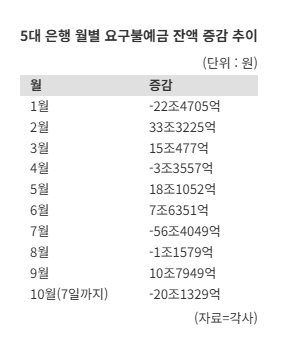
According to financial industry sources on the 11th, demand deposits at the five major banks totaled 655.3919 trillion won as of the 7th. That was down 20.1329 trillion won from 675.5249 trillion won at the end of September. More money flowed out early this month than the 10.7949 trillion won added over the entire month of September.
Demand deposits are accounts from which customers can deposit or withdraw money whenever they wish. They include corporate operating and payment funds, individuals’ living expenses, and money awaiting investment, so balances vary depending on when the funds are used.
Time deposits also declined over the same period. Their combined balance stood at 1,003.3581 trillion won on the 7th, down 2.729 trillion won from 1,006.0871 trillion won at the end of September. The combined decline in demand and time deposits was 22.862 trillion won. One explanation for the decrease in deposits is the routine use of corporate funds. As funds temporarily deposited for salary payments or transaction settlements are spent, demand deposit balances can fall.
A banking industry official explained, “Companies build up cash-like assets ahead of quarterly closings, so demand deposit balances tend to rise at the end of a quarter and fall when the next quarter begins. This pattern has also recurred in historical balance trends.”
There is also speculation that recent hacking and personal information leak incidents in the banking sector may have heightened customer anxiety and affected the movement of funds. Concerns that personal information could be exploited in secondary crimes such as voice phishing may weaken customers’ trust in their banks. The question is whether the decline in low-cost deposits such as demand deposits will continue. Demand deposits are a major low-cost funding source for banks; if their decline persists and they are replaced with funds carrying relatively higher interest rates, funding costs could rise.
Banks’ average deposit rates have already risen. According to the Bank of Korea, the average rate on total deposits at deposit-taking banks, based on outstanding balances, was 2.20% per year at the end of August, up 0.05 percentage points from the end of the previous month. With the average rate applied to existing deposit balances already higher, a further decline in low-cost deposits could leave banks with less room to reduce funding costs.
A banking industry official said, “If low-cost deposits continue to decline while interest rates are rising, banks could face greater pressure. If they have to secure the funds they lack through time deposits or bank bonds at higher rates, managing funding costs becomes difficult.”
[email protected] Ye Byeong-jeong Reporter