Three global big-tech alliances already—will LG’s revenue top 100 trillion won next year?
- Input
- 2026-10-14 07:59:00
- Updated
- 2026-10-14 07:59:00
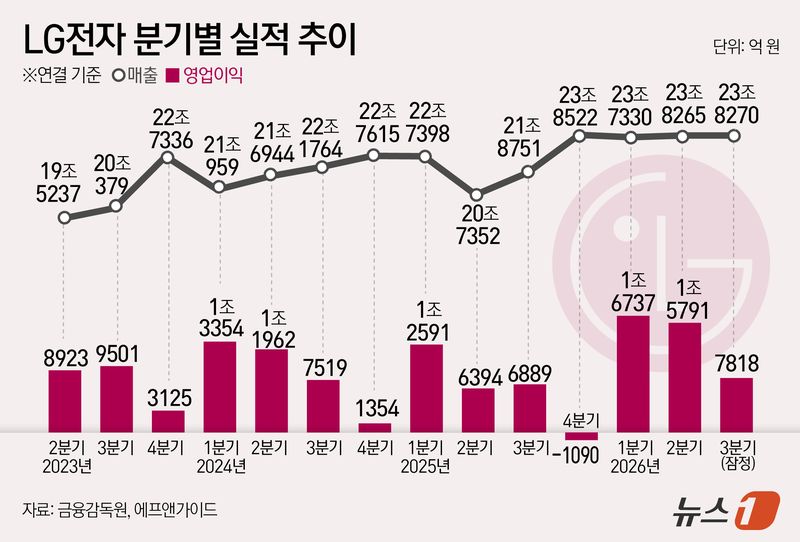
[Financial News] LG is forging a series of alliances with global tech giants. To join the global big-tech race in artificial intelligence (AI), it has pursued strategic partnerships with Microsoft (MS) and NVIDIA Corporation. With Apple Inc., it is also jointly developing products to strengthen its leadership in AI smart homes. The alliances with global tech giants are part of LG’s ongoing business restructuring and are expected to drive medium- to long-term earnings growth at its flagship affiliate, LG Electronics, prompting forecasts that its annual revenue could exceed 100 trillion won next year.
According to industry sources on the 14th, LG’s AI push—a key part of its long-term growth strategy—is gaining further momentum through three alliances with global tech giants. LG Electronics’ cumulative operating profit through the third quarter topped 4 trillion won, putting it on track to post its best-ever annual results this year.
In particular, LG Electronics is continuing to overhaul its Media Entertainment (MS) division to weather the economic slowdown and weakening consumer spending, while stepping up its heating, ventilation and air-conditioning (HVAC) business as a new B2B growth driver through an AI business alliance with Microsoft formed last month. LG Electronics was also recently selected as a partner in NVIDIA Corporation’s AI data-center cooling solutions business. The company aims to leverage its advanced HVAC technology to target the AI data-center cooling market and drive medium- to long-term earnings growth.
LG Electronics recently secured a major long-term supply contract in North America for a total of 5 gigawatts (GW), fueling expectations that chiller revenue will exceed 1 trillion won next year. Since large orders and long-term contracts are typically reflected in earnings after a lag of 7–9 months, LG Electronics plans to expand its HVAC business alongside its two mainstay businesses, home appliances and vehicle components, and carry this year’s earnings improvement into next year. Ko Seon-yeong, an analyst at Yuanta Securities, said, “With a recent supply contract for 5 GW, we expect to build an order backlog of up to 3.5 trillion won, mainly in the United States and the Middle East, by year-end.” She added, “Revenue can typically be recognized within 7–9 months of completing quality tests, so the business could begin contributing to earnings in the second half of 2027.”
LG Electronics has been jointly developing AI smart-home devices with Apple Inc. since last year. In a few months, it plans to begin selling a range of smart-home products under the LG brand, including video doorbells with cameras, smart door locks, security cameras, and smart temperature sensors and thermostats. LG Electronics is expected to target the North American smart-home market by leveraging Apple’s iPhone ecosystem. Amid slowing global demand for home appliances, the strategy is seen as an effort to open up overseas sales channels for smart-home products through its alliance with Apple while also maintaining its leadership in the home-appliance industry, a core business.
LG’s physical AI alliance with NVIDIA Corporation, formed last August, is also expected to bolster its medium- to long-term growth prospects. LG plans to go beyond technology exchanges and solution supply by identifying specific collaboration projects in robotics, AI factories and mobility, and pursuing their commercialization. In the first quarter of next year, it plans to unveil a bipedal humanoid robot based on NVIDIA Isaac GR00T, bringing together key capabilities from its affiliates, including LG Electronics’ robotics technology, LG Innotek’s sensors and LG Energy Solution’s batteries. “The group is transforming from traditional businesses such as home appliances and chemicals into a company focused on AI infrastructure and physical AI,” an LG official said. “Alliances with global tech giants will serve as a medium- to long-term growth driver.”
[email protected] Park So-hyun Reporter