“We should’ve just gone to work” ... Chuseok and the holiday double whammy leaves dual-income couples in their 30s and 40s with “holes” in their bank accounts [How Much Do You Need?]
- Input
- 2026-10-11 10:57:12
- Updated
- 2026-10-11 10:57:12
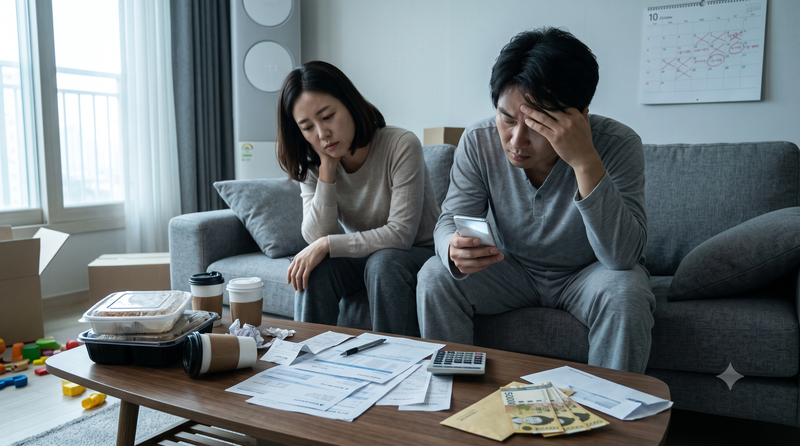
[Financial News] Sunday, October 11, 10 a.m. It is the weekend morning after the long “bridge holiday” stretching from National Foundation Day through Hangul Day has finally come to an end.
K, an office worker in their 40s, and their spouse are slumped deep into the living-room sofa. On their smartphone screen, the amount due on their credit card in a few days glows in red digits.
“Honey, we’re really in the red this month. We haven’t even made up for what we spent at Chuseok, and now that I add what we spent because the kids were off during this holiday, the credit card bill is more than twice what it usually is.”
At the sound of K’s wife’s sighing voice, K replied, rubbing a hand over their face.
“We’d have been better off just going to work as usual on a weekday. With so many days off, money just pours out even if all we do is breathe.”
A combined monthly income of 8 million won. They earn a respectable living as a dual-income couple, but after being hit by a “double whammy of fall holidays” spanning September and October, their bank accounts were already wrecked.
◇ 1.5 million won for Chuseok, 1 million won for the bridge holidays ... a “bill bomb” going off with no time to catch their breath
What wrecked the wallets of dual-income couples in their 30s and 40s this fall was, above all, the “cascade of spending.” Just three weeks ago, they spent well over 1.5 million won celebrating Chuseok, including allowances for both sets of parents, ancestral-rite expenses and fuel for the trip to their hometowns. Usually, after the holiday, they have to tighten their belts for a month or two to make up the deficit.
But October this year was brutal. During the golden holiday stretch encompassing National Foundation Day (October 3), the substitute holiday (October 5) and Hangul Day (October 9), schools and kindergartens declared discretionary days off and sent the children home.
The K couple had already taken a big financial hit from holiday expenses, but to go to work they still had to hire an emergency childcare sitter for 150,000 won a day or send their child to short-term special classes at a private academy.
Add the cost of three meals a day and snacks for the children at home, plus a day trip nearby over the weekend out of guilt, and another 1 million won vanished without a trace in the first week of October alone. The unmarried colleagues’ well-wishes—“You must be glad to have such a long holiday”—were, for parents, simply another way of saying “the expense report is getting longer.”
◇ The “capitalism of holidays,” proven by statistics and data
This is not overspending unique to the K couple. It is a structural irony of dual-income households, borne out by highly objective statistics.
Taken together, the Household Trends Survey published by Statistics Korea and big-data consumption trends from major credit card companies show that consumer spending by households in their 30s and 40s surges in months that include a major holiday or have an unusually high number of public holidays—by at least 20% and, in some cases, 30% or more compared with an ordinary month.
The categories where spending rises the most are eating out and delivery, transportation, and education expenses for childcare (such as special classes at private academies). A single-income household has the “time to spare” for one parent to care for the children and keep expenses down, but a dual-income household has to fill that gap in time entirely with “capital.” In other words, for dual-income couples in South Korea, a holiday is less a period of rest guaranteed by the state than a “structural gap” they have to fill out of their own pockets (with capital).
◇ “We don’t even have the energy to cook” ... depleted stamina fuels compensatory spending
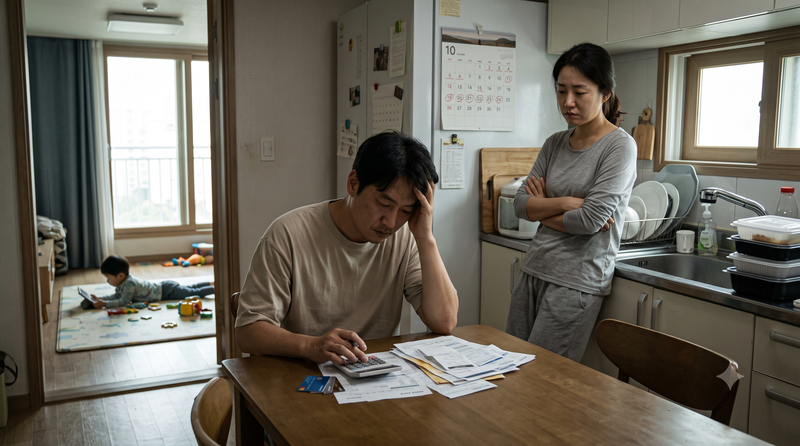
What hurts even more is that not only their wallets but their stamina has been completely drained. Throughout the holiday, they went back and forth between their in-laws’ homes and their own parents’ home, enduring emotional and physical labor; during October’s bridge holiday, they rushed around trying to cover the childcare gap.
Experts describe the spending patterns of couples in their 30s and 40s during this period as a typical combination of “survival spending” and “compensatory spending.” According to analysis by consumer behavior experts, including Lee Eun-hee, a professor in the Department of Consumer Studies at Inha University, dual-income households grappling with severe time poverty and exhaustion readily pay for expensive delivery meals or “anger spending” (spending to relieve stress) to replenish their drained energy.
In reality, on a Sunday like today, after the holidays are over, their resolve to save on food by using up what is in the fridge falls apart. They open a delivery app and say, “We’re so exhausted, let’s order lunch today”—an inescapable reality for them.
◇ “Who exactly are we working for?” ... the bitter reality check of fake income
“If this is how it’s going to be, why are we both working? Everything we earn goes right back out, and there’s nothing left.”
The wife’s self-deprecating remark as she faced the credit card statement due to arrive this week hits a sore spot for all dual-income couples in their 30s and 40s making their way through the fall of 2026. They are working at full throttle as a dual-income couple to live a little more comfortably than others and give their child good things, but reality is harsh.
The money they earn evaporates in an instant: in the name of filial devotion during the holidays, childcare over the long weekends, and the cost of patching up their drained bodies with IV drips and delivery food. It is the trap of so-called “fake income”—money that is never truly their own.
The more red-letter days there are on the calendar, the thinner their wallets become and the deeper their sighs grow: a cruel irony. On Sunday morning, October 11, in the empty living room left in the wake of the golden holiday, parents across South Korea are lacing up their shoes again to keep turning a treadmill they cannot step off, even next month.
[email protected] Jeon Sang-il Reporter