LGD drives OLED process innovation, seeks an overwhelming technology lead with 'FLiPP'
- Input
- 2026-10-11 10:00:00
- Updated
- 2026-10-11 10:00:00
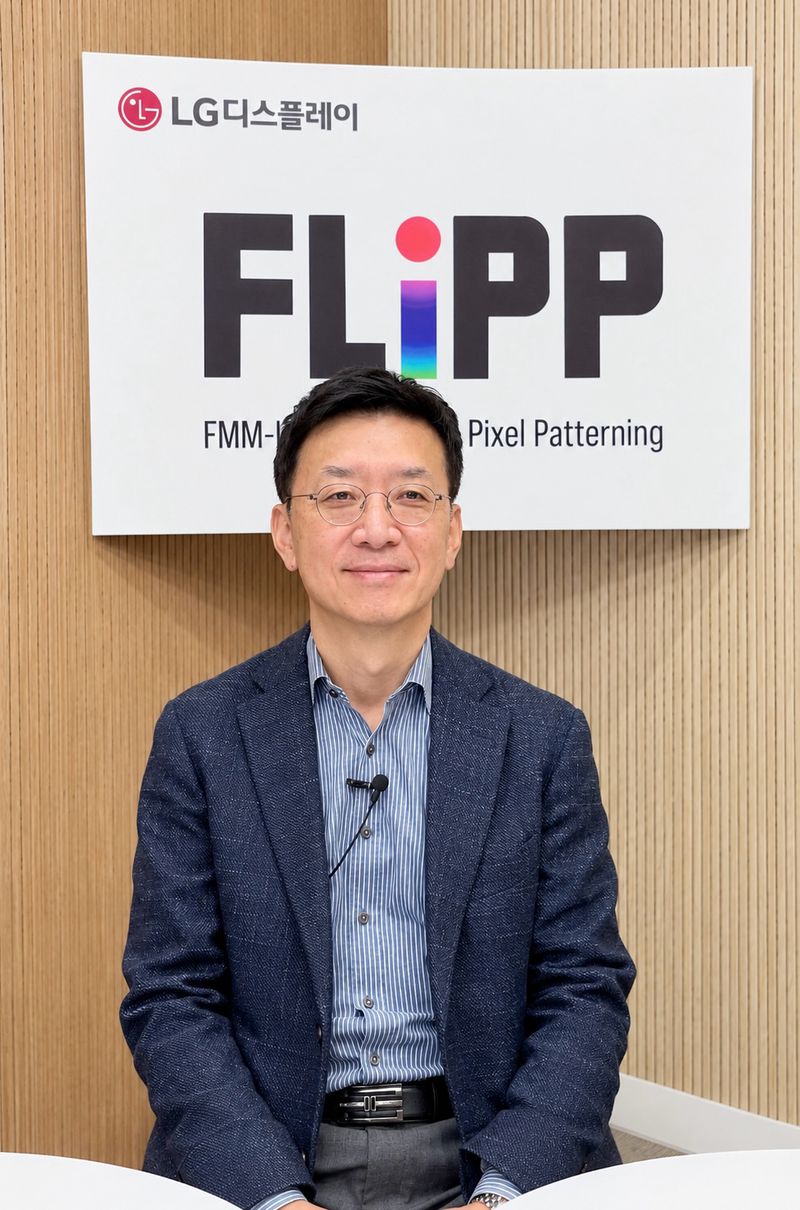
[Financial News] LG Display Co., Ltd. is pursuing OLED process innovation with 'FLiPP,' a next-generation organic light-emitting diode (OLED) manufacturing technology that does not use fine metal masks (FMMs). The strategy is to make the most of its existing OLED production infrastructure to reduce the burden of new investment while improving brightness, lifespan and production efficiency. In particular, the company plans to first apply the technology to IT products such as laptops and monitors, then expand its use from wearables to extra-large TVs to strengthen the competitiveness of its OLED manufacturing technology.
Choi Young-seok, chief technology officer (CTO) of LG Display Co., Ltd., said at the 'FLiPP Tech Seminar' held on the 8th, "FLiPP is the greatest process innovation available for 8th-generation production, and it will serve as a moat that makes display companies find it difficult and daunting to take on the challenge."
FLiPP is a next-generation patterning technology that eliminates the FMMs previously used to form red (R), green (G) and blue (B) pixels in the OLED manufacturing process. Unlike the conventional FMM method, it uses photolithography to form pixels precisely. Developed in-house by LG Display Co., Ltd., the technology is notable for being the world's first to realize an RGB OLED process using 8th-generation mother-glass substrates.
With this technology, the aperture ratio—the area in which pixels actually emit light—has been raised from 42% with the conventional FMM method to 65%. The company says the higher aperture ratio can be used to increase brightness by 1.6 times or extend lifespan by 2.4 times compared with the existing method, while also reducing power consumption by 13%.
Another competitive advantage is that the technology can use existing production infrastructure. Unlike competitors investing in new 8.6th-generation lines to expand OLED production for IT products, LG Display Co., Ltd. plans to maximize the use of its existing white OLED (WOLED) production facilities to improve investment efficiency. CTO Choi expressed confidence, saying, "With FLiPP, we can use our existing infrastructure as is and produce any product category, regardless of size (in inches) or application," and adding, "We can achieve significant results with a relatively smaller investment than would be required for a new 8.6th-generation line."
The company is also aiming to differentiate itself in terms of productivity. According to LG Display Co., Ltd., when producing 23.5-inch panels at an 8th-generation facility, FLiPP's panel-cutting efficiency is at least 93%, and its productivity is about 24% higher than with the conventional FMM method. The organic-material deposition process time is also reduced by about 40%, while FMM manufacturing and maintenance costs, as well as defects caused by mask sagging can be reduced.
LG Display Co., Ltd., however, is emphasizing FLiPP as a performance-innovation technology rather than simply a cost-cutting technology. Cho Heung-ryeol, an executive at LG Display Co., Ltd., said, "I don't want to tout FLiPP as a cost technology," adding that performance improvement is the priority and cost competitiveness can be achieved naturally during development.
LG Display Co., Ltd. aims to build a 'FLiPP One Platform' capable of producing OLED panels in a variety of sizes and for different uses. The company says the technology can be applied to products ranging from wearables in the 1-inch range to extra-large TVs measuring 100 inches or more.
The timing for mass production has not yet been decided. FLiPP, whose development began in earnest last July, is currently at the technology-development stage. The timing for applying it to mass production will be decided after further product development and discussions with customers. CTO Choi said, "FLiPP is currently in the technology-development stage," adding, "It is too early to decide when it will be applied to mass production." He added, "We need to have customers in place to begin mass production, and that will be decided through further discussions."
[email protected] Lim Su-bin Reporter