[Exclusive] 6 in 10 local-road bridges are at least 20 years old ... Upgrade budget falls despite aging
- Input
- 2026-10-11 14:54:12
- Updated
- 2026-10-11 14:54:12
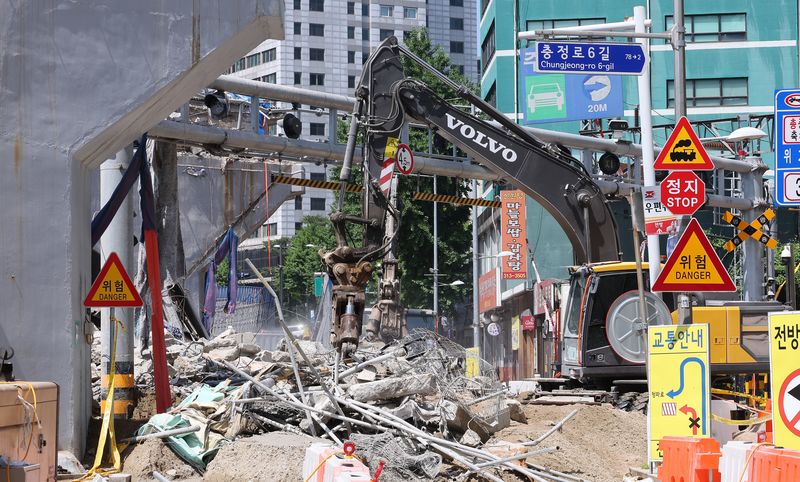
[Financial News] More than 6 in 10 local-road bridges managed by metropolitan and provincial governments nationwide were found to have been completed over 20 years ago. There are also more than 2,000 bridges at least 30 years old, but the budget for upgrading aging bridges and tunnels has instead declined over the past two years. Calls are growing to expand investment in proactive safety inspections, repairs and reinforcement to address the aging of infrastructure.
More than 30% of bridges are also at least 30 years old
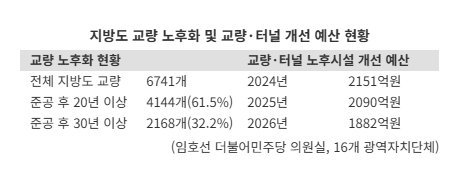
According to the “Status of Aging Bridges and Tunnels on Local Roads,” submitted by 16 metropolitan and provincial governments to the office of Democratic Party lawmaker Lim Ho-seon, a member of the National Assembly’s Public Administration and Security Committee, on the 11th, 4,144 of the 6,741 local-road bridges managed by city and provincial governments had been completed at least 20 years ago, accounting for 61.5% of the total.
Of these, 2,168 bridges, or 32.2% of the total, were at least 30 years old. In other words, about one in three bridges had been completed more than 30 years ago. Another 1,976 bridges had been completed at least 20 but fewer than 30 years ago.
Aging bridges were especially prevalent in North Gyeongsang Province. North Gyeongsang had the most bridges completed at least 20 years ago, with 599, followed by North Jeolla Province with 528 and Gangwon Province with 462. Among bridges at least 30 years old, the numbers were 358 in North Gyeongsang, 288 in South Chungcheong, 228 in Gyeonggi, 216 in South Gyeongsang, 208 in Gangwon and 192 in North Jeolla.
Tunnels are aging as well. Of the tunnels covered by the survey, 153 had been completed at least 20 years ago, accounting for 37.0% of the total. Of these, 55 were at least 30 years old.
Proactive investment plans needed to upgrade aging infrastructure
By contrast, the budget for upgrading aging bridges and tunnels has been declining. The 16 metropolitan and provincial governments’ combined budget for this purpose fell from 215.1 billion won in 2024 to 209 billion won last year, and was cut further to 188.2 billion won this year. It declined by about 26.9 billion won over two years, a drop of 12.5%.
The budget cuts were even steeper in some local governments. Sejong’s budget plunged 97.1%, from 3.13 billion won in 2024 to 90 million won this year. Over the same period, Jeju’s fell 61.8%, from 1.4 billion won to 540 million won, while Busan’s declined 42.8%, from 4.67 billion won to 2.67 billion won. Annual budgets can vary depending on the start and completion of major repair projects, but observers say sustained investment plans are needed to address the growing number of aging facilities.
“Six in 10 local-road bridges have been completed more than 20 years ago, yet the budget for upgrading aging infrastructure is actually falling,” Lim said. “Aging does not automatically mean danger, but waiting until after an accident to respond would be too late. The government and local authorities must draw up medium- and long-term investment plans for proactive inspections, repairs and reinforcement, and secure stable funding,” he stressed.
There were also many facilities in need of repair based on their safety ratings. Among local-road bridges, 213 were rated A, 4,514 B, 1,274 C and 4 D. The D-rated bridges were located in Sejong (1), South Chungcheong (2) and South Gyeongsang (1). Among tunnels, 90 were rated A, 284 B and 6 C.
Under the safety rating system established by the Special Act on the Safety Control and Maintenance of Establishments, a C rating means a facility has defects and requires repairs. A D rating means defects in major components require urgent repairs or reinforcement, and that restrictions on use must also be considered.
Experts said management systems should be strengthened to identify damage to facilities early and ensure appropriate follow-up measures based on diagnostic results. Bridges naturally deteriorate over time, and damage can accelerate due to factors such as loads exceeding design standards or weather conditions, making systematic inspections and management necessary.
“Institutional measures must be put in place to ensure accurate safety assessments are conducted and their results are reflected in budget allocations,” said Ahn Hong-seop, chair of the Korea Construction Safety Association. “We should curb new construction as much as possible going forward and shift the focus of spending toward repairing existing aging bridges first,” he urged.
“Even when funding is available, it takes considerable time to plan and design repairs and then carry them out,” said Cho Won-cheol, professor emeritus of civil engineering at Yonsei University. “The number of specialists in safety inspections and assessments should be at least tripled so they can inspect the condition of infrastructure and develop repair plans,” he noted.
[email protected] Kim Ye-ji Reporter