India's turmoil deepens as authorities impose traffic restrictions and preemptively detain protesters ahead of ‘vote theft’ rally
- Input
- 2026-10-10 19:31:14
- Updated
- 2026-10-10 19:31:14
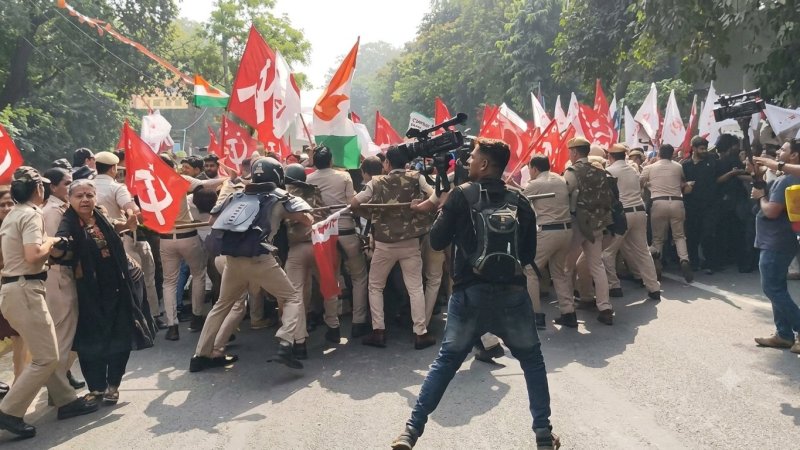
【New Delhi, India—Pragya Awasthi, Correspondent】As controversy mounts over revelations that India's Election Commission in New Delhi deleted names from voter rolls to benefit ruling-party candidates, the government has announced sweeping traffic restrictions—including the closure of metro station entrances—and limits on train services as it moves to preempt protests over alleged ‘vote theft.’ Meanwhile, continued reports of activists linked to the protests and demonstrators being detained while traveling have plunged Indian politics into uncontrollable turmoil.
According to Indian media and other sources on the 10th, Indian authorities announced that they had imposed sweeping traffic restrictions and detained protesters and others on preventive grounds ahead of a planned public protest at Jantar Mantar in the capital, New Delhi. The Supreme Court of India expressed concern that the measures were excessive and could infringe on citizens’ right to freedom of movement.
The protest was scheduled to take place at Jantar Mantar, a major gathering site in the capital, New Delhi. Organizers are demanding the resignation of Chief Election Commissioner (CEC) Gyanesh Kumar. They allege that voters were improperly removed from the electoral rolls during the Special Intensive Revision (SIR) of the rolls.
The Delhi Metro Rail Corporation (DMRC) announced that it would close entrances at 56 metro stations, citing large crowds expected for the protest and safety concerns around key facilities. Barricades were also set up at major Delhi border crossings and access roads, restricting the movement of vehicles and people entering the city. Ahead of the protest, authorities also suspended mobile internet service for 24 hours within a 4-kilometer radius of the Janpath-Kartavya Path intersection near Jantar Mantar in New Delhi, from 10 p.m. on the 9th until 10 p.m. on the 10th.
Indian railway authorities also restricted train services, citing traffic congestion around New Delhi and Hazrat Nizamuddin stations. Indian media reported that 245 trains departing from Delhi or terminating there had been canceled. The measures are also expected to affect people traveling from outside Delhi to join the protest. Authorities said the measures were intended to maintain law and order, citing concerns that crowds of protesters could gather around key facilities.
Concerns are also growing over the police response, which is seen as excessive. According to multiple reports, activists and student activists across the country have been detained on preventive grounds or subjected to police surveillance and pressure, while some protesters were reportedly detained en route to Delhi.
Reports said senior CJP figures were also held aboard an aircraft as they were heading to the protest site. Independent journalists were likewise held in hotel rooms, and they shared details of the situation directly on their social media channels. Opposition and left-wing figures were also reportedly detained by Delhi police on the 10th. They included former Delhi Chief Minister Arvind Kejriwal; former West Bengal Chief Minister Mamata Banerjee; former Kerala Chief Minister Pinarayi Vijayan; Neha Bora, an activist with the All India Students’ Association (AISA); M. A. Baby, general secretary of the Communist Party of India (Marxist); senior party leader Brinda Karat; John Brittas, a member of the Rajya Sabha (India’s upper house); and former Tripura Chief Minister Manik Sarkar.
A notable development in the dispute is the intervention of the Supreme Court of India. At a hearing on the traffic restrictions on the 9th, the court acknowledged the need to maintain law and order but said that completely shutting down essential public transport, including metro and rail services, in response to protests would be excessive. In particular, the court used the metaphor, “You shouldn’t wield a hammer to swat a fly,” emphasizing that citizens’ everyday movement should not be restricted in the name of controlling protests. The court said traffic restrictions should go no further than necessary to maintain public order and called for a review of limits on public transport services.
The government said it would draw up proportionate measures in response. Indian opposition figures also criticized the government’s response. Former Delhi Chief Minister Arvind Kejriwal strongly condemned the security restrictions and the detention of CJP leaders, arguing that the situation reminded him of a past state of emergency in India. Kejriwal claimed the government was excessively restricting peaceful protests.
The electoral-roll issue that has sparked major controversy is an administrative process for verifying voters’ eligibility to participate in elections. However, political controversy has persisted over the transparency and fairness of the process by which voters are removed from the rolls.
[email protected] Pragya Awasthi, Correspondent Reporter