“Hydrogen Made from Trash—Is It Really ‘Eco-Friendly’?” [Unboxing Lab]
- Input
- 2026-10-12 05:56:00
- Updated
- 2026-10-12 05:56:00
Do you remember the excitement of opening a delivery box? Even as we speak, university labs are producing amazing discoveries that could change our lives. They’re just wrapped in thick layers of “academic papers.” In “Unboxing Lab,” we’ll skip the complex equations and theories and get straight to the substance you want to know. So, shall we open the box? Today’s discovery is this study.
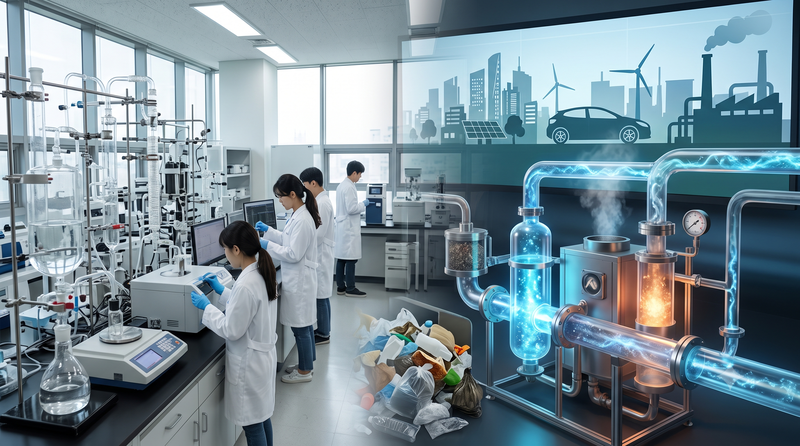
Making hydrogen from waste does not necessarily reduce greenhouse gas emissions. Using waste resources to produce hydrogen may mean that the heat or electricity previously generated from them must instead be supplied by other energy sources. To assess the actual emissions reduction, greenhouse gases emitted when using substitute fuels must also be included in the calculations.
■ The previous uses of waste resources must also be considered
The research team analyzed eight hydrogen production pathways using solid recovered fuel (SRF), mixed plastic waste (MPW), landfill gas (LFG), food waste, livestock manure, sewage sludge and other resources. The team compared methods that produce hydrogen by gasifying or breaking down waste resources with methods that use biogas from organic waste. The analysis included not only hydrogen production but also greenhouse gas emissions from collecting and processing waste resources and compressing and transporting hydrogen.
Domestic statistics on the use of waste resources show that solid recovered fuel and mixed plastic waste were previously used 66.4% for heat production and 33.6% for power generation. Landfill gas was used 79.8% for power generation, while 15.5% was incinerated and 4.6% used for heat production. Biogas from organic waste, including food waste, was used 45.4% for heat production, 29.1% for incineration and 25.6% for power generation.
Greenhouse gas emissions vary depending on how waste resources were used before they are diverted to hydrogen production. When waste previously used for power generation is diverted, the benefit of replacing that power generation can be taken into account. By contrast, diverting waste previously used to produce heat may require the shortfall to be made up with other fuels, such as coal or natural gas. The emissions from these substitute fuels can reduce the greenhouse gas savings from hydrogen production.
In a particular scenario in which solid recovered fuel and other waste resources previously used for heat production were diverted to hydrogen production, the team calculated emissions from using substitute fuels at 23.4 kilograms of carbon dioxide equivalent (CO2-eq.) per kilogram of hydrogen. Carbon dioxide equivalent is a measure that expresses the impact of greenhouse gases other than carbon dioxide in terms of carbon dioxide. This figure is specific to that scenario and does not apply equally to all waste-to-hydrogen pathways. The findings show that accurately assessing the greenhouse gas reduction benefits of hydrogen production requires considering not only the type of waste resource but also its previous use.
■ Where the hydrogen is used also matters
The team also analyzed how low emissions from hydrogen production and supply would need to be for hydrogen used as vehicle fuel, in power generation or in steel production to emit fewer greenhouse gases than existing technologies. Because the technologies used as comparators differ by sector, so do the benchmarks for assessing emissions reductions.
The study sets the benchmarks at 11.9 kilograms of carbon dioxide equivalent per kilogram of hydrogen for vehicles, 8.6 kilograms for natural gas combined-cycle power generation, and 15.8 kilograms for steel production using a coal-fired blast furnace. The vehicle-sector figure is based on a comparison with electric vehicles, while the comparators for power generation and steel production are natural gas combined-cycle power generation and the coal-fired blast furnace process, respectively. If emissions from hydrogen production and supply are below the relevant benchmark, hydrogen can emit fewer greenhouse gases than the existing technology in that sector.
These benchmarks differ from South Korea’s clean hydrogen certification criteria. The domestic criteria are based on greenhouse gas emissions generated up to the point at which one kilogram of hydrogen is produced and supplied, and require emissions to be no more than 4 kilograms of carbon dioxide equivalent. By contrast, the figures given in the study for vehicles, power generation and steel are benchmarks for assessing the potential to reduce emissions by comparing hydrogen with existing technologies in each end-use sector. Therefore, a finding that emissions are lower than those of existing technologies in a particular sector does not, by itself, mean that the domestic clean hydrogen certification criteria are met.
The team found that greenhouse gas emissions from some waste-to-hydrogen pathways using carbon capture and storage (CCS) could be lower than those from natural-gas-based hydrogen produced in Australia and then liquefied and transported. However, the same result did not apply to every waste-to-hydrogen pathway. The greenhouse gas reduction benefits of hydrogen can vary depending on the production method, whether carbon is captured, the waste resources’ previous uses and hydrogen’s end use.
The study was conducted by Professor Choi Won-jae of Ewha Womans University, the corresponding author, and master’s student Gwak Gyu-na, the first author. The findings were published online ahead of print in the international journal *Energy Conversion and Management* and are scheduled to appear in its December issue.
[email protected] Kim Man-gi Reporter