A ‘lifespan of sight’ is as precious as healthy life expectancy: What eye care should people prioritize at each age?
- Input
- 2026-10-10 10:58:22
- Updated
- 2026-10-10 10:58:22
Kim’s Eye Hospital has released an analysis of changes in eye health by age from 2021 to 2025, based on public data from the Health Insurance Review & Assessment Service and the Ministry of Education, as well as the hospital’s own data. It found that the number of patients in their 20s and 30s treated for retinal detachment and retinal tears rose by 30.2%, while the figures for people in their 40s and 50s increased by 53.4% and 56.1%, respectively. The total number of patients treated for macular degeneration increased by 69.5%, surpassing 620,000, and the percentage of elementary, middle and high school students with vision problems rose for the third consecutive year, reaching 58.25% last year.
Vision problems among students rise for third straight year ... 74% of first-year high school students affected
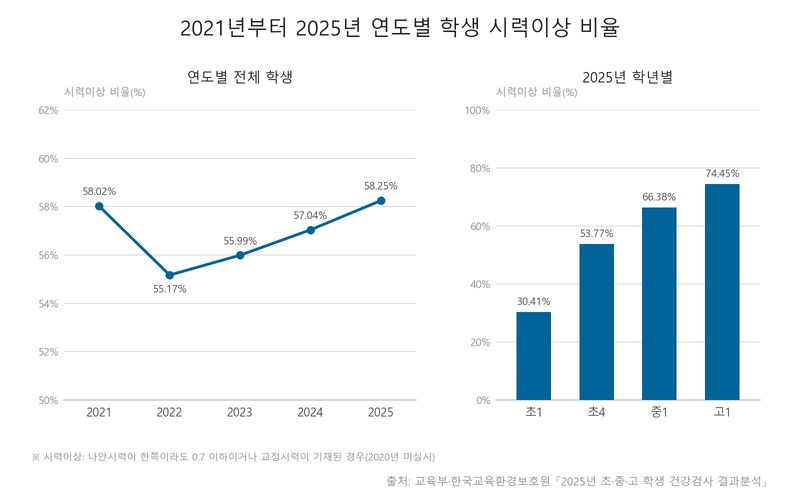
Last year’s student health examinations found that 58.25% of all students had vision problems. That was similar to the 58.02% recorded in 2021, but after falling to 55.17% in 2022, the rate rose for three consecutive years to its highest level in the past five years. The rate increased with each grade level: 30.41% among first-graders and 53.77% among fourth-graders in elementary school, 66.38% among first-year middle school students, and 74.45% among first-year high school students.
This is closely related to the increase in myopia among children and adolescents. Myopia is rising rapidly among children and adolescents in East Asia, including South Korea, underscoring the need to monitor changes in vision throughout childhood and adolescence.
Vision problems are not the only concern. Over the same period, the number of patients aged 0 to 19 treated for dry eye also increased by 13.9%. Changes in lifestyle, including excessive close-up work and increased smartphone use, may have contributed to the rise in dry eye during childhood and adolescence, when the condition was once uncommon.
People in their 20s and 30s: Don’t overlook the health of the ‘inside of the eye’
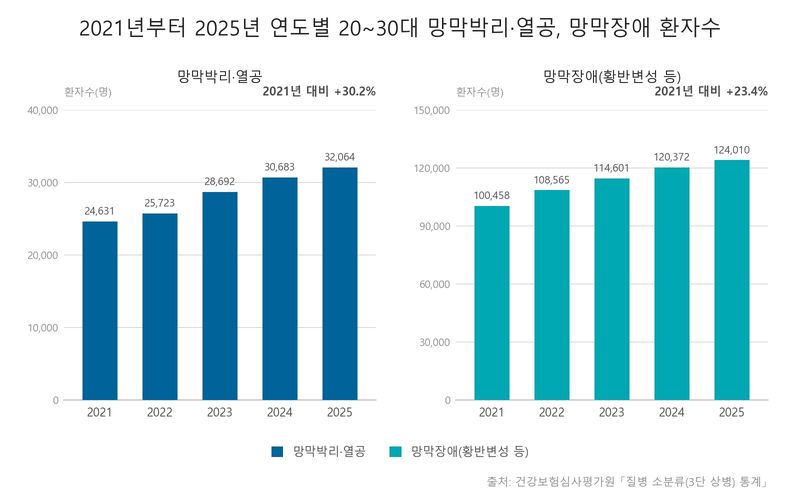
People in their 20s are less likely than other age groups to be treated for the major eye conditions covered in this analysis, and often have little reason to see an ophthalmologist if they have no discomfort. Yet the number of patients in their 20s and 30s treated for retinal detachment and retinal tears rose by 30.2%, while the number treated for retinal disorders, including macular degeneration, increased by 23.4%.
Because the retina is at the back of the eye, it is difficult to assess its condition from the outside, and some conditions may cause no noticeable discomfort in their early stages. Retinal detachment and retinal tears in particular can lead to permanent vision loss if not treated in time. Even young people should see an ophthalmologist if they develop unusual symptoms, such as a sudden worsening of floaters. Those with high myopia should also have their retinas checked regularly.
People in their 40s and 50s: Retinal and optic nerve diseases rise sharply
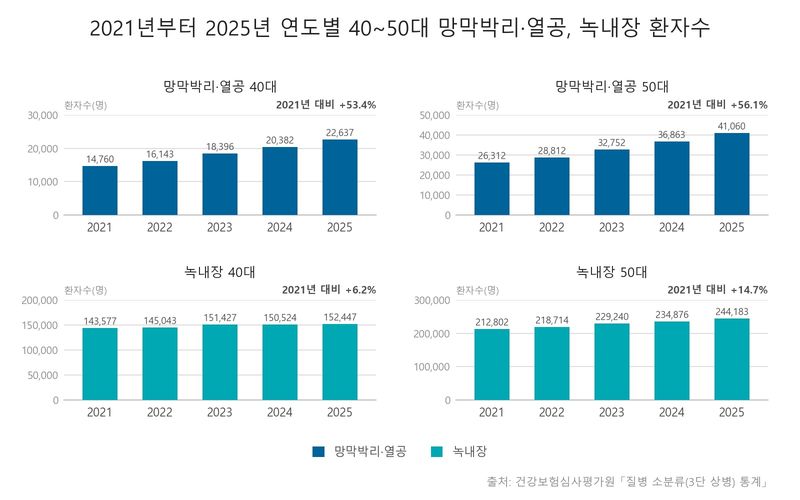
People in their 40s and 50s begin to notice changes in their vision, such as difficulty seeing nearby text, while the number of patients treated for retinal and optic nerve diseases also starts to rise sharply. The increase in patients treated for retinal detachment and tears was higher among people in their 40s and 50s—53.4% and 56.1%, respectively—than among those in their 20s and 30s. The number of patients treated for glaucoma fell among people in their 20s, but began rising again from their 30s onward, increasing by 14.7% among those in their 50s.
From this stage of life, eye health should be managed with a focus on preserving visual function over the long term, not just on ‘seeing well.’ It is important to monitor the condition of the retina and optic nerve as well as changes that are easier to notice, such as presbyopia. As with regular health checkups, it is a good idea to have your eyes checked regularly even if you have no particular symptoms.
People aged 60 and over accounted for 84% of the increase in macular degeneration
For older people, eye health is directly linked to independence in daily life and quality of life. The number of patients treated for macular degeneration rose by 69.5%, from 367,000 in 2021 to 623,000 last year, with people aged 60 and over accounting for 84% of the increase. The number of patients treated for glaucoma and diabetic retinopathy also rose over the same period.
These conditions often cause no noticeable symptoms in their early stages, so regular eye examinations are necessary even for people with good vision and no discomfort.
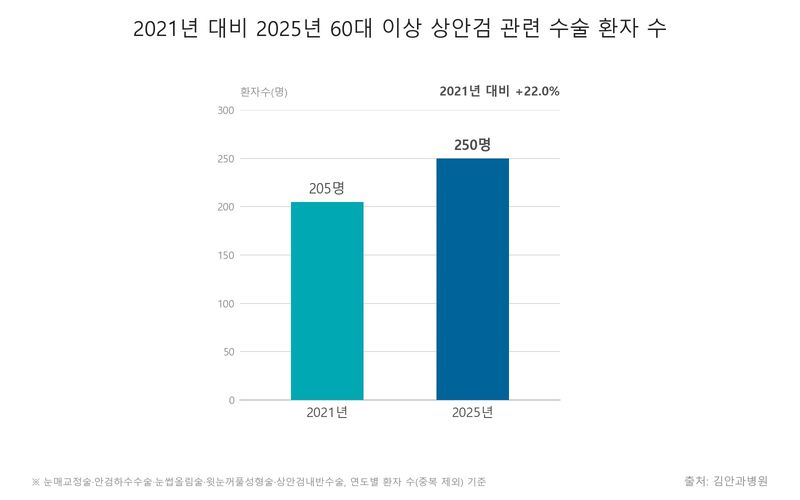
It is also important to address everyday problems, including those related to eyelid function. According to Kim’s Eye Hospital’s own data, the number of patients aged 60 and over who underwent upper-eyelid-related procedures—including eye-shape correction, ptosis surgery, brow lifts, upper blepharoplasty and surgery for upper eyelid entropion—increased by about 22.0%, from 205 in 2021 to 250 last year. The hospital said the figure indicates that eye care for older people is expanding beyond vision to include eyelid function and relief from everyday discomfort, rather than simply reflecting increases or decreases in any particular disease.
Cho Han-ju, vice president of clinical affairs at Kim’s Eye Hospital, said, “It is important to look at changes in eye health over time, rather than focusing only on its condition at a single point. The eyes continue to change throughout life, from vision changes during childhood and adolescence to retinal health in younger adults and the rise in retinal and optic nerve diseases after middle age. That is why regular checkups, even when there is no particular discomfort, are important for maintaining healthy visual function over the long term.”
[email protected] Jung Myung-jin, Medical Correspondent Reporter