Jeju sites with soil-moisture deficits fall from 21 to 11; two in Seongsan still ‘very deficient’
- Input
- 2026-10-10 08:05:05
- Updated
- 2026-10-10 08:05:05
【Financial News, Jeju—Reporter Jeong Yong-bok】 The number of monitoring sites in Jeju with soil-moisture deficits has fallen from 21 last August to 11. However, five of the seven monitoring sites in eastern Jeju, one of the country’s major winter-vegetable growing areas, still showed moisture deficits, while two sites in Seongsan-eup, Seogwipo, were at the most severe ‘very deficient’ level.
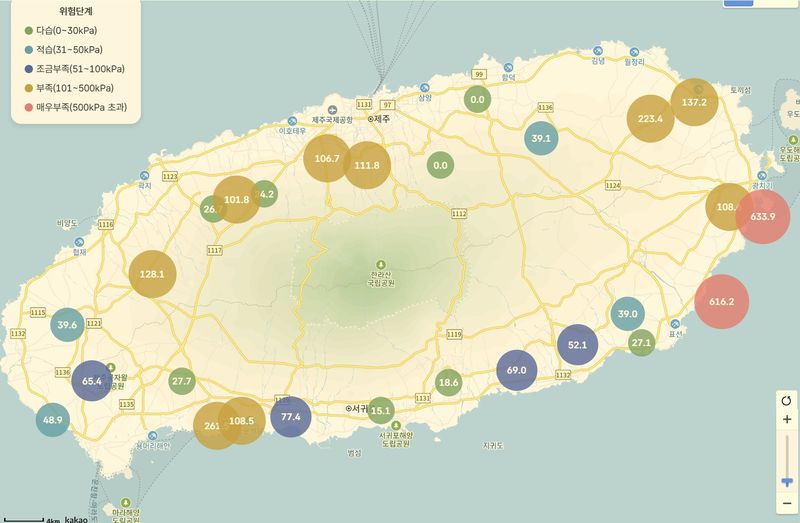
According to drought information from the Jeju Agricultural Digital Integrated Information Service (JejuDA) run by the Jeju Special Self-Governing Province Agricultural Research and Extension Services, 11 of the 27 monitoring sites whose data were released on the morning of the 10th were classified as ‘deficient’ or worse in soil moisture. Nine were ‘deficient’ and two were ‘very deficient.’
On August 14, 21 of the 27 monitoring sites were classified as ‘deficient’ or worse. Their share of all monitoring sites fell by 37.1 percentage points, from 77.8% to 40.7%. The number of sites classified as ‘very deficient,’ which had stood at seven, also declined to two.
The most severe signs of moisture deficits in this monitoring round were concentrated in eastern Jeju. Soil-water tension measured 637.8 kPa in Goseong-ri, Seongsan-eup, Seogwipo, and 618.7 kPa in Samdal-ri. Both sites fall into the highest-risk category designated by the Agricultural Research and Extension Services: ‘very deficient.’
Haengwon-ri in Gujwa-eup, Jeju City, was also classified as ‘deficient,’ at 222.2 kPa, while Handong-ri and Susan-ri recorded 134.0 kPa and 107.8 kPa, respectively. This means soil-moisture deficits were detected at five of the seven monitoring sites in eastern Jeju.
By contrast, even in the nearby eastern area, Gasi-ri was ‘adequately moist’ at 39.1 kPa, while Sehwa-ri in Pyoseon-myeon was ‘wet’ at 26.8 kPa. Soil-moisture conditions varied considerably even between nearby areas.
Dry sites also remain in other parts of the island. Gamsan-ri and Sangdae-ri in the west; Ora 2-dong, Nohyeong-dong and Sineom-ri in the north; and Sangye-dong in the south were classified as ‘deficient.’
Soil-water tension is a measure of the force with which soil holds onto water. The higher the reading, the harder it is for crop roots to absorb moisture from the soil. The Agricultural Research and Extension Services classifies soil-water tension of 0–30 kPa as ‘wet,’ 31–50 kPa as ‘adequately moist,’ 51–100 kPa as ‘slightly deficient,’ 101–500 kPa as ‘deficient,’ and over 500 kPa as ‘very deficient.’
Changes in soil moisture in eastern Jeju are drawing attention because the area is closely tied to the country’s major winter-vegetable production base.
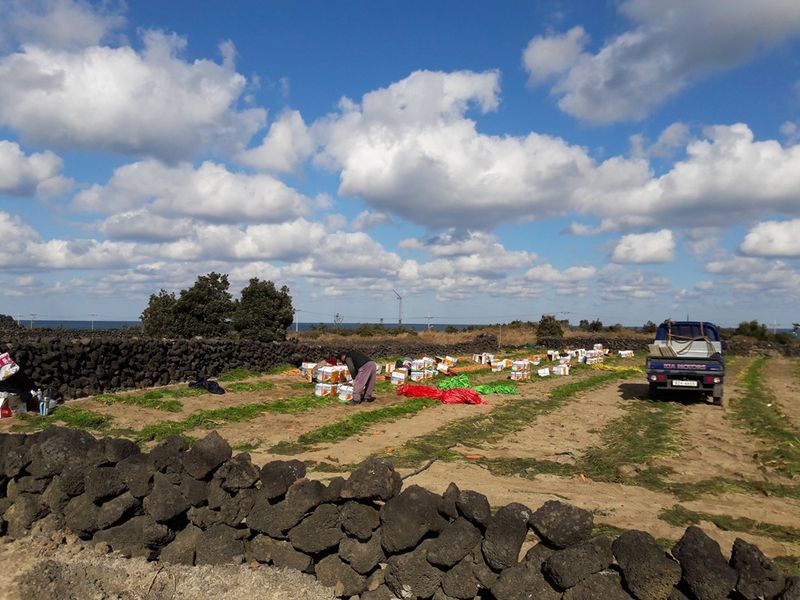
Gujwa-eup in Jeju City and Seongsan-eup in Seogwipo are major domestic growing areas for winter carrots. Winter vegetables such as winter radishes, cabbage and broccoli are also cultivated on a large scale in Jeju.
Production estimates for the 2025–2026 crop year released by the Agricultural Research and Extension Services last June put winter radish production at 396,800 tonnes and carrot production at 60,670 tonnes. That is why moisture conditions on Jeju’s farmland are an important agricultural concern.
Drought and extreme heat caused actual agricultural damage in Jeju this summer. The area of deodeok crops estimated to have been damaged, as assessed by the Jeju provincial government on August 13, was 130 hectares, or 41.4% of the island’s total cultivated area of 314 hectares. Failed germination, crop death and poor growth were reported mainly in Gujwa-eup, Seongsan-eup and Pyoseon-myeon.
At the time, Jeju secured 1.457 billion won in special grants for disaster and safety management and decided to allocate 816 million won of that amount to drought response. Key measures include repairing and upgrading agricultural irrigation facilities, installing pipelines, renting water trucks, and expanding water-supply equipment such as large-capacity water bladders and pumps.
The Agricultural Research and Extension Services also expanded its monitoring network to assess moisture conditions more precisely by area. In July, it added soil-water tension sensors to automatic weather observation equipment at 39 existing sites and installed soil-moisture and tension measuring equipment at 35 additional farmland sites, establishing a monitoring system with 74 sites in total.
Attention is also focused on how much the rain forecast for Jeju from the weekend will ease moisture deficits on farmland. According to the Jeju Regional Meteorological Administration on the 10th, 5–50 mm of rain is expected across Jeju from this morning through the morning of the 12th. Occasional rain is also expected in some areas on the 11th, and on the 12th rain may continue through the morning in places, mainly east of Hallasan.
However, a maximum of 50 mm does not mean that the same amount of rain will fall across all of Jeju. Rainfall is expected to vary by area, and the amount of moisture that remains in the soil after the rain will also depend on soil characteristics.
When announcing the expansion of its soil-moisture monitoring network last July, the Agricultural Research and Extension Services said that rainfall data alone make it difficult to accurately assess actual water shortages on farmland.
Although the number of sites with soil-moisture deficits across Jeju has fallen in this monitoring round, severe signs of dryness persist in some major winter-vegetable growing areas. The key going forward will be the extent to which soil moisture recovers in eastern Jeju after the weekend rain and farmers’ actual irrigation needs.
[email protected] Jeong Yong-bok Reporter