If private financing falls through, switch to public funding; if a feasibility study hits a roadblock, change the route... Seoul seeks to revive stalled rail projects
- Input
- 2026-10-11 14:57:18
- Updated
- 2026-10-11 14:57:18
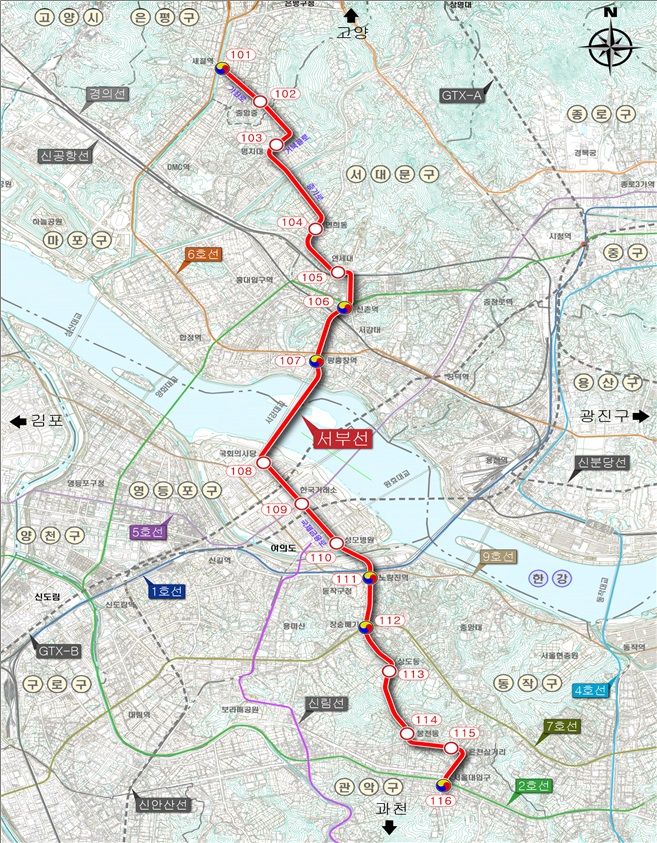
[Financial News] Urban rail projects in Seoul, which have languished for years, are gaining momentum again. For the Seobu Line, whose private investment project fell through, the city is pursuing both a new call for private bids and a possible shift to a publicly funded project (one financed with Seoul Metropolitan Government or central government funds). The Gangbuk Transversal Line and Mokdong Line, which failed to pass preliminary feasibility assessments, are also being revised to improve their viability as they move through the government approval process.
According to the Seoul Metropolitan Government and district offices on the 11th, the city finalized the revocation of the preferred bidder status for the Seobu Line private investment project on July 20 and is preparing to issue a new call for bids to select an operator. It is also considering switching to public funding if it cannot secure an operator through the new bidding process.
Seobu Line: Shift to public funding under consideration
The Seobu Line project previously ran into difficulties after Doosan Engineering & Construction Consortium, the existing preferred bidder, failed to secure construction investors. The Seoul Metropolitan Government began the process of revoking the consortium’s preferred bidder status in April and is now preparing a new call for bids to find another private-sector operator. Meanwhile, the city plans to carry out related procedures in parallel, including a preliminary feasibility study for a shift to public funding.
The districts traversed by the Seobu Line are prioritizing swift progress over the way the project is funded. There is also a sense that a shift to public funding is needed in case the private investment project falls through again.
An official from one district said, “The districts want the project to move forward quickly, regardless of whether it is pursued as a private-sector project or funded by the Seoul Metropolitan Government,” adding, “I understand that (the Seoul Metropolitan Government) is also considering a shift to public funding.”
The districts are looking to the Wirye-Sinsa Line as an example. It, too, was initially pursued through private investment but switched to public funding after efforts to secure an operator failed. In February, the Ministry of Land, Infrastructure and Transport approved and announced a revision to the Urban Railway Network Construction Plan, officially confirming the shift to public funding about 18 years after the line was first proposed in 2008. The Seoul Metropolitan Government plans to draw on its experience of shortening administrative procedures during the Wirye-Sinsa Line’s transition to public funding to minimize delays to the Seobu Line project as well.
Gangbuk Transversal Line and Seonam Line Await Government Approval
The Gangbuk Transversal Line and Mokdong Line, which had failed to clear the preliminary feasibility assessment hurdle, have also revised their project plans and are making another attempt. The Seoul Metropolitan Government improved the economic viability of both routes and submitted the Third Urban Railway Network Construction Plan to the Ministry of Land, Infrastructure and Transport’s Metropolitan Transport Commission (MTC) in August.
The Gangbuk Transversal Line will run 25.79 km from Mokdong Station to Cheongnyangni Station. The Seoul Metropolitan Government has drawn up a plan to improve the project’s viability by reducing the number of stations by two from the original plan and incorporating 49 future development plans.
The Mokdong Line was expanded and reorganized as the “Seonam Line.” The main line will run from Magongnaru Station to Gasan Digital Complex station, while a branch line will run from the West Seoul Truck Terminal to Dangsan Station. The plan extends the northern and southern endpoints of the original route and incorporates additional travel demand resulting from the Mokdong redevelopment.
The two lines failed to pass preliminary feasibility assessments in 2024, but were included in the Third Urban Railway Network Construction Plan after their project plans were revised. The plan includes six lines: the Gangbuk Transversal Line, Seonam Line, Nangok Line, Seobu Line, Seobu Line southern extension, and Sillim Line northern extension. They span a total of 68.5 km, with a project cost of 9.1996 trillion won.
A Seoul Metropolitan Government official said, “We improved the economic viability of the Seonam Line and Gangbuk Transversal Line and submitted them to the MTC for review in August. We are now waiting for the results,” adding, “If the government approves the plan, we intend to begin the follow-up procedures for each route, including preliminary feasibility assessments.”
The Seoul Metropolitan Government hopes the Third Urban Railway Network Construction Plan will be approved by the end of the year. At a parliamentary audit held on the 7th by the National Assembly’s Land, Infrastructure and Transport Committee, Kim Yong-seok, chair of the MTC, also responded to a request for approval within the year, saying, “I will make every effort.”
[email protected] Seong Chorong Reporter