'3 Billion Won Project Coercion Allegations': Former Jeonbuk Provincial Council Member Park Yong-geun Also Loses Appeal at Second Instance in Bid to Overturn Party Expulsion
- Input
- 2026-10-09 23:16:00
- Updated
- 2026-10-09 23:16:00
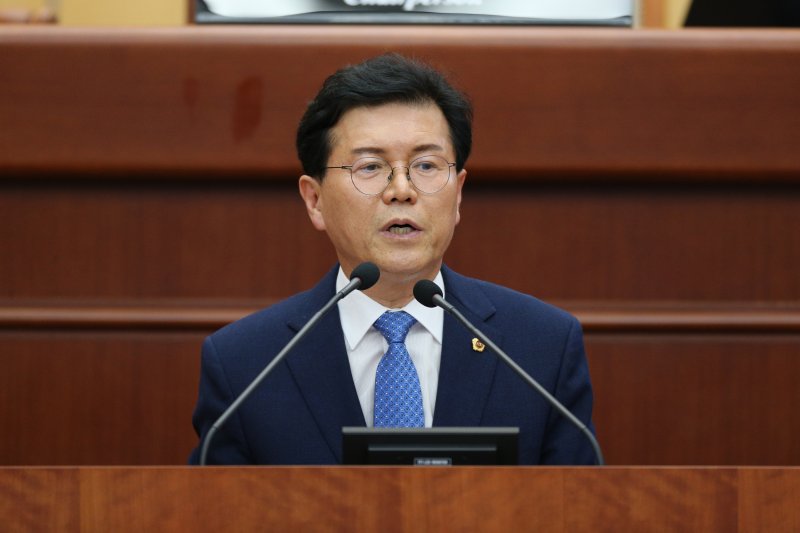
[Financial News] Former Jeonbuk Provincial Council member Park Yong-geun, who was expelled from his party over allegations that he pressured public officials to adopt a project worth around 3 billion won, has also lost his appeal challenging the disciplinary action.
Legal sources said on the 9th that the Seoul High Court’s Civil Division 27-3 (Presiding Judges Lee Yong-ho, Park Sun-young and Jeong Chong-ryeong) ruled last month against Park, as in the first trial, in his suit against the Democratic Party of Korea seeking to have the disciplinary resolution declared invalid.
Park was previously accused of calling provincial government officials to his office and, in front of people involved in the project, pressuring them by saying that if they did not adopt an electricity-saving system (FECO) costing around 3 billion won, he would demand that they submit documents and cut the budget. In response, the Democratic Party’s Jeonbuk Provincial Party Ethics Tribunal voted to expel Park in April last year. After the party’s central organization also rejected his request for reconsideration, Park filed suit in court.
During the trial, Park argued that his actions were legitimate legislative activities aimed at saving budget funds and resolving public grievances. He also argued that expulsion was excessively harsh compared with other grounds for disciplinary action, such as drunk driving or assault, and cited the police decision not to refer him to prosecutors on the attempted-coercion charge as grounds for invalidating the disciplinary action.
However, both the first- and second-instance courts rejected Park’s arguments. Based in part on the consistency of statements by public officials who were present at the time, the courts found that Park had exerted pressure by wielding the threat of budget cuts and demands for document submissions.
The appeals court said, “The other disciplinary cases cited by the plaintiff involved no more than personal misconduct, whereas the plaintiff’s misconduct involved using public powers granted to local councils, including the authority to deliberate on budgets and conduct administrative audits, in an attempt to intervene in vested interests.” It noted that the nature and seriousness of the misconduct were clearly different.
Regarding the police decision not to refer the attempted-coercion charge to prosecutors, the court dismissed the argument, saying, “Given the nature of criminal cases, the police may decide not to refer a case when there is no direct evidence, even if circumstances supporting the allegation exist.” It added, “An acquittal or a decision not to refer a case in criminal proceedings does not mean that the grounds for disciplinary action in a civil suit are also invalid.”
[email protected] Park Ji-hyun Reporter