Hangul Day’s 580th Anniversary and Kagyanal’s Centenary... Jeju to Pursue AI Translation of Endangered Jeju Language
- Input
- 2026-10-09 11:28:06
- Updated
- 2026-10-09 11:28:06

【Financial News, Jeju—Reporter Jeong Yong-bok】 Policies to protect the Jeju language, which is at risk of disappearing, are being expanded in Jeju as the island marks the 580th anniversary of the promulgation of Hunminjeongeum and 100 years since “Kagyanal,” the starting point of Hangul Day, was established. Jeju Province plans to build a comprehensive Jeju language dictionary with more than 40,000 headwords and introduce AI-powered search, translation and speech recognition services, broadening opportunities for people to learn and use the language in daily life.
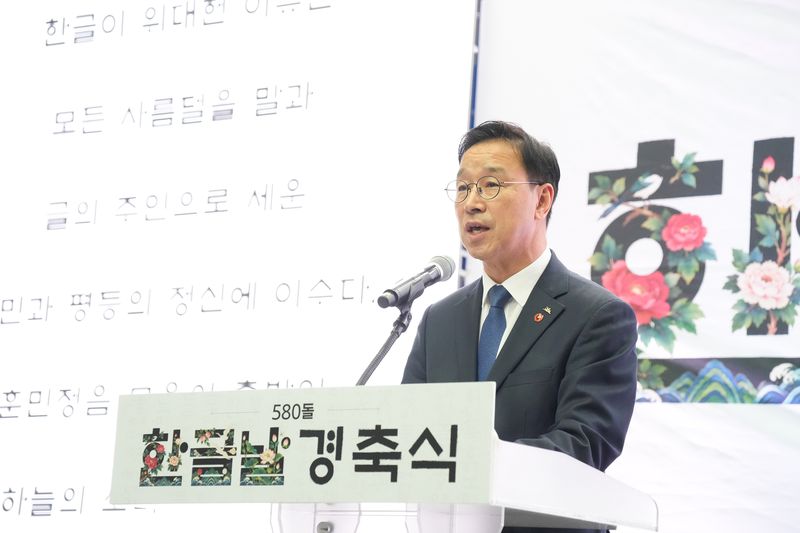
According to Jeju Special Self-Governing Province on the 9th, the province held the “580th Hangul Day Celebration” that day at Tamna Hall at the provincial office, attended by around 200 people, including Governor Wi Seong-gon, Jeju Provincial Council Chair Song Young-houn, Jeju Superintendent of Education Ko Ui-suk, Jeju Studies Research Center Director Kim Wan-byeong, and representatives of organizations related to Hangul and the Jeju language.
This year’s ceremony is significant because it coincides with the 580th anniversary of the promulgation of Hunminjeongeum in 1446 and the centenary of the establishment of “Kagyanal” in 1926.
Kagyanal was the anniversary of the promulgation of Hunminjeongeum, first designated in 1926 by the Korean Language Research Society to protect the Korean language and writing during Japanese colonial rule. Its name came from “ga-gya-geo-gyeo,” the sequence used to teach Hangul at the time, and it was renamed Hangul Day in 1928.
Along with this historical significance, how to protect the Jeju language, which is at risk of disappearing, was presented as an important challenge for the island.
In 2010, UNESCO classified the Jeju language as “Critically Endangered.” The designation warns that if a language is not adequately passed down between generations, the number of people who use it will decline and it may eventually disappear.
In his commemorative address, Governor Wi Seong-gon emphasized the historical and cultural value embodied in the Jeju language, saying, “Arae-a, the sound of heaven and the starting point of the vowels in Hunminjeongeum, is still alive in the Jeju language today.”
Arae-a is an archaic Korean vowel that is no longer used in modern standard Korean but remains in some Jeju language vocabulary. The Jeju language retains distinctive pronunciations and vocabulary of this kind, making it valuable linguistic material for examining the history and diversity of the Korean language.
He stressed, “A language cannot be protected through dictionaries and records alone; it can survive only if we learn it, speak it and use it gladly.”
Jeju Province is pursuing policies to expand both the documentation and everyday use of the Jeju language.
The province plans to develop Jejueowat, a Jeju language web dictionary currently in pilot operation, into a comprehensive dictionary with at least 40,000 headwords, and to roll out AI-powered Jeju language search, translation and speech recognition services by the end of this year.
Jejueowat is an online dictionary where users can look up the meanings of Jeju language words and enter old Hangul, including arae-a.
The province also operates Peuda, a Jeju language education platform. It provides online learning materials, regional Jeju language vocabulary and oral history materials, among other resources, and supports participation in Jeju language education.
The province plans to document older people’s oral accounts, work songs and haenyeo culture in the Jeju language, and to support the production of cultural content in which younger generations sing and tell stories in the language.
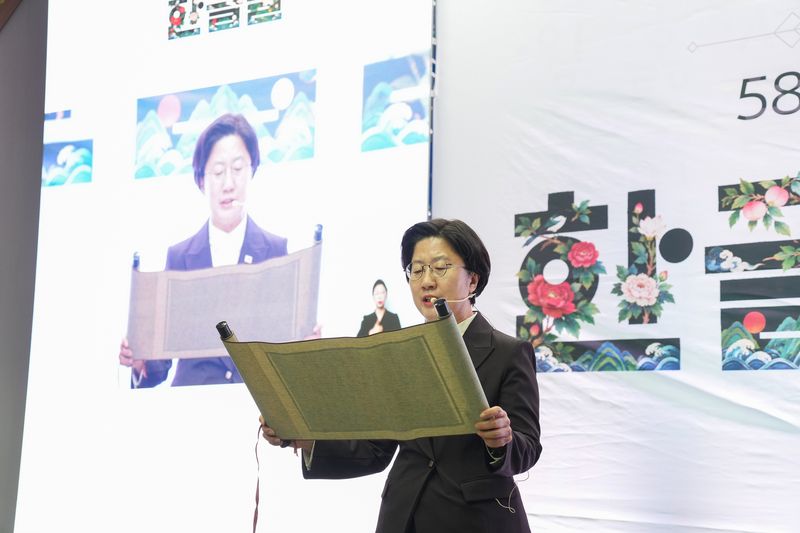
This ceremony, too, was held using the Jeju language alongside standard Korean. Under the slogan “Etching anew in Jeju the spirit behind the creation of Hunminjeongeum,” the program included a reading of its preface, awards for contributors, celebratory performances, a rendition of the Hangul Day song and three cheers.

Jeong Yesil, chair of the incorporated Jeju Language Preservation Society, and Choi Myeong-ja, vice chair of the incorporated Hangul Calligraphy Lovers’ Association, received commendations from the governor of Jeju Province for their contributions to preserving Hangul and the Jeju language.
At the 25th Hangul Calligraphy Love Competition, Park Bok-hui received the Hangul Excellence Award, while Kim Gyeong-don, owner of the restaurant “Byeoti Deuneun Got Baetdi” in Yeon-dong, Jeju City, received the Beautiful Jeju Language Signboard Award. The Gaonnuri Choir, which promotes the Jeju language through song, took part in the celebratory performance.
The challenge for Jeju language preservation policy is to turn the expansion of dictionaries and AI technology into actual use. This means making the language easy to find and learn in digital settings while continually broadening opportunities to speak and write it at schools, at home and in local communities.
Governor Wi said, “We will ensure that the Jeju language does not remain a legacy of the past, but continues as both a language of everyday life today and an asset for future generations.”
[email protected] Jeong Yong-bok Reporter