“Pay 7 million won a month,” says landlord—“everything’s gone up”: renters reel amid an unprecedented rental market [Real Estate A to Z]
- Input
- 2026-10-10 14:00:00
- Updated
- 2026-10-10 14:00:00
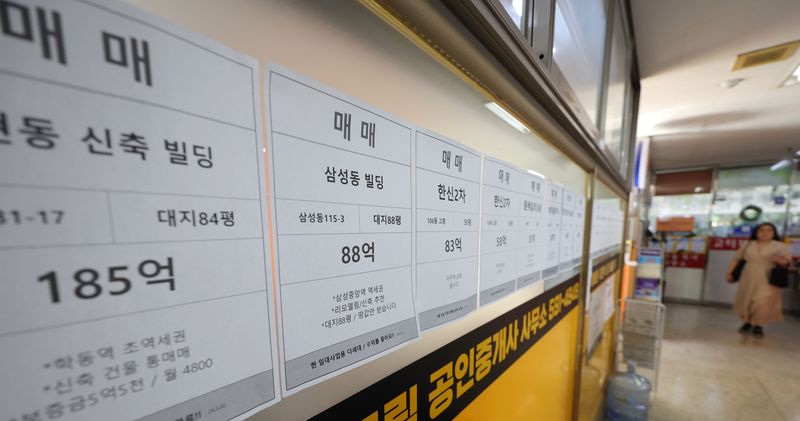
[Financial News] According to statistics from the Ministry of Land, Infrastructure and Transport, monthly rentals accounted for 52.1% of apartment leases in the Seoul metropolitan area from January through August this year. On a monthly basis, monthly-rental transactions for Seoul apartments have outnumbered jeonse leases since March. A decline in jeonse listings and a rapid shift to monthly rentals are driving up both jeonse and monthly rents. Their rates of increase are similar.
Nowon: 10.2%, Dongtan: 9.8% ... Monthly rents surge
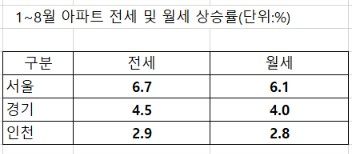
Our analysis of changes in apartment rental indices across the Seoul metropolitan area from January through August this year, using monthly statistics from the Korea Real Estate Board, found that jeonse and monthly rents rose in the 6% range in Seoul, the 4% range in Gyeonggi, and the 2% range in Incheon.
By region, apartment jeonse prices in Seoul rose 6.7% from January through August this year. Monthly rents also increased by 6.1% over the period, barely different from jeonse. The pattern was similar elsewhere: in Gyeonggi, jeonse rose 4.5% and monthly rents 4.0%; in Incheon, the respective increases were 2.9% and 2.8%. “The rule of thumb used to be that when jeonse prices jumped, monthly rents stabilized, if you looked only at the two rental markets,” one source said. “But an entirely different pattern has emerged this year.”
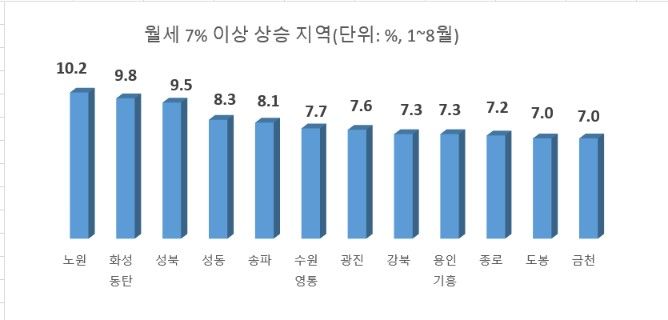
Looking at monthly rent increases by area from January through August, the biggest rises were in Seoul’s outlying districts and in Gyeonggi areas close to workplaces. Nowon District recorded the largest increase in apartment monthly rents in the metropolitan area, at 10.2%. Jeonse prices there also rose 10.3%, putting increases in both markets above 10%. In March, Nowon District also saw a record-high monthly rent of 7 million won. The previous peak was 4 million won in 2021, when rental prices soared.
Second was Dongtan District in Hwaseong, Gyeonggi, where monthly rents rose 9.8%. In Gyeonggi, other areas near semiconductor hubs with convenient commutes, including Yeongtong in Suwon (7.7%) and Giheung in Yongin (7.3%), also ranked among those with the highest increases.
In Seoul, monthly rents rose sharply mainly in northern and outlying districts, including Seongbuk, Gangbuk, Jongno, Dobong, and Geumcheon. In Gireum-dong, Seongbuk District, an 84-square-meter apartment was leased for 3.7 million won a month in May. This was the highest monthly rent in the district for a standard 84-square-meter unit.
“Regulations on the home-sales market fuel instability in the jeonse and monthly-rental markets”
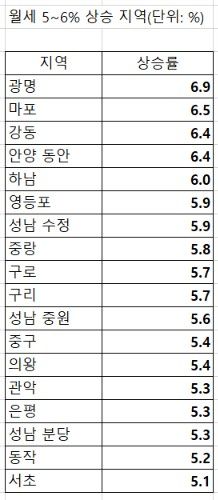
There were also many areas where monthly rents rose by 5–6%. Eighteen areas were in this range, including Gwangmyeong, Gyeonggi (6.9%), and Mapo District (6.5%). Only two areas in the Seoul metropolitan region saw monthly rents fall from January through August this year: Icheon (-0.9%) and Gwacheon (-0.9%).
As of August this year, the average monthly rent for an apartment in Seoul was 1.64 million won. Of Seoul’s 25 districts, Jungnang-gu was the only one where the average monthly rent in August was no more than 1 million won, at 969,000 won. Even Nowon and Dobong, once among the more affordable districts, have had average monthly rents above 1 million won since June. The average apartment monthly rent across the Seoul metropolitan area, including Gyeonggi and Incheon, also hit a record 1.297 million won in August this year, nearing 1.3 million won.
Chang-Moo Lee, a professor at Hanyang University, said, “Owner-occupied and rental housing coexist in South Korea, so the home-sales market and the jeonse and monthly-rental markets are closely intertwined. Any intervention in the home-sales market is bound to affect the rental markets as well.”
[email protected] Lee Jong-bae Reporter