South Korea demands apology at UN over 'DMZ landmine incident'... North Korea calls it an 'unscrupulous disruptive act'
- Input
- 2026-10-09 08:34:19
- Updated
- 2026-10-09 08:34:19
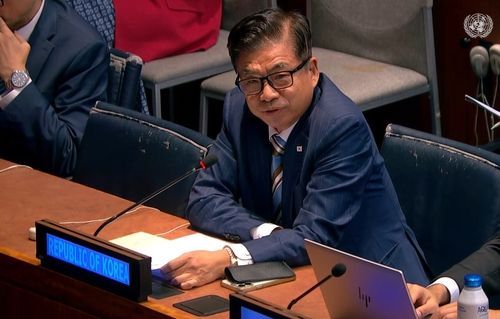
In a speech at the general debate of the First Committee of the 81st UN General Assembly (Disarmament and International Security) at United Nations Headquarters in New York that day, South Korea's ambassador to the UN, Cha Ji-hun, said, "Three (of our) soldiers were injured in a landmine explosion in the DMZ on September 21." He added, "The results of a joint investigation supported by our military and the UN Command and subjected to forensic analysis confirmed that the explosion was caused by mines deliberately planted by North Korean troops south of the Military Demarcation Line (MDL)." He said, "This is a clear violation of the Korean Armistice Agreement."
Ambassador Cha said, "We urge North Korea to stop these acts that heighten tensions and call on it to issue a public apology and take responsible measures," and called for it to engage in dialogue to ease tensions on the Korean Peninsula and restore trust.
North Korea then took the floor under its right of reply and sought to evade responsibility for the DMZ landmine incident.
A North Korean representative claimed, "The so-called 'landmine explosion incident' cited by South Korea is an unscrupulous act of obstruction aimed at portraying fortification measures in the South's border area—a legitimate exercise of sovereignty—as military aggression." The representative also said South Korea's claim was nothing more than the military's "poor trick" to shift responsibility onto North Korea.
The representative then invoked the name of Unification Minister Chung Dong-young, claiming, "A South Korean official also remarked that it would be difficult to judge the landmine explosion as a deliberate attack by North Korea." The previous day, Minister Chung had said during the National Assembly Foreign Affairs and Unification Committee's audit of the Ministry of Unification that the North Korean landmine explosion "cannot yet be identified as an attack."
South Korea then exercised its right of reply again and rebutted North Korea's claims. North Korea responded in turn, and the back-and-forth continued.
An Ji-in, a counsellor at South Korea's Permanent Mission to the UN, cited the findings of the joint investigation by the South Korean military and the UN Command, along with the forensic analysis, and stressed that they had clearly established that the explosion was caused by a landmine deliberately planted by North Korea.
North Korea took the floor again, designated South Korea an enemy state and said it would not discuss with Seoul matters concerning the exercise of military sovereignty on its territory. It also maintained a hard-line stance, saying, "We will defend our territorial sovereignty through the full exercise of force, not through negotiations."
In his speech that day, Ambassador Cha also criticized North Korea's nuclear and missile development and military cooperation between North Korea and Russia. He said North Korea's nuclear weapons and ballistic missile programs pose a grave threat not only to peace and security on the Korean Peninsula and in the international community, but also to the global nonproliferation regime. He called for an immediate end to military cooperation between North Korea and Russia, which violates multiple UN Security Council resolutions.
[email protected] Kim Hyeong-gu Reporter