“Osteoporosis Could Develop Before Age 80”: Hwang Shin-hye Reveals Bone Density Test Results [Health Talk]
- Input
- 2026-10-09 06:20:00
- Updated
- 2026-10-09 06:20:00
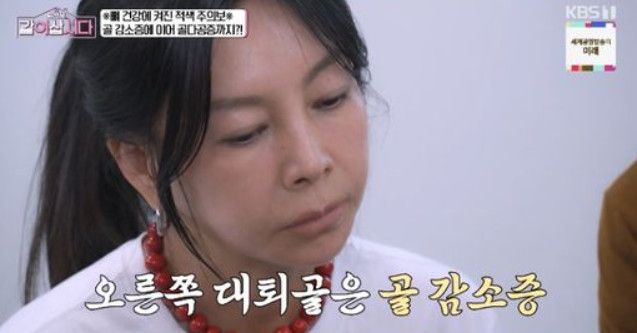
[Financial News] Actress Hwang Shin-hye received a bone density test score close to the diagnostic threshold for osteoporosis. Osteoporosis often progresses without noticeable symptoms, and women can lose bone mass rapidly after menopause, making regular bone density tests and fracture-risk management important.
A broadcast of KBS 1TV’s “Let’s Live Together with Hwang Shin-hye” on the 7th showed Hwang Shin-hye, Yang Jeong-a and Shin Gye-suk undergoing health checkups.
Ahead of her bone density test, Hwang Shin-hye expressed concern, saying, “My bone density is low.” The results showed that the T-score at the third site in her spine had fallen to -2.4.
The doctor in charge said, “Didn’t they say osteoporosis is diagnosed at -2.5 or below? You’re right on the verge of it, so you need to be careful.” Osteopenia was also detected in her right femur, and the doctor said that, based on the current trend, “osteoporosis could develop before age 80.”
T-score of -2.4, just 0.1 away from osteoporosis
A bone density test measures how strong the bones are. For postmenopausal women and men aged 50 and older, the T-score— which compares bone density with the average for young adults—is commonly used.
According to the Korea Disease Control and Prevention Agency’s National Health Information Portal, a T-score of -1.0 or higher is classified as normal; a score below -1.0 but above -2.5 as osteopenia; and a score of -2.5 or lower as osteoporosis. Hwang Shin-hye’s reported score of -2.4 falls in the osteopenia range but is close to the osteoporosis threshold of -2.5.
Osteopenia is a condition in which reduced bone mass weakens the bones, but it often causes no noticeable symptoms. The Korea Disease Control and Prevention Agency says that without management, it can progress to osteoporosis or lead to fractures even from minor impacts.
Osteoporosis, too, often causes no noticeable symptoms until a fracture occurs. Seoul National University Hospital defines osteoporosis as a condition in which bone quantity and quality decline, increasing the likelihood of fractures, and says fractures commonly occur in the wrists, spine and hips.
Bone density may decline faster after menopause
The importance of bone density management for women in their 60s, such as Hwang Shin-hye, is related to the loss of bone mass after menopause.
The Korean Society for Bone and Mineral Research says that in women, the risk of osteoporosis increases as the secretion of female hormones declines after menopause. According to the society’s data, among every 10 women aged 50 and older in South Korea, about three have osteoporosis and five have osteopenia.
The Korea Disease Control and Prevention Agency also says that bone mass increases through a person’s 30s and gradually declines from age 50 onward. In particular, bones can weaken rapidly after menopause due to declining estrogen levels.
Access to bone density testing for women has also expanded under the national health screening program. According to the Korean Society for Bone and Mineral Research, starting in 2025, osteoporosis screening under the program will be offered to women at ages 54, 60 and 66, with age 60 added to the previous ages of 54 and 66.
Calcium, vitamin D and weight-bearing exercise are important
Not everyone diagnosed with osteopenia receives medication. The Korea Disease Control and Prevention Agency says that at the osteopenia stage, the basics are regular testing, nutritional management, physical activity, and calcium and vitamin D intake; medication may be considered when fracture risk is high.
Exercise is also necessary. Seoul National University Hospital says weight-bearing exercise such as walking, jogging and hiking helps maintain bone health. Lifestyle measures to prevent osteoporosis also include avoiding smoking and reducing excessive alcohol consumption.
The Korean Society for Bone and Mineral Research also recommends that bone density testing and fracture-risk assessment be conducted together, since osteoporosis and osteopenia are common among postmenopausal women. Those with risk factors such as a history of fractures, a family history, low body weight or long-term steroid use should consult a medical professional about when to get tested and whether treatment is needed.
[email protected] Han Seung-gon Reporter