“Then why are there bald people?” Twenty years overcoming a cold shoulder... The history of hair transplantation in Honam, shaped by change [Interview with 100 Hair-Loss Experts]
- Input
- 2026-10-12 08:00:00
- Updated
- 2026-10-12 08:00:00
When things that should normally be there are absent, their absence brings loss. Hair loss—a source of deep and profound loss for us—has emerged as one of the defining issues of our time. To confront and overcome hair loss, we are meeting 100 hair-loss experts, beginning with a physician who was among the first generation of pioneers in hair-loss treatment. Look forward to the new stories that will unfold beyond the two words “hair loss.” [Editor’s note]
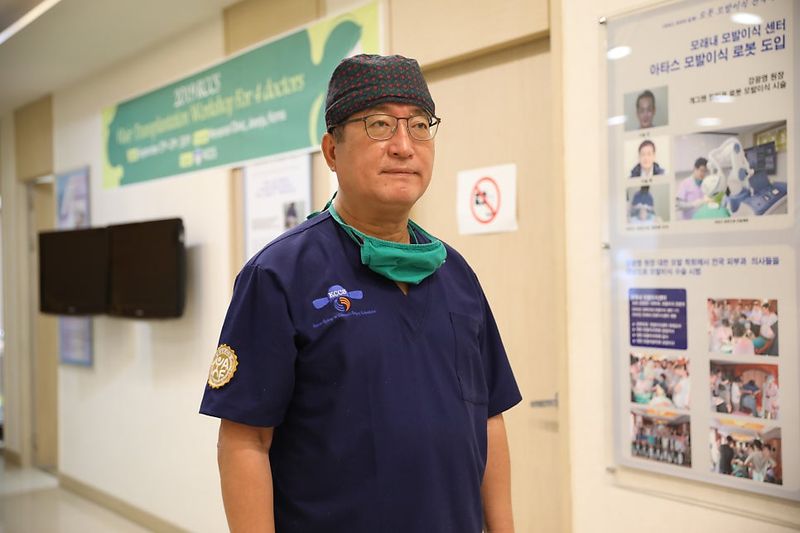
[Financial News] In the early 2000s, when the very concept of hair transplantation was still unfamiliar, Kang Gwang-yeong, director of Moraenae Hair Transplant Center, brought the procedure to the Honam region, where it was virtually uncharted territory. Driven by a determination to learn, he traveled more than 200 kilometers each week to develop his skills, and adapted faster than anyone when he encountered unfamiliar areas such as robotic FUE surgery and multi-implanters. Even now, more than 20 years after he began performing hair transplants, he continues to live a life of seeking change.

A year traveling from Jeonju to Daegu... Moments spent witnessing the history of hair transplantation
— You pioneered hair transplantation in the Honam region.▲ In 2000, after earning my dermatology specialist certification at Jeonbuk National University Hospital, I joined my family’s hospital, which had opened in Jeonju. Since it was a new beginning, I wanted to try something special. I asked my mentor for advice, and they recommended hair transplantation and connected me with Professor Kim Jeong-cheol through a professor at Kyungpook National University Hospital. Professor Kim was a pioneer of hair transplantation in Korea.— And so you spent more than a year traveling between Jeonju and Daegu.▲ While running my dermatology clinic, I visited the Hair Transplant Center at Kyungpook National University Hospital every weekend. Surgeries usually began at 9 a.m., so I had to set out at 4 or 5 in the morning to observe them. But it wasn’t hard. When I thought about what I could learn, even driving on the highway before dawn was fun.At the time, academic meetings, lectures and exchanges such as live surgery (a real-time surgical broadcast) were also taking place actively in Daegu, centered on Professor Kim and his students. I also enjoyed being able to take part in the history of hair transplantation as it was just beginning to unfold, both inside and outside the operating room.— Do you remember your first surgery?▲ It was May, when spring was in full bloom. I operated on a junior from medical school, and, fortunately, Professor Kim came all the way to Jeonju to supervise me. What I remember is that, even though I prepared as he had taught me and reviewed everything several times, I still noticed things that were lacking on the day of the surgery. Professor Kim also moved seamlessly from designing the procedure through harvesting and implantation, but when I tried doing it myself, I found it difficult. Still, the result was excellent. Two or three years later, my junior came back, saying they wanted another hair transplant. I performed the second transplant myself.— Did that surgery make you well known in the Honam region?▲ No. Hair transplantation was not yet a mainstream field anywhere in the world. Even in Korea, it was only somewhat known in Yeongnam, where the Hair Transplant Center at Kyungpook National University Hospital is located. In Jeonju, when I explained hair transplantation to patients, they would look me up and down and ask, “Then why are there bald people?”
So I took part in various activities, including publicity, lectures and television appearances. I devoted nearly 10 years to raising awareness of hair transplantation, and because patients were so few, I even operated on weekends if someone wanted the procedure. Awareness of hair transplantation grew very slowly, little by little.
A robot that performs surgery, tools that shorten operating time... Innovation brought into the operating room
— Since this field did not change rapidly, I imagine you had more opportunity to build up solid clinical experience.▲ That’s right. Doctors who began performing hair transplants in the early 2000s are often called the “first generation,” and they all tried many different approaches. I, too, started with strip surgery, but for patients who were afraid of it, I was among the second or third in Korea to introduce robotic FUE surgery. And while single implanters, which load one follicle onto each needle, were commonly used, I focused on adapting to change and improving my skills—for example, by using multi-implanters that can load several follicles at once.— Could you explain in more detail how robotic FUE surgery works?▲ When harvesting follicles, the robot is placed against the back of the head. It then determines the angle and depth of each follicle on its own and harvests it. It’s easiest to think of it as having artificial intelligence built in. AI is a hot topic now, but when we introduced the robot in 2015, it was groundbreaking. It was also very expensive.I learned a great deal about surgical techniques using that robot, and performed quite a lot of procedures with it. My case numbers were among a handful worldwide. But since the robot had been made in the West, it began to become clear that some aspects were not well suited to East Asian patients. Eventually, the day came when I was better than the robot (laughs). I hardly use it now.— I hear you still use a multi-implanter.▲ That’s right. An implanter is a device used to load harvested follicles onto a needle and insert them into the scalp. Usually, one follicle is loaded onto each needle. That means you have to replace the implanter 3,000 times to transplant 3,000 hairs. By contrast, a multi-implanter loads 10 follicles at a time. Each time you replace the implanter, you can transplant 10 follicles, which saves time and prevents the doctor’s attention from being disrupted during the replacement process.— Exactly how much time does it save?▲ With a single implanter, transplanting one follicle takes about two seconds. A multi-implanter takes less than 10 seconds to transplant 10 follicles. The time savings are even more noticeable in large hair transplants. For 5,000 hairs or more, a single implanter takes three to four hours, while a multi-implanter finishes the job in around an hour and a half.— It seems there’s no reason not to use a multi-implanter. But aren’t there more clinics that use single implanters?▲ There are different surgical methods that suit different people, aren’t there? When I first encountered the multi-implanter, I also found it more inconvenient. It was larger than a single implanter, and even holding it felt awkward. Professor Kim Mun-gyu, who developed the multi-implanter, kept upgrading it and helped me get used to it.
There are also varying opinions about implanters. I find it tiring to load follicles one by one into a single implanter, and to have a staff member stand throughout the operation to pass it to me. Others, however, say that loading follicles 10 at a time into a multi-implanter is more difficult and tiring, or that its bulk is inconvenient. Some doctors do not use an implanter at all. They prefer the “slit” method: making small incisions in the recipient area and inserting the harvested follicles into them. There are many different ways to perform surgery.
A happy ending begins with “change”
— From using a multi-implanter to robotic surgery, and even learning hair transplantation in the first place, you seem undaunted by challenges.▲ I was simply part of a process of change, and adapted to it. When hair transplantation was a new development, I met Professor Kim Jeong-cheol and learned as he taught me. When I was offered the chance to use a single implanter, I used one. The same goes for AI-powered robots and multi-implanters. You could say I was lucky. There were people who introduced me to new developments before I had the chance to encounter them myself.— It’s now been well over 20 years since you began performing hair transplants. Are you still embracing change?▲ Yes. One reason I try to attend the International Society of Hair Restoration Surgery’s annual meeting is to keep up with change. I’m curious about the biggest challenges facing hair transplantation today and how leading experts in different countries are addressing them. The more you learn about hair transplantation, the more fascinating it becomes—and the better you can get at it.— So is your goal going forward also to embrace change?▲ To add one more thing, I want to create change for my patients, too, and see how it unfolds. For a while, I held exercise meetups with patients who had undergone hair transplants. I wanted to follow their progress and hear their advice as well as their reviews.Patients who were told they looked younger after a hair transplant would say they left priority seats on public transportation open, even though they were old enough to sit in them. It was about more than looking young—they wanted to “live young.” After hair transplants, some gained the confidence to find jobs, while others went on to get married. I learned from my patients that hair transplantation is not merely cosmetic surgery, but a treatment that draws out inner confidence and brings vitality to life, with benefits that compound. I want to continue being there at the starting point of the changes my patients will experience.
[email protected] Kim Hyeon-seon Reporter