[Editorial] Samsung Electronics Co., Ltd. Sets an Astonishing Record, but Must Look to the Future, Not Become Complacent
- Input
- 2026-10-08 18:26:03
- Updated
- 2026-10-08 18:26:03
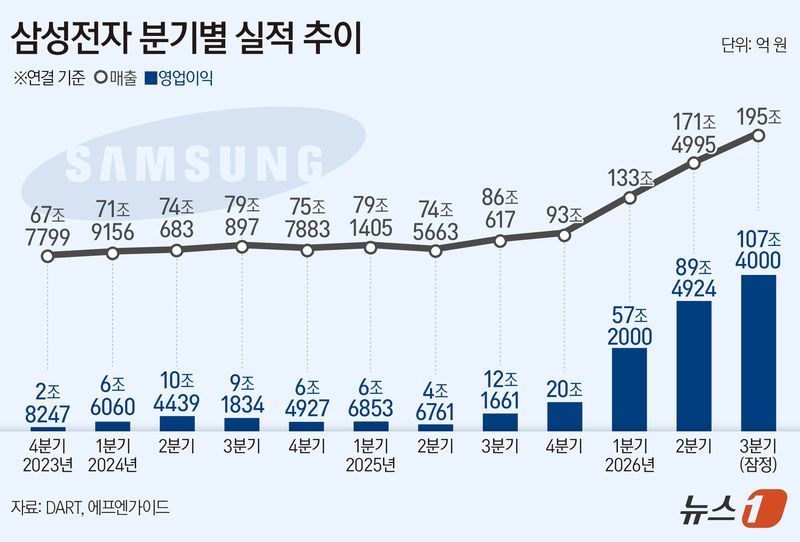
Revenue also rose 126.6% from the same period last year to 195 trillion won, while the operating margin reached as high as 55.1%. Revenue, operating profit and the operating margin are all astonishing records. Even if these results prove temporary, we cannot help but applaud a Korean company for reaching uncharted territory. The August current-account balance figure was also released that day: $46.11 billion. It was the second-largest on record, after July’s $49.73 billion. Semiconductor exports accounted for about half of it.
Samsung Group’s semiconductor business, launched with its acquisition of Korea Semiconductor in 1974, has already reached the top in the world in both technology and scale. The bold choices and investments of a single company are effectively driving Korea’s economy. Of course, the contributions of other semiconductor companies and their partner firms, including SK hynix, are no less significant than Samsung’s.
Given the economic circumstances in Japan and major European countries, where the semiconductor industry has little competitiveness, there is no shame in praising our companies for their outstanding judgment and decisions. Competitors such as Japan may well be kicking themselves for having missed out on the semiconductor industry.
There are issues to consider in light of Samsung Electronics Co., Ltd.’s historic record. First, the semiconductor industry’s technological capabilities must be further advanced to leave competing countries behind. Investment in research and development must rise in line with earnings to maintain a technological lead so wide that competitors cannot catch up. That will only be possible by investing a large share of profits and hiring talented people from around the world.
Next come generous government support and deregulation. The rapid development of artificial intelligence (AI) will continue to drive up demand for semiconductors. To keep pace with technological innovation and meet global demand, multiple factories must be built quickly. Semiconductor complexes are currently under construction in Yongin and the Honam region, but speed is the issue. The government is, I understand, fully aware of this, but it must pay attention to even the smallest details. If semiconductors are a sturdy pillar of our economy, it is only natural to pour policy support into the sector.
Securing the next growth engine to replace semiconductors is even more important. A new storage technology that replaces semiconductors may emerge someday. Governments and businesses alike must make unceasing efforts to discover and foster advanced technologies and industries beyond semiconductors. The industrial landscape decades from now will be different from today’s. There will be no point in regretting complacency then.
The anti-business sentiment and forces that hold companies back are also issues to consider now. The government, first of all, must maintain a business-friendly stance. Rogue companies should certainly be sanctioned, but, as we have seen, regulations and punitive measures targeting chaebol have in fact been excessive. We must first change the view that treats companies as agents of exploitation and regards them with hostility. Labor unions are among those forces. Companies must exist for unions to exist. Excessive demands for performance bonuses using strikes as a tool can also hinder business growth. Disputes must be minimized, and labor and management alike must make concessions and seek harmony. That is how unions can survive and the national economy can grow.