“The 42 trillion won era of venture funds, but private contributions are declining” ... LP share at 65% [fn Market Watch]
- Input
- 2026-10-08 20:35:22
- Updated
- 2026-10-08 20:35:22
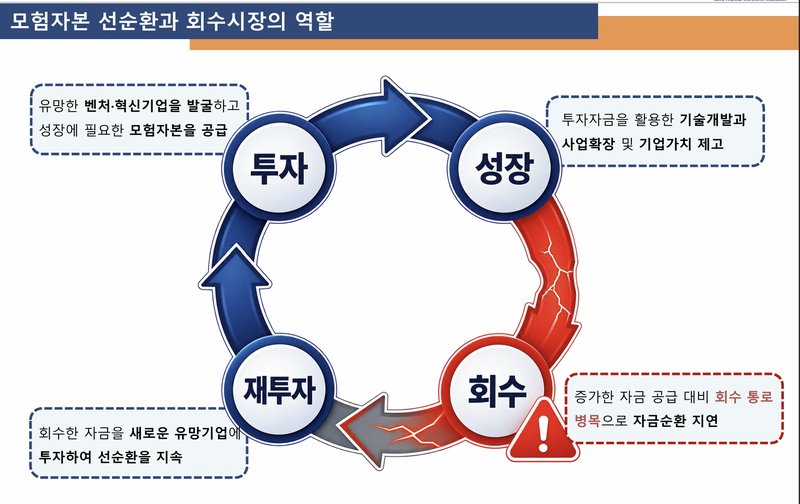
Kim Hee-jin, head of Industry Finance Team 3 at Korea Growth Investment Corporation, said at the “Policy Seminar on Revitalizing the Venture Exit Market with a Focus on the Securities Industry,” held at the Korea Financial Investment Association in Yeouido, Seoul, on the 8th, that the scale of new domestic VC and PEF fund formations had grown from 12.8 trillion won in 2015 to 42.1 trillion won last year. VC funds grew from 2.6 trillion won to 14.3 trillion won over the same period, while PEFs also grew from about 10 trillion won to nearly 30 trillion won.
The problem is that the exit market is growing more slowly than the supply of new capital. He noted, “Exits from domestic venture investments are concentrated in initial public offerings (IPOs) and off-market sales, but the IPO market is not keeping pace with the growth in new fund formations.” Given that VC and PEF funds typically have terms of 8–10 years, the burden of exiting funds raised on a large scale in the past could also grow in the years ahead.
As concerns about bottlenecks in the exit market grow, the share of private contributions is also declining. According to Korea Growth Investment Corporation, private LP contributions to domestic VC funds fell 10 percentage points, from about 75% in 2022 to 65% in the first half of this year. By contrast, the relative share of policy-driven funds such as the Fund of Funds and Korea Growth Investment Corporation increased. However, it is difficult to conclude that delays in exits account for the entire decline in the private LP share, as market conditions and changes in investment strategies may also have played a part.
Kim stressed, “If new funds continue to grow rapidly while investments are not exited smoothly, existing investors’ money could remain tied up for a long time, and their ability to commit to new funds could be constrained.”
One proposed solution is to develop the LP-interest secondary market, where fund interests are sold partway through a fund’s life. In an LP-interest secondary transaction, an existing investor sells its interest in a fund to a third party. This allows investors to recover their capital before a company goes public or a fund sells all of its assets.
However, the domestic secondary market remains at an early stage. According to the presentation materials, secondary funds account for about 24% of newly formed venture funds overseas, compared with just 5–8% in Korea. The number of domestic specialist asset managers with experience in LP-interest secondary transactions was also found to be only four or five.
The securities industry is also set to invest to expand the exit market. Lim Byung-tae, head of Securities Division 1 at the Korea Financial Investment Association, said at the seminar that “the securities industry plans to invest about 1 trillion won in secondaries over the next three years.” Nine securities firms will make individual investments totaling about 700 billion won, while 15 firms are pursuing the creation of joint funds worth about 300 billion won.
Lim explained, “If the securities industry has so far focused on expanding the supply of new risk capital, it should now also turn its attention to the exit market,” adding, “Because the exit market has not developed sufficiently, bottlenecks have emerged in the virtuous cycle of exiting investments and reinvesting the proceeds.”
[email protected] Kim Hyun-jung Reporter