Prosecutors grant deferred prosecution; court finds quid pro quo in solicitation... Corruption Investigation Office for High-ranking Officials (CIO) questions complainant in 'Kim Seung-won allegations'
- Input
- 2026-10-08 17:10:43
- Updated
- 2026-10-08 17:10:43
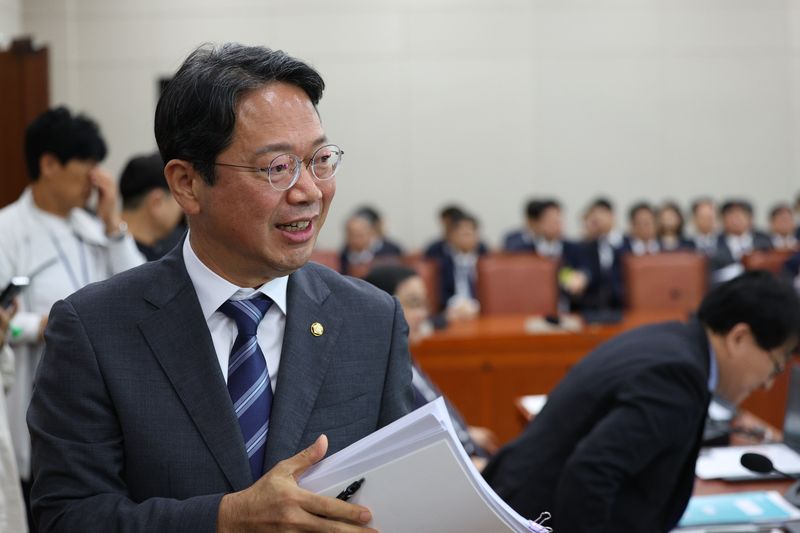
[Financial News] The Corruption Investigation Office for High-ranking Officials (CIO) has begun questioning a complainant in connection with allegations that Kim Seung-won, a Democratic Party of Korea lawmaker, sought a favor regarding the Ministry of Food and Drug Safety’s approval of a clinical trial. After prosecutors previously granted Kim deferred prosecution, an appeals court in a related case found that the solicitation was made in exchange for compensation, drawing attention to the outcome of the CIO’s investigation.
According to legal circles on the 8th, the CIO’s Investigation Division 1, led by Chief Prosecutor Na Chang-su, summoned and questioned Cho, who filed a complaint against Kim on charges including abuse of official authority, providing bribes to a third party, and accepting bribes through intermediation.
The CIO received the complaint on the 28th of last month and assigned the case to Investigation Division 1 on the 30th of the same month. The complainant, Cho, asked investigators to establish how Kim came to contact the then head of the Ministry of Food and Drug Safety, what effect that contact had on the clinical trial approval review, and whether money or other benefits were provided—or a payment promised—in connection with the solicitation.
The allegations emerged during the approval process for a clinical trial of a COVID-19 treatment being developed by GenNCell in 2021. Investigators found that Kim contacted Kim Kang-lip, then head of the Ministry of Food and Drug Safety, at the request of Yang, who was identified as a broker, regarding the clinical trial approval.
The Seoul Western District Prosecutors’ Office previously investigated Kim and granted him deferred prosecution in December 2024. Prosecutors found the allegation that he had agreed to receive 5 million won in political donations in return for arranging the favor to be substantiated, but concluded that it was difficult to determine that the solicitation itself was illegal. Investigators found that no donation was actually transferred.
However, the assessment of whether the solicitation was made in exchange for compensation changed in an appeal in a separate criminal case involving Kang Se-chan, a Kyung Hee University professor and GenNCell founder, on the 30th of last month. The Seoul High Court’s Criminal Division 7, presided over by Judge Gu Hoe-geun, sentenced Kang to four years in prison and a fine of 40 million won in an appeal on charges including breach of trust, and ordered him detained in court. In particular, it found him guilty of violating the Act on Regulation and Punishment of Criminal Proceeds Concealment, a charge for which he had been acquitted at trial.
The appeals court found that Kang had solicited the head of the Ministry of Food and Drug Safety, through Kim, to approve the clinical trial plan, and that 600 million won was paid to broker Yang in return. The fact that the money was paid in the form of an investment was also taken into account in assessing the charge of concealing criminal proceeds.
However, the appeals court’s ruling on Kang does not automatically establish Kim’s criminal liability. The prosecutors’ deferred-prosecution decision and the appeals court’s ruling on Kang also differ in the matters examined and the charges applied.
The allegations involving Kim are also being investigated by police as a separate complaint case. The Seoul Yeongdeungpo Police Station previously summoned and questioned related complainants on the 11th and 12th of last month.
Kim acknowledges contacting the head of the Ministry of Food and Drug Safety, but maintains that he merely conveyed a request to check whether the clinical trial process was proceeding fairly and that he made no improper solicitation.
[email protected] Yoo Seon-jun Reporter